

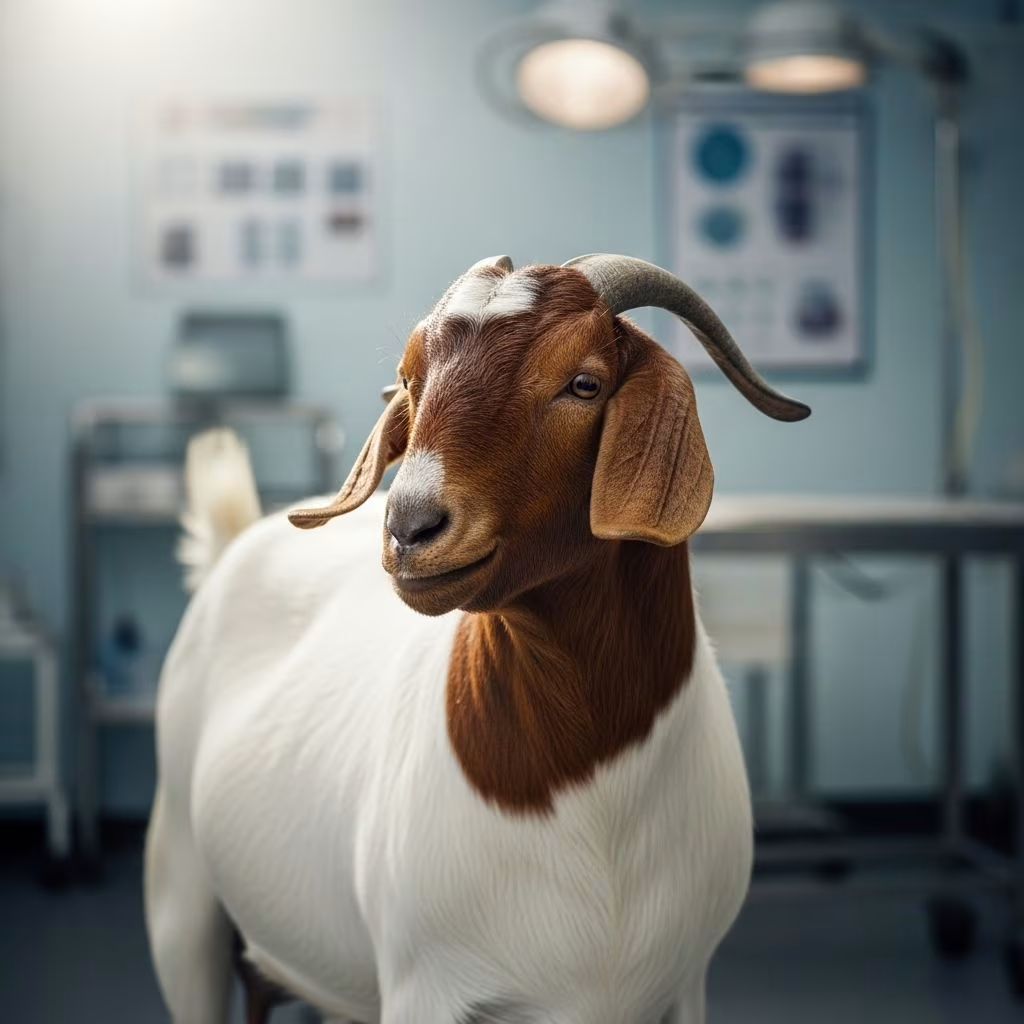
Introduction to Pre-Breeding Evaluations
Successful goat production depends on establishing a robust reproductive program that begins with thorough evaluation of breeding animals. Before introducing bucks and does into the breeding season, producers must conduct comprehensive assessments to identify animals capable of meeting production goals and maintaining herd health standards. This proactive approach minimizes unexpected breeding failures, reduces costly interventions, and maximizes genetic potential within the herd. Whether managing dairy goats for milk production or meat breeds for market, understanding reproductive health assessment protocols is fundamental to operational success.
Pre-Breeding Preparation for Male Goats
Body Condition and Nutritional Status
Male goats require specific nutritional management to support reproductive function throughout the demanding breeding season. Bucks should enter the breeding period at a body condition score of 3 to 4 out of 5, representing moderate flesh coverage without excessive fat accumulation. This optimal range provides energy reserves necessary for sustained breeding activity while avoiding the metabolic complications associated with obesity.
Bucks can lose more than 10% of their body weight during an active breeding season as they pursue does and engage in mating behaviors. Producers should implement strategic feeding programs 6 to 8 weeks before the anticipated breeding start date to build body reserves. High-quality forage combined with appropriate grain supplementation ensures bucks maintain vigor and fertility throughout the breeding period. Adequate protein intake (12-14% for mature bucks) supports spermatogenesis and overall reproductive health.
Pre-Breeding Health Screening
Before conducting detailed reproductive assessments, bucks should receive general health evaluations. Oral examination confirms appropriate dentition and age assessment, providing initial evidence of nutritional adequacy. Cardiovascular and respiratory assessments ensure no underlying disease processes compromise breeding capacity. Structural soundness evaluation confirms that legs, feet, and hooves are sufficiently functional for natural mating or collection procedures.
Infectious disease testing forms a critical component of pre-breeding preparation, particularly when introducing new genetics into an established herd or when expanding breeding operations. Veterinarians typically recommend screening for Corynebacterium pseudotuberculosis and caprine arthritis-encephalitis virus, which can significantly impact herd health and reproductive success.
Physical Reproductive Examination
Testicular Assessment and Development
Thorough testicular evaluation provides baseline information about a buck’s reproductive capacity. Veterinarians palpate both testicles to confirm complete descent into the scrotum, as cryptorchidism (undescended testicles) remains a disqualifying condition despite its relative rarity in goats. Young bucks receiving their initial breeding soundness examination should have both testicles fully descended by 8 to 12 weeks of age.
Testicular consistency should be slightly firm and uniform throughout, without nodules, hardness, or soft areas that might indicate infection or injury. Testicles must be symmetric in size and feel; asymmetry may suggest unilateral epididymitis, orchitis, or previous trauma. While infections affecting the testicles or epididymis occur in only about 1% of breeding bucks, affected animals should be evaluated for treatment potential or culling decisions.
Scrotal circumference provides an objective measurement of testicular size and correlates directly with semen production capacity. Mature bucks over 14 months of age should demonstrate scrotal circumference exceeding 25 centimeters. This measurement can vary seasonally, with reductions of as much as 3 centimeters outside the primary breeding season. Young bucks aged 12 to 30 months represent the optimal age range for initial breeding soundness assessment, as testicular development stabilizes within this window.
Penis and Prepuce Examination
The external genitalia require careful palpation to identify any structural abnormalities that might interfere with natural mating or semen collection. The prepuce should be examined for scars, lesions, hair accumulation, or masses that could prevent penis protrusion. The penis itself can be assessed through electroejaculation procedures or manual exteriorization, during which an assistant applies pressure to the sigmoid flexure while the prepuce is stabilized.
During manual exteriorization, the buck is typically positioned on its rump or laid on its side to facilitate visualization and palpation. Any abnormalities including strictures, scars, abscesses, or developmental defects should be documented and considered relative to breeding soundness determination. In some cases, ultrasound imaging may be warranted to evaluate internal reproductive structures or determine treatment feasibility for identified problems.
Semen Collection and Evaluation Methods
Collection Techniques
Two primary methods for obtaining buck semen exist, each with distinct advantages. Artificial vagina collection produces higher-quality samples with superior sperm preservation but requires the presence of an estrous doe to stimulate the buck. This method is labor-intensive and may not be practical for routine screening operations.
Electroejaculation offers greater convenience, eliminating the need for an in-heat doe and allowing rapid sample collection. While samples obtained through electroejaculation may demonstrate slightly lower overall quality compared to artificial vagina collection, they remain adequate for reproductive assessment when proper technique and equipment are employed. Regardless of collection method, semen must be maintained at body temperature (37°C or 98.6°F) and evaluated promptly to ensure accurate assessment of motility and viability.
Gross and Microscopic Evaluation
Initial semen assessment occurs through gross examination, where color, consistency, and contamination are evaluated. Normal buck semen appears cloudy white without visible blood, urine, or debris. Any discoloration or contamination may indicate collection complications or underlying health issues requiring further investigation.
Microscopic examination provides detailed information about sperm function and morphology. Gross motility assessment occurs at low magnification (100X), where a drop of undiluted semen is placed on a warmed slide. Satisfactory samples demonstrate general oscillation to vigorous swirling patterns, while sporadic oscillation suggests poor viability or low sperm concentration.
Progressive motility evaluation requires higher magnification (400X) and dilution of semen with prewarmed isotonic solution. Individual sperm are observed for forward movement capability, as this characteristic directly correlates with fertilization potential. Bucks should demonstrate at least 30% progressively motile sperm to achieve acceptable breeding soundness status, though higher percentages indicate superior fertility potential.
Sperm Morphology Analysis
Morphological assessment at 1,000X magnification determines the percentage of sperm with normal structure versus those exhibiting head, midpiece, or tail defects. A minimum of 70% morphologically normal sperm represents the threshold for acceptable fertility, though some abnormalities have been reclassified based on recent reproductive research. Distal cytoplasmic droplets, previously considered defects, are now recognized as normal sperm characteristics that do not impair fertility in ruminants.
Staining techniques including eosin-nigrosin preparation allow clear visualization of sperm cellular structures under light microscopy. Phase-contrast microscopy using formalin-killed sperm preparations provides alternative assessment methods. Sperm with multiple morphological defects or those suggesting systemic reproductive problems warrant further veterinary evaluation before breeding decisions are finalized.
Female Goat Reproductive Assessment
Pre-Breeding Physical Preparation
Does require distinct nutritional management compared to bucks. Does should enter the breeding season at a body condition score of 2 to 3 out of 5, representing marginal body condition. This leaner body score maximizes metabolic response to focused feeding programs while minimizing the risk of pregnancy toxemia complications during late gestation, when does often experience reduced feed intake.
Unlike bucks, does typically receives breeding soundness examinations only after failing to conceive during a breeding season or when specific fertility problems are suspected. However, proactive evaluation of young doelings can identify developmental abnormalities preventing successful reproduction.
Identifying Developmental Abnormalities
Young doelings should receive external genital examination to identify intersex conditions or developmental anomalies. An enlarged clitoris, hypotrophic vulva, or increased urogenital distance may suggest intersex characteristics, a condition particularly common in homozygous polled females within Alpine, Saanen, and Toggenburg breeds. Identifying these conditions early allows producers to make informed management decisions regarding herd retention.
Diagnostic Evaluation for Infertility
Does presenting with repeated breeding failure benefit from comprehensive reproductive assessment. Vaginal speculum examination allows direct visualization of vaginal walls, vestibules, and cervix, identifying lesions, anatomical abnormalities, or signs of prior infection. Transabdominal and transrectal ultrasonography provides detailed imaging of the uterus and ovaries, revealing cystic conditions, hydrometra (pseudopregnancy), or other structural abnormalities affecting conception or gestation.
Timeline and Scheduling Recommendations
Breeding soundness examinations should be conducted 2 to 3 weeks before the anticipated breeding season begins. This timeline allows producers to implement corrective measures or make alternative management decisions if initial assessment results fall below acceptable standards. Early scheduling also accommodates retesting protocols when initial semen evaluations demonstrate borderline parameters requiring confirmation.
For seasonal breeding operations, examinations typically occur in late summer to early fall, before the natural breeding season that peaks in autumn. For year-round or extended breeding programs, examinations should be scheduled relative to planned breeding dates to ensure timely reproductive assessment.
Acceptable Standards and Breeding Decisions
| Assessment Parameter | Minimum Acceptable Standard | Optimal Range |
|---|---|---|
| Body Condition Score (Bucks) | 3 out of 5 | 3–4 out of 5 |
| Scrotal Circumference (Mature Bucks) | ≥25 cm | 28–32 cm |
| Progressive Sperm Motility | ≥30% | ≥50% |
| Morphologically Normal Sperm | ≥70% | ≥80% |
| Testicular Symmetry | No asymmetry | Symmetric, firm consistency |
| Body Condition Score (Does) | 2–3 out of 5 | 2.5 out of 5 |
Communicating Assessment Results
Producers should engage in detailed discussion with their veterinarian regarding breeding goals and herd objectives before examinations occur. Different operations maintain distinct requirements; a buck expected to breed a large number of does across extensive pasture systems requires higher fitness standards than one managing a smaller, controlled breeding group. Understanding these operational parameters ensures veterinarians include appropriate assessment components and provide recommendations tailored to specific production contexts.
Conclusion
Reproductive assessment represents a critical investment in goat herd health and productivity. Through systematic evaluation of body condition, physical reproductive anatomy, and semen characteristics, producers identify animals capable of achieving breeding objectives while excluding those with compromised fertility. Combined with appropriate nutritional management, infectious disease screening, and timely scheduling, breeding soundness examinations establish the foundation for successful breeding seasons and sustained herd performance.
References
- Breeding soundness examination (BSE): a decision-making tool that predicts the reproductive ability of male livestock — National Center for Biotechnology Information (PubMed). 2022. https://pubmed.ncbi.nlm.nih.gov/35488000/
- Breeding Soundness Examination in Goats — Merck Veterinary Manual. 2024. https://www.merckvetmanual.com/management-and-nutrition/management-of-reproduction-goats/breeding-soundness-examination-in-goats
- Breeding Soundness Examination of Bucks — MSD Veterinary Manual. https://www.msdvetmanual.com/management-and-nutrition/breeding-soundness-examination-of-the-male/breeding-soundness-examination-of-bucks
- Breeding Soundness Exams in Small Ruminants — University of Kentucky College of Agriculture, Food and Environment. https://www.kysheepandgoat.org/post/breeding-soundness-exams-in-small-ruminants
- Preparing rams for a successful breeding season — Michigan State University Extension. https://www.canr.msu.edu/sheep_goats/reproduction/preparing-rams-for-a-successful-breeding-season
- Preparing sheep and goats for fall breeding — University of Missouri Extension. https://extension.missouri.edu/news/preparing-sheep-and-goats-for-fall-breeding



