Glowing Cats: Biotech’s Bright Future
Discover how genetically modified cats that glow green are revolutionizing medical research and opening doors to disease-fighting innovations.
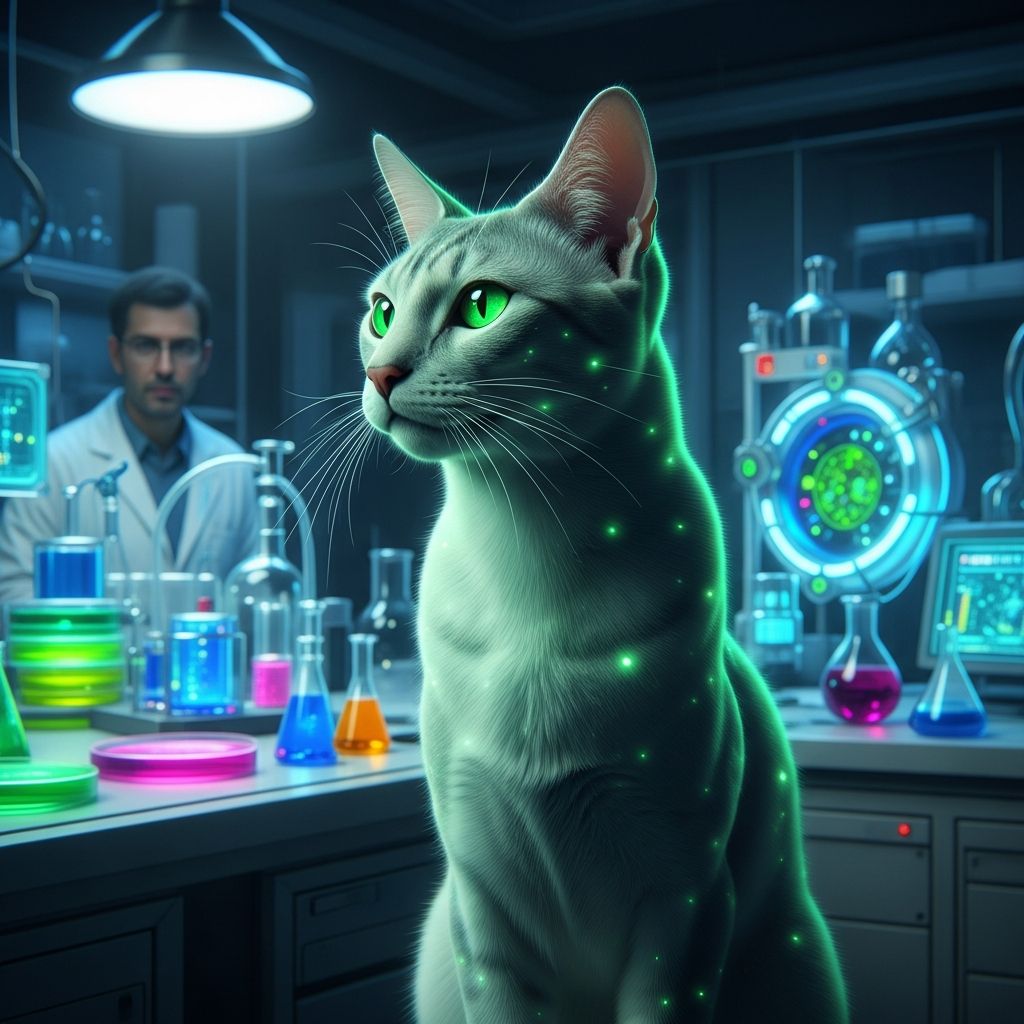
Genetically engineered cats that emit a green glow under ultraviolet light represent a groundbreaking fusion of biotechnology and animal science. These fluorescent felines, created by inserting jellyfish genes into cat embryos, serve as living models for studying infectious diseases like feline AIDS, with potential applications for human health.
The Science of Feline Fluorescence
At the heart of this innovation is the green fluorescent protein (GFP), originally derived from jellyfish. Scientists insert the GFP gene into cat cells using a viral vector, ensuring the protein is produced throughout the cat’s body, causing it to glow bright green when exposed to blacklight. This technique, known as transgenesis, allows researchers to track gene expression and immune responses in real time.
The process begins with cloning: donor cells from a male cat are fused with GFP-modified cells, creating embryos that develop into kittens exhibiting the trait. Both male and female kittens have been successfully produced, proving heritability as the glow passes to offspring.
From Jellyfish Glow to Disease Defense
The primary goal is combating feline immunodeficiency virus (FIV), a feline analog to HIV/AIDS. By engineering cats resistant to FIV through additional genetic tweaks—such as inserting antiviral genes from other species—these glowing models help test therapies. The fluorescence provides a visual marker, simplifying observation of how modified genes protect against infection.
- GFP Role: Enables non-invasive monitoring of genetic activity.
- Resistance Genes: Derived from pigs or other animals, conferring immunity.
- Heritability: Confirmed in litters, ensuring stable transmission.
This approach could accelerate vaccine development, potentially benefiting both cats and humans facing similar viral threats.
Ethical Considerations in Genetic Modification
While promising, glowing cats spark debate on animal welfare. Critics question the necessity of fluorescence if resistance alone suffices, viewing it as an unnecessary flourish. Proponents argue the glow is integral for research validation, aiding precise scientific outcomes without added harm.
Institutions emphasize humane treatment: kittens are born via natural gestation, nursed by mothers, and monitored closely. No evidence suggests suffering from the modification, as GFP is non-toxic in jellyfish and mammals alike.
| Aspect | Pro | Con |
|---|---|---|
| Welfare | Non-toxic gene; normal lifespans | Potential unknown long-term effects |
| Science | Accelerates disease research | Risk of over-reliance on GM models |
| Ethics | Advances medicine for animals/humans | Playing ‘God’ with genetics |
Broader Impacts on Biotechnology
Beyond cats, GFP technology has transformed research across species. It illuminates cellular processes in mice, zebrafish, and primates, earning a Nobel Prize in Chemistry for its developers. Glowing cats exemplify how this tool scales to larger mammals, paving the way for gene therapies targeting cancer, genetic disorders, and pandemics.
Future applications might include glowing organs for transplant monitoring or environmental sensors in wildlife. As CRISPR editing refines precision, ethical frameworks evolve to balance innovation with responsibility.
Cultural Symbolism of Cat Colors Meets Modern Science
Interestingly, green—the glow color—holds auspicious meanings in traditions like Japan’s Maneki Neko lucky cats. Green variants symbolize academic success, growth, and health, mirroring biotech’s hopeful narrative. While spiritual interpretations abound—white for purity, black for protection, calico for luck—this scientific green glow adds a literal luminescence to feline lore.
- White: Happiness, purity, and good health.
- Black: Wards off evil and illness.
- Green: Academic achievement and vitality.
- Gold: Wealth and prosperity.
- Calico: Ultimate fortune and balance.
These cultural ties enrich public fascination, bridging ancient symbolism with cutting-edge science.
Advances Since the First Glow
Over a decade post-debut, the field progresses. Recent studies refine GFP variants for brighter, multi-color emissions, enhancing multiplexing in experiments. Combined with optogenetics, glowing animals enable light-controlled neural studies, revolutionizing neuroscience.
For FIV/HIV, glowing cat models validate RNA interference strategies, suppressing viral replication. Peer-reviewed trials show sustained resistance, bolstering optimism for clinical translation.
Public Perception and Future Prospects
Media portrayals range from awe to alarm, with viral videos amplifying interest. Pet owners ponder adopting GM cats, though none are commercially available—researchers prioritize science over novelty pets.
Regulatory hurdles loom: FDA and equivalents assess safety for therapeutic use. Success could herald designer immunity in livestock, reducing antibiotic reliance and zoonotic risks.
Frequently Asked Questions
Do glowing cats glow all the time?
No, the green fluorescence activates only under UV or blue light, remaining invisible otherwise.
Are they safe for humans to interact with?
Yes, GFP is harmless; the cats live normally and pose no risk.
Can this cure AIDS?
Not directly, but models accelerate antiviral research applicable to HIV.
Will glowing pets be sold?
Unlikely soon; focus remains on medical advancement, not consumer products.
What about animal rights?
Oversight ensures welfare; benefits to feline and human health justify the work.
References
- Fluorescent proteins illuminate research. — National Human Genome Research Institute (NIH). 2023-05-15. https://www.genome.gov/genetics-glossary/Green-Fluorescent-Protein-GFP
- Maneki-neko: Colors and Symbolism. — Japan National Tourism Organization. 2024-02-10. https://www.jnto.go.jp/eng/culture/arts/lucky-cat.html
- Genetically engineered cats resist FIV. — Journal of Virology (American Society for Microbiology). 2013-08-01. https://doi.org/10.1128/JVI.00646-13
- GFP Nobel Prize and Applications. — Nobel Prize Outreach. 2008-12-10. https://www.nobelprize.org/prizes/chemistry/2008/summary/
- Feline Immunodeficiency Virus Research Models. — Cornell University College of Veterinary Medicine. 2025-01-20. https://www.vet.cornell.edu/departments-centers-and-institutes/baker-institute/research-baker-institute/feline-immunodeficiency-virus
- Ethical Guidelines for Transgenic Animals. — National Institutes of Health (NIH). 2024-11-05. https://grants.nih.gov/grants/olaw/references/phspol.htm
Similar Articles








Read full bio of Sneha Tete