
Giant Liver Fluke In Ruminants: 7-Month Life Cycle Guide
Exploring the biology, spread, and control of Fascioloides magna in livestock and wildlife across continents.
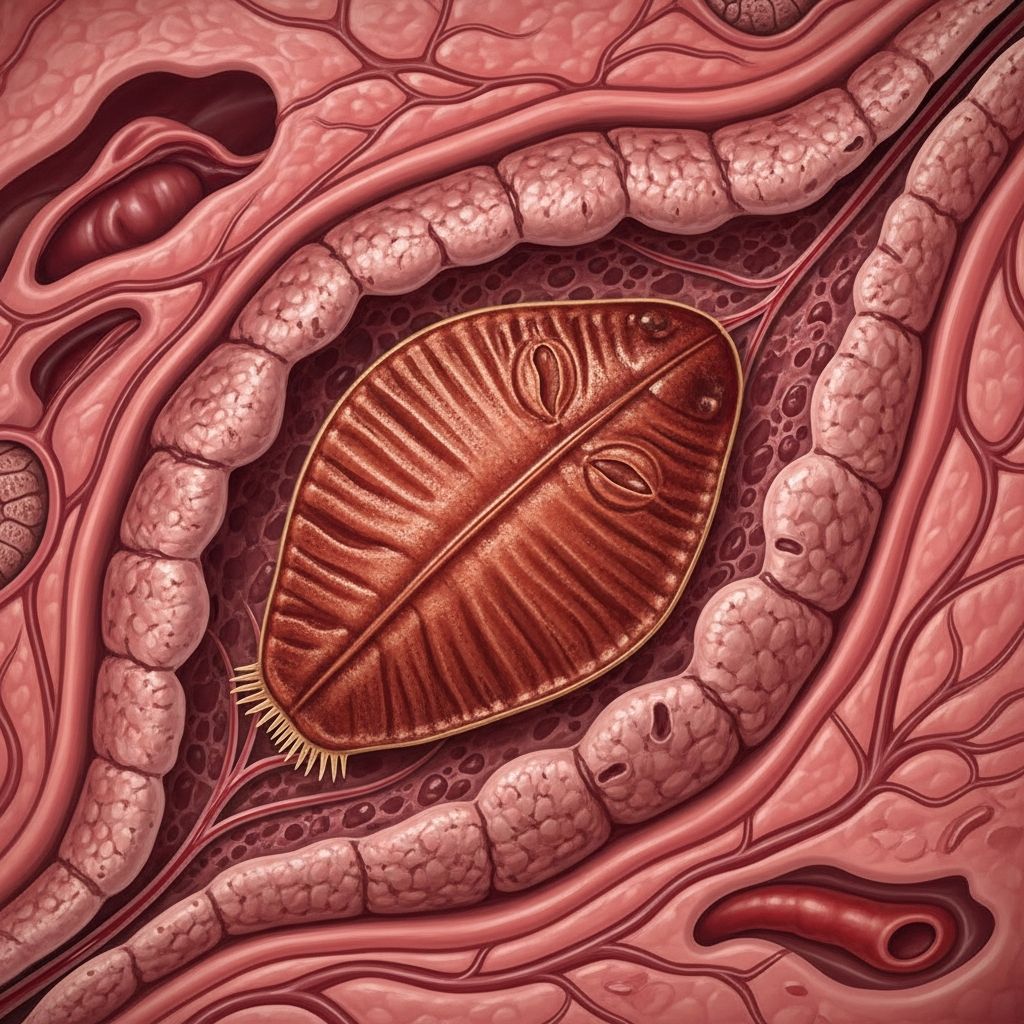
The giant liver fluke, scientifically named Fascioloides magna, represents a significant parasitic threat to both wild and domestic ruminants. This large trematode primarily targets the livers of its hosts, leading to varied degrees of damage depending on the species involved. Native to North America, it has spread to parts of Europe, posing challenges for veterinarians and wildlife managers alike.
Biological Characteristics of the Parasite
Fascioloides magna stands out due to its impressive size among flukes, reaching lengths of up to 100 mm, widths of 11-26 mm, and thicknesses of 2-4.5 mm. Unlike related species such as Fasciola hepatica, it lacks distinctive anterior shoulders and features a robust, fleshy body covered in a reddish-brown tegument. Internal structures like oral and ventral suckers, along with elements of the digestive and reproductive systems, are visible under microscopic examination of stained specimens.
These flukes feed on blood within the host’s liver, producing hematin pigment as a byproduct, which often appears as black deposits in affected tissues. Their oval shape and large dimensions make them identifiable during postmortem inspections.
Complex Life Cycle Overview
The life cycle of F. magna is indirect, requiring specific intermediate and definitive hosts. Eggs passed in the feces of infected definitive hosts hatch in aquatic environments, releasing free-swimming miracidia. These miracidia penetrate lymnaeid snails, where they undergo development through sporocysts, rediae, and cercariae stages, ultimately encysting as metacercariae on submerged or emergent vegetation near water bodies.
Definitive hosts, mainly cervids like white-tailed deer, elk, caribou, red deer, and fallow deer, become infected by grazing on contaminated plants. Upon ingestion, metacercariae excyst in the intestine, penetrate the gut wall, traverse the peritoneal cavity, and migrate to the liver parenchyma. There, they mature over a prepatent period of about 3-7 months, often pairing up before forming fibrous cysts that connect to bile ducts, allowing egg release.
- Key stages: Egg → Miracidium → Snail (intramolluscan development) → Cercaria → Metacercaria → Definitive host ingestion.
- Total cycle duration: Approximately 7 months.
- Rare migrations: Occasionally to lungs or other sites.
Host Susceptibility and Geographic Spread
Host responses to F. magna vary dramatically, categorizing animals as definitive, dead-end, or aberrant hosts. In North America, white-tailed deer, elk, and caribou serve as primary reservoirs, while in Europe, introduced populations affect red and fallow deer. The parasite has been documented in regions including the US, Canada, Austria, Czech Republic, Germany, Hungary, Italy, Poland, Slovakia, and recently Slovenia.
| Host Category | Examples | Key Features |
|---|---|---|
| Definitive | White-tailed deer, elk, caribou, red deer | Thin-walled cysts in liver; eggs shed in feces; patent infection. |
| Dead-end | Cattle, alpacas, llamas | Thick-walled cysts; no bile duct connection; no eggs in feces; low pathogenicity. |
| Aberrant | Sheep, goats | Immature flukes migrate extensively; severe liver damage; often fatal. |
Domestic livestock often encounter the parasite through shared habitats with wildlife, especially near ponds and streams.
Tissue Damage and Clinical Manifestations
In definitive hosts, adult flukes reside singly or in small groups within thin fibrous cysts in the liver parenchyma. These cysts contain dark fluid with eggs and debris, sometimes leading to localized inflammation, pressure atrophy, or fibrosis. Clinical signs are minimal unless burdens are heavy.
Cattle experience encapsulation in thick-walled cysts filled with viscous black fluid, rarely communicating with bile ducts. This results in liver condemnation at slaughter but seldom causes death. In contrast, sheep and goats suffer immensely as immature flukes fail to encapsulate and wander through the liver and other organs, causing hemorrhagic tracts, inflammation, and eosinophilic infiltrates. Even low numbers can prove lethal due to extensive tissue destruction.
Common pathological hallmarks across hosts include black tortuous migration tracts, hemorraghic lesions, and pigment-laden macrophages. Heavy infections may contribute to secondary issues like “Red Water” disease in cattle, where liver damage enables Clostridium haemolyticum proliferation, turning urine red.
- Symptoms in severe cases: Weight loss, anemia, weakness, jaundice (more in aberrant hosts).
- Incidental findings: Often detected postmortem in sheep.
Diagnostic Approaches
Ante-mortem diagnosis challenges arise because dead-end and aberrant hosts do not shed eggs in feces. Fecal sedimentation or flotation rarely detects eggs, limiting its utility.
Serological tests, such as ELISA detecting antibodies against fluke antigens, offer promise for early detection in cattle and sheep. Coprological methods work only in patent definitive hosts. Ultrasonography or liver biopsies can reveal cysts or tracts, while postmortem examination confirms via gross lesions: fibrous capsules, black pigment, and flukes.
Molecular techniques, like PCR on tissue or fecal samples, enhance specificity, as shown in recent characterizations.
Prevention and Management Strategies
Control hinges on interrupting the life cycle through integrated approaches. Avoid grazing near snail habitats; drain wetlands or use molluscicides judiciously to target lymnaeid snails.
Farm biosecurity includes fencing to separate livestock from cervid reservoirs. Strategic anthelmintic treatments, such as triclabendazole or clorsulon, reduce fluke burdens in cattle but require timing based on the 7-month prepatent period. In sheep, early intervention is critical due to high lethality.
Wildlife management involves monitoring cervid populations and habitat modification. Liver condemnation at abattoirs underscores economic impacts.
Economic and Public Health Implications
Beyond animal health, F. magna incurs losses from reduced productivity, treatment costs, and condemned livers. In endemic areas, it affects the viability of sheep farming and wildlife conservation efforts. No direct zoonotic risk exists, but secondary bacterial infections pose indirect concerns.
Recent Research and Emerging Threats
Ongoing studies focus on molecular epidemiology, vaccine development, and spread modeling. Reports from Slovenia highlight expanding European ranges, urging vigilance. Genomic tools aid in strain differentiation and resistance monitoring.
Frequently Asked Questions (FAQs)
What is the main host for Fascioloides magna?
White-tailed deer and other cervids are primary definitive hosts in North America.
Can cattle pass on F. magna eggs?
No, cattle are dead-end hosts; cysts do not connect to bile ducts.
How do you treat infected sheep?
Use flukicides like triclabendazole early; heavy infections may be fatal.
Is F. magna spreading in Europe?
Yes, documented in multiple countries including recent Slovenian cases.
What preventive measures work best?
Habitat management, fencing, and strategic deworming.
References
- Fascioloides magna — Cornell University College of Veterinary Medicine. 2021-05-26. https://www.vet.cornell.edu/about-us/news/20210526/fascioloides-magna
- Fascioloides magna – Learn About Parasites — Western College of Veterinary Medicine, University of Saskatchewan. N/A. https://wcvm.usask.ca/learnaboutparasites/parasites/fascioloides-magna.php
- Fascioloides magna in Ruminants — Merck Veterinary Manual. N/A. https://www.merckvetmanual.com/digestive-system/fluke-infections-in-ruminants/fascioloides-magna-in-ruminants
- Fascioloides magna — Wikipedia (informed by primary sources). N/A. https://en.wikipedia.org/wiki/Fascioloides_magna
- Identification and Molecular Characterization of Giant Liver Fluke — PMC (PubMed Central). 2024. https://pmc.ncbi.nlm.nih.gov/articles/PMC10974814/
- Fascioloides magna — Animal Diversity Web, University of Michigan. N/A. https://animaldiversity.org/accounts/Fascioloides_magna/
- First report of the giant liver fluke in Slovenia — Frontiers in Veterinary Science. 2025. https://www.frontiersin.org/journals/veterinary-science/articles/10.3389/fvets.2025.1673629/full
Similar Articles








Read full bio of medha deb


