

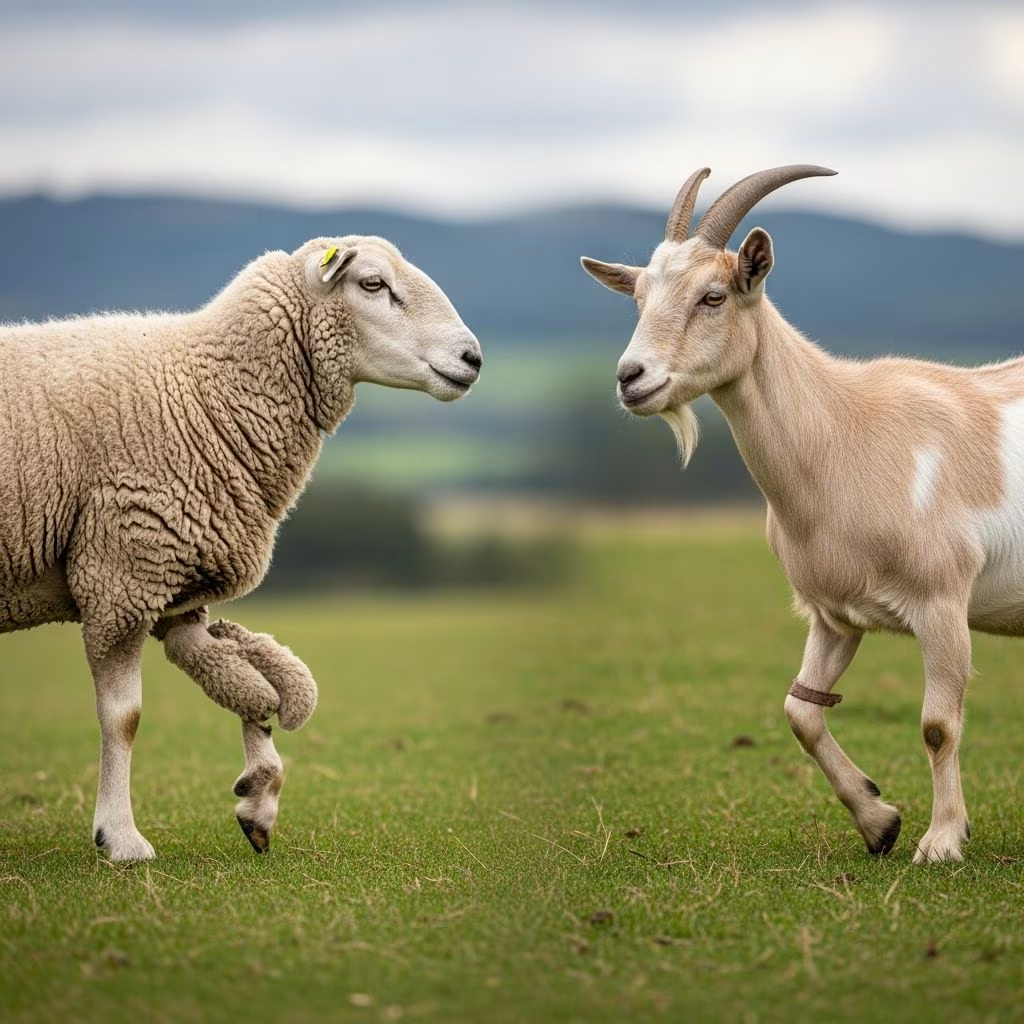
In the world of small ruminant farming, maintaining herd health hinges on understanding congenital and inherited conditions that impact the musculoskeletal system. Sheep and goats, vital to global agriculture, face several genetic disorders that manifest as skeletal deformities, muscle abnormalities, and mobility issues. These conditions not only affect animal welfare but also pose economic challenges for producers through reduced productivity and increased mortality. This article delves into the primary disorders, their genetic underpinnings, clinical presentations, diagnostic approaches, and practical management strategies, drawing from established veterinary knowledge to empower farmers and veterinarians.
Understanding the Genetic Basis of Musculoskeletal Anomalies
Most musculoskeletal anomalies in sheep and goats stem from autosomal recessive or dominant mutations, often linked to specific chromosomes or genes regulating growth and development. For instance, defects in fibroblast growth factor receptor 3 (FGFR3) lead to abnormal bone elongation, while chloride channel disruptions cause muscle stiffness. These traits persist in populations due to carrier animals showing no symptoms, allowing inadvertent breeding propagation. Early identification through genetic testing is crucial, as many disorders are semilethal, impacting lambs and kids from birth or shortly after.
Breeds like Suffolk, Hampshire, and Texel sheep, along with certain goat lines, exhibit higher susceptibility. Environmental factors, such as nutrition or toxins, can exacerbate genetic predispositions, mimicking or worsening symptoms. Awareness of breed-specific risks enables targeted screening and breeding programs to reduce incidence.
Spider Lamb Syndrome: A Major Concern in Ovine Herds
Among sheep disorders, spider lamb syndrome stands out as a debilitating chondrodysplasia primarily affecting Suffolk and Hampshire breeds. This recessive condition arises from a mutation on chromosome 6, inactivating FGFR3 and triggering excessive skeletal overgrowth in homozygous lambs. Affected animals display pronounced medial deviations at the carpus and hock, rendering them unable to stand comfortably. Deformities may be evident at birth or emerge within 4-6 weeks, progressing to severe limb bowing, muscle wasting, and spinal curvatures like kyphosis.
Characteristic skull changes include a convex nasal bridge (Roman nose) and elongated occipital condyles. Limb pathology reveals thickened, irregular growth plates in radii, ulnae, tibiae, and irregular cartilage. Liver IGF regulation may contribute to these manifestations. Lambs often succumb early due to inability to nurse or move, emphasizing the need for carrier detection via DNA tests to eliminate the gene from breeding stock.
Dwarfism and Limb Deformities in Texel Sheep
Texel sheep face an autosomal recessive dwarfism characterized by initial normalcy at birth, followed by stunted growth, shortened neck and legs, and forelimb varus (inward bending) by 2-4 weeks. Severely impacted lambs adopt a wide stance, show movement reluctance, and typically perish within months from starvation or weakness. Necropsy findings include eroded cartilage in hip and shoulder joints, plus a floppy, flattened trachea.
This condition underscores the importance of radiographic screening in young Texels and selective breeding. While not as widespread as spider lamb syndrome, it significantly hampers meat production in affected lines, prompting genetic registries to track and cull carriers.
Muscular Hyperplasia: The Double Muscling Phenomenon
Double muscling, or muscular hyperplasia, occasionally appears in sheep via the callipyge (CLPG) gene mutation, predominantly in heterozygous males. Unlike the pronounced effects in cattle, ovine cases yield postnatal hindquarter and hindlimb muscle enlargement, potentially boosting carcass yield but risking birthing complications and reduced fertility. Management involves balancing desired muscling against welfare concerns, with genetic selection favoring moderate expression.
| Species | Gene Involved | Key Effects | Inheritance |
|---|---|---|---|
| Sheep | CLPG | Hindlimb hyperplasia in males | Heterozygous |
| Cattle (e.g., Belgian Blue) | MSTN | General hypertrophy | Recessive |
Muscular Dystrophy in Merino Sheep
Merino sheep suffer from an autosomal recessive muscular dystrophy, where muscle fibers progressively atrophy and fibrose, replaced by fat. Clinical progression includes poor growth, hindlimb stiffness, reluctance to ambulate, and death by 2-3 years from cachexia. Affected tissues appear pale, firm, and fatty on inspection. Elevated enzymes like CK and AST confirm myopathy. Prevention relies on pedigree analysis and avoiding consanguineous matings in purebred flocks.
Myotonia Congenita: The Fainting Goat Phenomenon
Goats with myotonia congenita, dubbed “fainting goats,” inherit a dominant mutation impairing skeletal muscle chloride channels. This leads to delayed relaxation post-contraction, triggered by startle, resulting in a sawhorse stance, limb splaying, and collapse. Episodes begin postnatally and resolve quickly, with normalcy between attacks. While not fatal, it complicates handling and grazing. Breeding away from the trait is advised, though some preserve it for novelty.
Other Notable Congenital Conditions
- Spastic Paresis: Inherited hypertonia of gastrocnemius in goats and sheep, causing rear leg extension and arched back. Surgical or therapeutic interventions may aid mild cases.
- Polydactyly: Extra digits, likely polygenic, more cosmetic than functional but indicative of broader genetic issues.
- Arthrogryposis: Joint contractures from in utero muscle or nerve deficits, seen in multiple breeds; recessive inheritance reported.
- Mucopolysaccharidosis IIID: Nubian-specific enzyme deficiency causing growth failure, skeletal dysplasia, and neurological signs.
Diagnostic Approaches and Tools
Diagnosis combines clinical exam, radiography, histopathology, and genetics. Radiographs reveal growth plate irregularities in spider lamb cases or joint erosions in dwarfism. Muscle biopsies confirm dystrophy or myotonia. PCR tests for known loci (e.g., FGFR3, CLPG) enable carrier status determination. Early intervention, like supportive care or euthanasia for humane reasons, is standard.
Prevention and Management Strategies
Key to control is genetic screening: use commercial tests for high-risk breeds, maintain pedigrees, and introduce unrelated stock. Quarantine new animals and avoid inbreeding. Nutritional balance prevents exacerbation; e.g., adequate minerals reduce physeal stress. Cull affected individuals and carriers where feasible. Educational programs for herders promote ethical breeding.
Frequently Asked Questions (FAQs)
What causes spider lamb syndrome in sheep?
A recessive FGFR3 mutation on chromosome 6 leads to overgrowth and deformities.
Are fainting goats in pain?
No, myotonia episodes are stiffness without pain; goats recover fully between events.
Can dwarfism in Texel sheep be treated?
No cure exists; management focuses on supportive care, but most severe cases are fatal early.
How to test for carriers of these genes?
Labs offer DNA panels for breeds like Suffolk, Texel, and Nubians; consult vets for samples.
Do environmental factors play a role?
Yes, nutrition or toxins can worsen genetic predispositions, but genetics are primary.
Future Directions in Research and Breeding
Advances in genomics promise marker-assisted selection, eradicating lethal alleles without broad culling. CRISPR editing explores therapeutic potentials, though regulatory hurdles remain. Collaborative breed associations drive progress, reducing incidences herd-wide. Farmers benefit from open-access databases tracking defect prevalence, fostering sustainable practices.
In summary, proactive genetic management transforms these challenges into opportunities for robust flocks. By prioritizing testing and informed breeding, producers safeguard animal health and economic viability.
References
- Congenital and Inherited Anomalies of the Musculoskeletal System in Sheep and Goats — Merck Veterinary Manual. 2023. https://www.merckvetmanual.com/musculoskeletal-system/congenital-and-inherited-anomalies-of-the-musculoskeletal-system/congenital-and-inherited-anomalies-of-the-musculoskeletal-system-in-sheep-and-goats
- Overview of Congenital and Inherited Anomalies of the Musculoskeletal System in Large Animals — MSD Veterinary Manual. 2023. https://www.msdvetmanual.com/musculoskeletal-system/congenital-and-inherited-anomalies-of-the-musculoskeletal-system/overview-of-congenital-and-inherited-anomalies-of-the-musculoskeletal-system-in-large-animals
- Small Ruminant Bone and Muscle Disorders — University of Minnesota Libraries Publishing. 2022. https://open.lib.umn.edu/largeanimalsurgery/chapter/small-ruminant-bone-and-muscle-disorders/
- Genetic Defects in Sheep and Goats — An-Najah National University. 2020. https://agri.najah.edu/sites/default/files/Lecture%2018.pdf
- Congenital Anomalies in Native Breeds of Sheep and Goats — EMRO. 2003. https://applications.emro.who.int/imemrf/458/Vet-Med-J-2003-51-3-363-380-eng.pdf
- Approach to Investigating Congenital Skeletal Abnormalities — SAGE Journals. 2015. https://journals.sagepub.com/doi/10.1177/0300985815579999



