

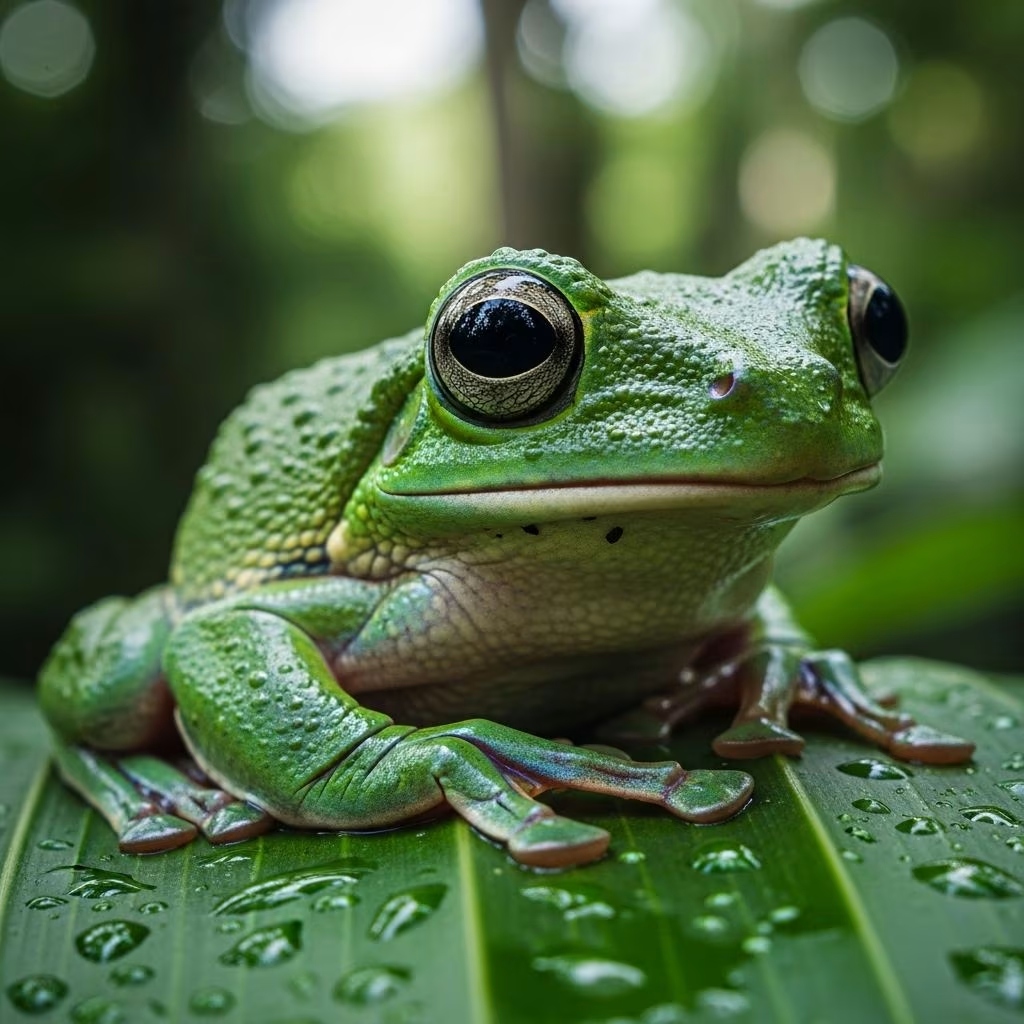
Understanding Frog Names and Nomenclature
Frogs are among the most diverse and fascinating amphibians on Earth, with approximately 7,600 to 7,700 species distributed across the globe. Each frog species carries both a scientific name and common names that reflect its characteristics, habitat, and behaviors. Understanding how frogs are named provides insight into their evolutionary relationships, geographic origins, and distinctive features that make each species unique.
The naming of frogs follows a rigorous taxonomic system that has evolved over centuries of biological study. From the smallest frogs measuring just a few millimeters to larger species spanning several inches, the diversity in frog nomenclature is as remarkable as the diversity of the frogs themselves. This comprehensive guide explores the intricate world of frog names, helping enthusiasts and researchers alike navigate the complex landscape of amphibian taxonomy.
Scientific Classification of Frogs
Frogs belong to a well-defined biological classification system that places them within the broader context of the animal kingdom. Understanding this hierarchical structure is essential for comprehending how frog names are assigned and how different species relate to one another evolutionarily.
The Taxonomic Hierarchy
All frogs share a common taxonomic lineage that begins at the kingdom level and becomes progressively more specific:
- Kingdom: Animalia – encompasses all animals
- Phylum: Chordata – includes all vertebrates with spinal cords and backbones
- Class: Amphibia – characterizes cold-blooded vertebrates that transition between aquatic and terrestrial environments
- Order: Anura – the order containing all modern frogs and toads, a name derived from Greek meaning “tailless”
Within the order Anura, frogs are further divided into families, genera, and species. This hierarchical classification system, established through careful morphological analysis and increasingly through genetic research, allows scientists to organize and understand the relationships among the thousands of frog species that exist today.
Major Frog Families and Their Names
The order Anura is divided into three suborders—Archaeobatrachia, Mesobatrachia, and Neobatrachia—which contain approximately 59 families of frogs. These families are further distinguished by specific characteristics, geographic distributions, and common naming conventions.
Ranidae: The True Frogs
The Ranidae family, commonly known as true frogs, represents one of the most recognizable groups of amphibians. True frogs are characterized by their smooth skin, streamlined bodies, and powerful hind legs adapted for jumping. Members of this family are found across the Northern Hemisphere and Africa. A notable example is the Mountain Yellow-legged Frog (Rana muscosa), which represents the genus Rana within the Ranidae family.
Hylidae: The Tree Frogs
Tree frogs belonging to the family Hylidae are among the most diverse and visually distinctive amphibians. These frogs, which can be arboreal, terrestrial, or semiaquatic, are characterized by adhesive toe discs that enable them to climb and navigate complex vegetation. Many Hylidae species display remarkable color-changing abilities depending on light, moisture, and temperature conditions. The Hylidae family includes over 1,062 species, making it one of the richest families in terms of species diversity.
Bufonidae: The True Toads
The Bufonidae family, comprising true toads, contains approximately 657 species that are characterized by warty skin, robust bodies, and ground-dwelling habits. These amphibians are known for their defensive secretions and are found on nearly every continent except Antarctica.
Other Significant Families
Beyond the major families, numerous other frog families contribute to the remarkable diversity of Anura. The Microhylidae (narrow-mouthed frogs) with 758 species, Strabomantidae (tropical frogs) with 807 species, and Dendrobatidae (poison dart frogs) represent just a fraction of the taxonomic richness within frog nomenclature. Specialized families like Centrolenidae (glass frogs), Pipidae (clawed frogs), and Rhinodermatidae (Darwin’s frogs) demonstrate the extraordinary variety in frog form and function across different ecological niches.
Scientific Names and Binomial Nomenclature
The scientific name of any frog consists of two components: the genus name and the species name. This binomial nomenclature system, established by Carl Linnaeus in the 18th century, provides a standardized method for naming and identifying organisms across the scientific community.
Components of Scientific Names
The genus name is capitalized and represents a group of closely related organisms that share common ancestors and characteristics. The species name, written in lowercase and italicized, identifies a specific organism that can interbreed and produce fertile offspring. For example, in the scientific name Lithobates catesbeianus (American Bullfrog), Lithobates is the genus and catesbeianus is the species.
Examples of Scientific Nomenclature
Different frog species exemplify the diversity of scientific naming conventions:
| Common Name | Scientific Name | Genus | Family |
|---|---|---|---|
| American Bullfrog | Lithobates catesbeianus | Lithobates | Ranidae |
| Poison Dart Frog | Dendrobates auratus | Dendrobates | Dendrobatidae |
| Green Treefrog | Litoria caerulea | Litoria | Hylidae |
| Wood Frog | Lithobates sylvaticus | Lithobates | Ranidae |
| Common Toad | Bufo bufo | Bufo | Bufonidae |
Common Names and Regional Variations
While scientific names provide standardized identification, common names offer culturally relevant and descriptive appellations for frog species. Common names often reflect distinctive characteristics, vocalizations, geographic locations, or indigenous cultural references.
Characteristic-Based Naming
Many frog common names derive from physical characteristics or behavioral traits. The Green Treefrog (Litoria caerulea) is named for its vibrant green coloration and arboreal lifestyle. The Poison Dart Frog (Dendrobates auratus) takes its name from the toxic alkaloids in its skin, historically used by indigenous peoples to poison blow darts. The Glass Frog (family Centrolenidae) is named for its remarkable translucent skin that reveals internal organs. Names such as Tusked Frog, Striped Rocketfrog, and Bleating Treefrog similarly reflect distinctive features or behaviors.
Sound-Based Naming
Many frog species are named after the distinctive vocalizations they produce. Frogs within the genus Crinia are excellent examples of this naming convention: the Beeping Froglet (Crinia parinsignifera), Clicking Froglet (Crinia signifera), and Wallum Froglet (Crinia tinnula) all derive their common names from the specific sounds of their calls. Similarly, tree frogs in the genus Litoria include species like the Northern Laughing Treefrog (Litoria rothii) and Southern Laughing Treefrog (Litoria tyleri), whose names evoke the quality and character of their vocalizations.
Geographic and Habitat-Based Names
Geographic origins and habitat preferences frequently appear in frog common names. The Eastern Sedgefrog (Litoria fallax) and Cooloola Sedgefrog (Litoria cooloolensis) reference specific geographic regions in Australia. The Scarlet-sided Pobblebonk (Limnodynastes terraereginae) is named for both its striking coloration and the “pobblebonk” sound it produces. Habitat descriptors such as “marsh,” “creek,” and “treefrog” help distinguish species according to their preferred environmental niches.
Diversity and Distribution of Frog Species
With approximately 3,500 species of frogs and toads found worldwide, frogs represent one of the most successful and diverse groups of amphibians on Earth. Their distribution spans from tropical rainforests to temperate woodlands, from high mountain elevations to wetlands and grasslands.
Global Distribution
Different regions of the world host unique frog assemblages. Australia is particularly rich in endemic frog species, with families like Myobatrachidae and numerous Litoria species found nowhere else on Earth. North America hosts approximately 21 species within the genus Rana alone, plus numerous other species in different genera and families. The tropical regions of Central and South America contain extraordinary frog diversity, including the visually spectacular poison dart frogs and numerous tree frog species.
Size and Scale
Frog species exhibit remarkable variation in size. The smallest frog species, Psyllophryne didactyla, discovered in Brazil, measures only a few millimeters in length, while larger species such as the American Bullfrog can exceed eight inches. This dramatic variation in size is reflected in and influences how different species are named and distinguished.
Conservation Status and Named Species
Many frog species have been assigned conservation status designations that sometimes appear alongside their scientific and common names. Species like Fleay’s Barred Frog (Mixophyes fleayi) and Giant Barred Frog (Mixophyes iteratus) are listed as endangered, while others such as the Wallum Rocketfrog (Litoria freycineti) and Cascade Treefrog (Litoria pearsoniana) are designated as vulnerable. These conservation designations reflect the increasing pressures that frog populations face globally due to habitat loss, climate change, disease, and pollution.
The Importance of Proper Nomenclature
Accurate and consistent naming of frogs serves multiple critical functions in scientific research, conservation efforts, and public education. Scientific names ensure that researchers worldwide can communicate precisely about specific species regardless of language barriers. Common names make amphibians more accessible and meaningful to the general public. Together, these naming systems facilitate the protection and understanding of frog biodiversity.
Frequently Asked Questions About Frog Names
Q: Why do scientists use Latin names for frogs?
A: Latin scientific names provide a universal language that transcends geographical and linguistic boundaries, ensuring that all scientists worldwide can accurately identify and discuss specific frog species. This standardization prevents confusion that might arise from different common names used in different regions.
Q: How many frog species exist in the world?
A: Approximately 7,600 to 7,700 species of frogs have been identified and classified, with new species still being discovered regularly. Some sources cite around 3,500 species of frogs and toads, though this represents a more conservative estimate.
Q: What does the order name “Anura” mean?
A: The order name Anura is derived from Greek and literally means “tailless,” reflecting the most obvious morphological characteristic that distinguishes frogs and toads from their amphibian relatives, the salamanders and newts.
Q: How are common frog names determined?
A: Common frog names are often based on distinctive physical features, vocalizations, geographic locations, or habitat preferences. For example, tree frogs are named for their arboreal lifestyle, while many species are named after the specific sounds they produce during mating calls.
Q: What is the difference between frogs and toads?
A: Both frogs and toads belong to the order Anura and are classified as amphibians. The distinction between “frogs” and “toads” is more colloquial than scientific. Toads typically belong to the family Bufonidae and are characterized by warty skin and more robust bodies, while true frogs (family Ranidae) generally have smooth skin and more streamlined bodies.
Q: Are there frogs found in every state and region?
A: Frogs are found on nearly every continent except Antarctica, with different regions hosting unique species assemblages. For example, Pennsylvania is home to 18 native frog and toad species, while Australia hosts numerous endemic species found nowhere else on Earth.
References
- Classification of Frogs — Australian Museum Research Center. 2023. https://mrccc.org.au/wp-content/uploads/2023/01/Classification-of-Frogs.pdf
- Frog — Wikipedia. Accessed 2025. https://en.wikipedia.org/wiki/Frog
- Taxonomy & History – Mountain Yellow-legged Frog (Rana muscosa) — San Diego Zoo Global. https://ielc.libguides.com/sdzg/factsheets/mountainyellow-leggedfrog/taxonomy
- Scientific Name of Frog — GeeksforGeeks. https://www.geeksforgeeks.org/biology/frog-scientific-name/
- Frog Facts — Journey North. https://journeynorth.org/tm/frog/FrogFacts.html
- Frog – Definition, Species, Habitat, Classification, & Facts — Britannica. https://www.britannica.com/animal/frog
- Frogs and Toads — Pennsylvania Department of Conservation and Natural Resources. https://www.pa.gov/agencies/fishandboat/conservation/species-management/reptiles-and-amphibians/frogs-and-toads



