

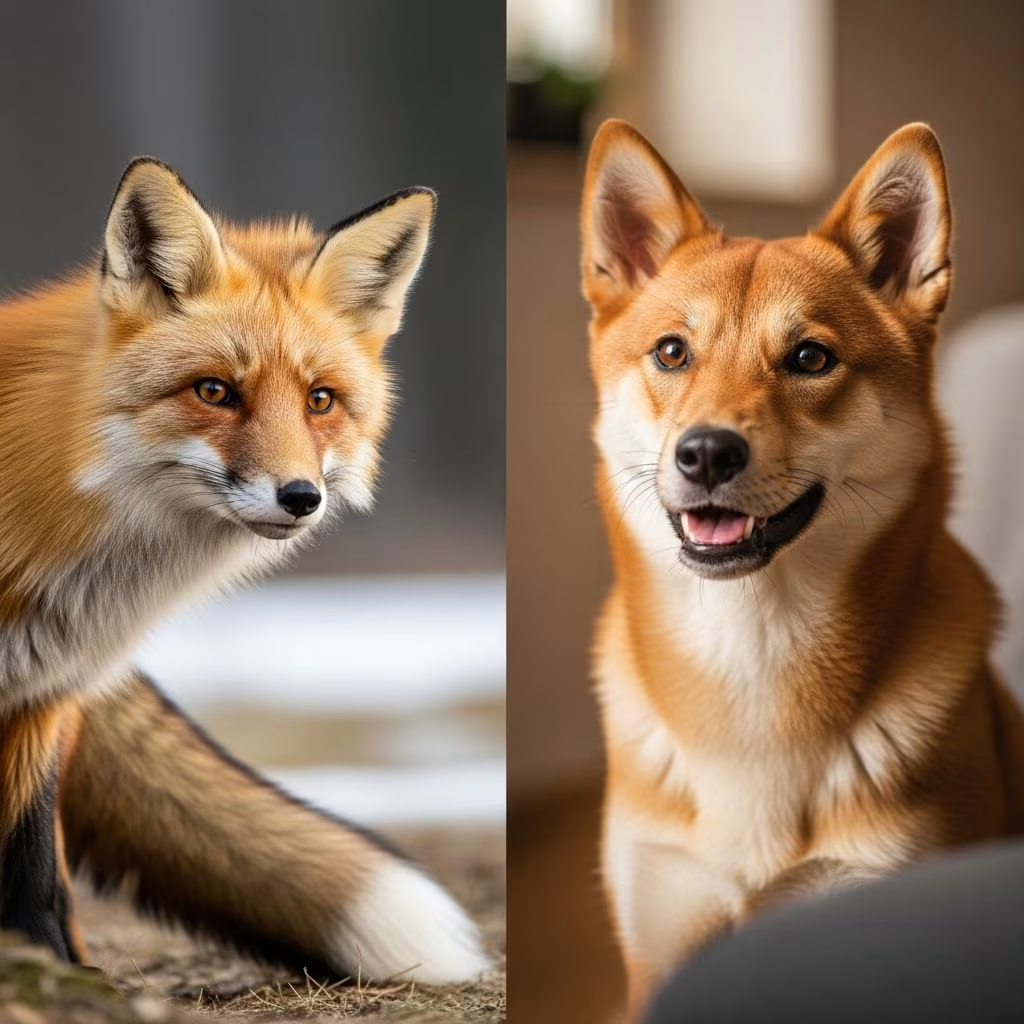
Foxes and dogs belong to the same broad family, Canidae, but diverge significantly in genetics, behavior, and adaptability to human life. While both trace roots to ancient carnivorans, dogs underwent intense domestication from wolves, whereas foxes evolved as wild, solitary hunters.
The Canidae Family Tree: A Shared Ancient Origin
The Canidae family emerged around 40 million years ago during the Eocene epoch, following the extinction of non-avian dinosaurs. Carnivorans split into caniforms (dog-like) and feliforms (cat-like), with the first true canids appearing as adaptable mammals capable of diverse diets and social structures.
Within Canidae, foxes represent the genus Vulpes, while dogs fall under Canis. Their common ancestor likely resembled early wolves or proto-canids from the Pleistocene, but lineages split millions of years ago. Fossil evidence shows foxes diverging earlier from wolf-like ancestors, with remains found alongside ancient wolves suggesting parallel evolution paths.
Modern phylogeny, based on mitochondrial and nuclear DNA, confirms monophyly of Canidae groups. Wolf-like canids (including dogs) colonized regions multiple times, but foxes adapted to niche habitats independently.
Genetic Blueprints: Chromosomes and Compatibility
Dogs possess 78 chromosomes, enabling hybridization within the Canis genus (e.g., wolf-dog, coyote-dog crosses). Red foxes, however, have only 38 chromosomes, creating a genetic barrier that prevents viable offspring with dogs.
This chromosomal mismatch underscores their separation. Despite family ties, foxes and dogs are distinct species: Vulpes vulpes for red foxes versus Canis familiaris for dogs. Shared traits like scent communication and vocalizations stem from deep ancestry, not recent interbreeding.
| Feature | Dogs (Canis) | Foxes (Vulpes) |
|---|---|---|
| Chromosomes | 78 | 38 |
| Genus Divergence | Recent from wolves (~0.8 Mya) | Earlier (~millions of years) |
| Hybridization | Possible within genus | Impossible with dogs |
| Social Structure | Pack-oriented (domesticated) | Solitary or small family |
Behavioral Contrasts: Wild Instincts vs. Tamed Loyalty
Dogs evolved cooperative pack behaviors alongside humans during the Upper Paleolithic, fostering symbiosis through hunting aid and protection. This mutualism shaped their friendliness and trainability.
Foxes, conversely, remain wary and elusive, prioritizing survival in diverse environments. They hunt alone, pouncing on prey, and supplement diets with plants or insects—traits less pronounced in domesticated dogs.
- Fox agility: Expert burrowers and climbers, evading threats nimbly.
- Dog sociability: Bred for human companionship, excelling in obedience.
- House-training: Dogs readily adapt; foxes resist due to strong marking instincts.
Lifespans reflect lifestyles: pet dogs average 10-15 years, while wild foxes endure 2-4 years amid predation and scarcity.
The Silver Fox Experiment: Domestication in Action
In the 1950s, Russian geneticist Dmitry Belyaev initiated a groundbreaking study at the Institute of Cytology and Genetics. Starting with 10,500 silver foxes bred for fur, he selected for tameability by breeding the least aggressive individuals.
Over generations, about 50,000 offspring yielded a population with dog-like behaviors: tail-wagging, whining for attention, and human affinity. Morphological shifts emerged spontaneously—floppy ears, curly tails, shortened snouts, piebald coats—mirroring dog domestication traits.
These changes arose from selection targeting neurohormonal genes, particularly the HPA axis (hypothalamic-pituitary-adrenal), altering stress responses. Epigenetic modifications likely destabilized development, producing variations via regulatory genes.
Selection for tameability induced profound shifts: “a unique domestic fox with behavior very similar to another species, the domestic dog.”
The experiment proved domestication universally affects behavior first, triggering correlated physical changes. It models early dog evolution from wolves, bypassing breed-specific tweaks.
Physical Likenesses and Divergences
Both species boast lithe builds, keen senses, and carnivorous dentition suited for tearing meat. Foxes, however, feature narrower snouts, larger ears for heat dissipation, and bushier tails for balance.
Coat diversity explodes in dogs via selective breeding, but foxes show natural variations like the ‘Star’ depigmentation in domesticated lines, linked to a single incompletely dominant gene.
Skeletal adaptations in tame foxes included shortened limbs and widened skulls, echoing ‘neoteny’—retention of juvenile traits—in pets.
Evolutionary Pathways: From Wild Packs to Hearth Companions
Dogs’ domestication began ~15,000-40,000 years ago from gray wolf populations, coinciding with human migrations. Pleistocene wolves like Canis edwardii and Canis dirus preceded this, with modern wolves enabling the transition.
Foxes, adapted to forests, deserts, and tundras, never faced similar human pressures. Rare historical exceptions, like the Fuegian dog potentially linked to fox-like canids, remain debated and unproven for widespread domestication.
Genetic studies reveal dogs’ loyalty stems from amplified oxytocin responses and reduced fear genes—changes replicable in foxes under experimental selection.
Modern Implications: Pets, Conservation, and Hybrids
Exotic pet enthusiasts sometimes acquire foxes, but their wild nature poses challenges: musky odors, digging, and nocturnal activity clash with home life. Legal restrictions abound due to rabies risks and invasiveness.
Conservation highlights foxes’ ecological roles as predators controlling rodents. Dogs aid in fox tracking for studies, underscoring ironic kinship.
Mythical ‘fox-dog hybrids’ lack evidence; chromosome counts preclude them. Videos of ‘friendly foxes’ often feature selectively bred experimentals, not wild types.
FAQs: Clarifying Fox-Dog Connections
Can foxes and dogs mate?
No, differing chromosome numbers (38 vs. 78) prevent fertile hybrids.
Why do some foxes act like dogs?
Breeding programs select for tameness, eliciting dog-like traits via genetic shifts.
Are foxes closer to dogs or cats?
Dogs; both are Canidae (caniform carnivorans), distant from feliform cats.
Could foxes be domesticated like dogs?
Yes, as Belyaev’s foxes demonstrate, but it requires generations of targeted selection.
What’s the lifespan difference?
Wild foxes: 2-4 years; pet dogs: up to 15 years.
Key Takeaways on Canid Kinship
- Shared Canidae roots unite foxes and dogs evolutionarily.
- Genetic and chromosomal gaps prevent direct interbreeding.
- Domestication experiments reveal behavioral selection drives physical changes.
- Foxes embody wild canid essence; dogs, human-shaped companions.
This kinship enriches our appreciation of biodiversity, blending wild heritage with domesticated bonds.
References
- Animal evolution during domestication: the domesticated fox as a model. — Trut, L., Oskina, I., & Kharlamova, A. 2009-07-01. https://pmc.ncbi.nlm.nih.gov/articles/PMC2763232/
- Are Foxes Dogs? Unraveling the Canine Connection. — Oreate AI Blog. 2024 (approx., recent access). https://www.oreateai.com/blog/are-foxes-dogs-unraveling-the-canine-connection/8d73a5b4a395d42f54e8181a94191f90
- Are Foxes Related to Dogs or Cats? The Absolute Answer. — All Things Foxes (YouTube). 2023 (approx.). https://www.youtube.com/watch?v=cbu3Dme979U
- Canidae. — Wikipedia (sourced from peer-reviewed phylogenies). Ongoing (2024 updates). https://en.wikipedia.org/wiki/Canidae
- Foxes as pets: Case study of the Fuegian Dog. — Journal of Zoology. 2024-10-11. https://zslpublications.onlinelibrary.wiley.com/doi/full/10.1111/jzo.70031



