

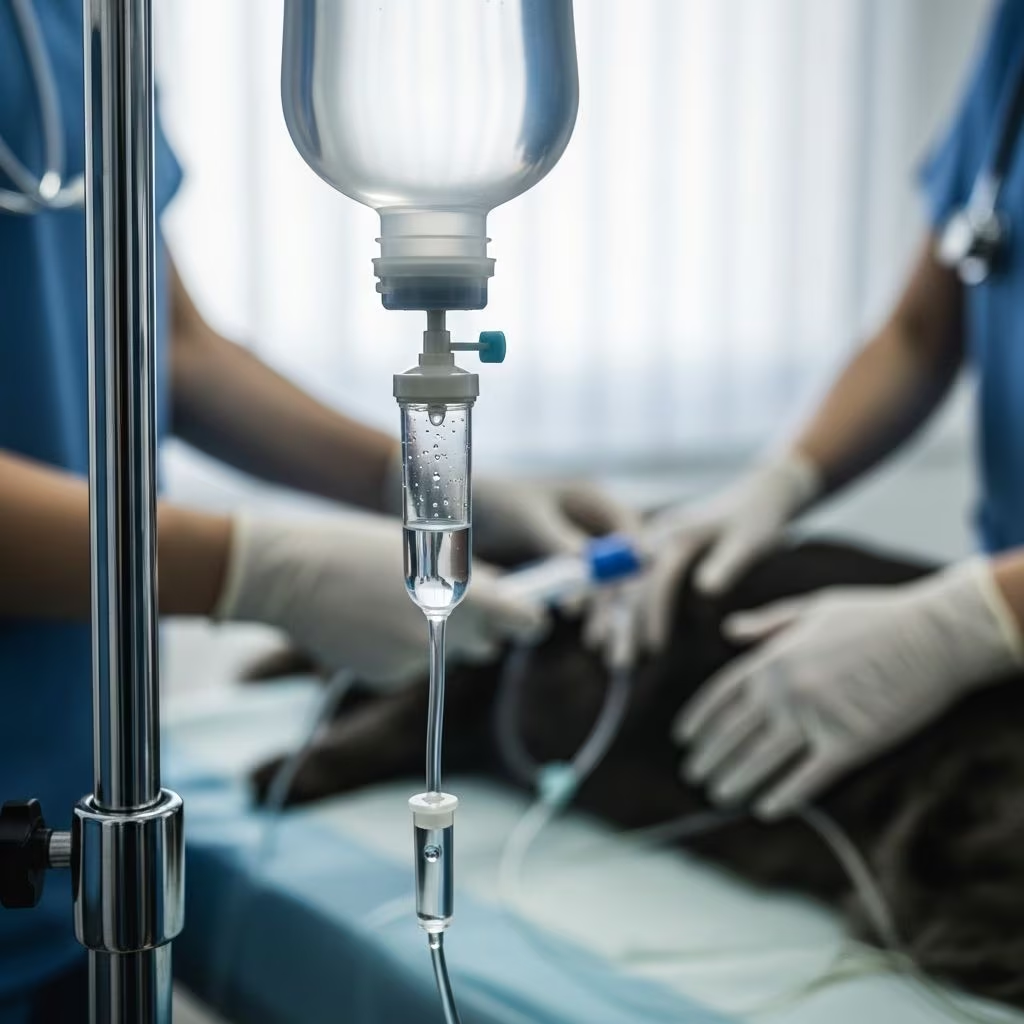
Fluid therapy represents a cornerstone of modern veterinary medicine, enabling practitioners to address critical imbalances in hydration, perfusion, and electrolyte status across various species. By restoring intravascular volume, correcting dehydration, and supporting organ function, veterinarians can significantly improve patient outcomes in scenarios ranging from emergency resuscitation to routine maintenance during hospitalization.
Understanding Body Fluid Dynamics
The body maintains a delicate balance of fluids distributed across intracellular, interstitial, and intravascular compartments. Total body water typically constitutes 60% of body weight in animals, with variations by species, age, and condition. Intravascular fluid, primarily plasma, accounts for about 8% of body weight and is crucial for oxygen delivery and nutrient transport. Disruptions, such as those from vomiting, diarrhea, or hemorrhage, necessitate targeted fluid interventions to realign these compartments.
Key factors influencing fluid distribution include osmolarity, oncotic pressure, and hydrostatic forces. Isotonic solutions mimic plasma osmolarity to expand vascular volume without shifting fluids excessively between compartments. Veterinary professionals must assess these dynamics through physical exams, history, and diagnostics to tailor therapy effectively.
Assessing the Need for Fluid Therapy
Initial evaluation begins with a thorough physical examination and history to identify signs of inadequate perfusion or dehydration. Indicators include prolonged capillary refill time, weak pulses, cool extremities, sunken eyes, and tacky mucous membranes. Dehydration percentage is estimated via skin tenting, eye position, and pulse quality: mild (5-6%), moderate (7-10%), severe (>10%).
- Perfusion deficits: Pale gums, tachycardia, hypotension signaling shock.
- Ongoing losses: Vomiting, diarrhea, polyuria requiring replacement.
- Electrolyte imbalances: Hyponatremia or hyperkalemia from renal disease.
Quantitative tools like lactate levels, central venous pressure, and urine specific gravity refine assessments, guiding precise fluid plans.
Phases of Fluid Administration
Fluid therapy unfolds in distinct yet overlapping phases: resuscitation, rehydration, and maintenance.
Resuscitation Phase
This urgent stage targets life-threatening hypovolemia and shock. Rapid boluses restore perfusion: dogs receive 10-20 mL/kg IV over 15-30 minutes, cats 5-10 mL/kg, reassessing endpoints like normal mentation, warm extremities, and lactate <2.5 mmol/L. Aggressive administration improves survival, often sufficing without inotropes unless cardiogenic shock persists.
Rehydration Phase
Follows stabilization, replacing dehydration deficits over 24-48 hours. Calculate deficit as body weight (kg) × dehydration % × 1000 mL, then divide by correction time. Add maintenance (dogs 2-6 mL/kg/hr, cats 2-3 mL/kg/hr) and ongoing losses (e.g., 2 mL/kg per diarrheal stool).
Maintenance Phase
Sustains homeostasis during recovery, matching insensible losses (respiration, feces) plus urine output. Holliday-Segar formula approximates: 40 mL/kg/day for first 10 kg, 20 mL/kg for next 10 kg, 10 mL/kg thereafter, adjusted for species.
Types of Fluids and Selection Criteria
Fluid choice hinges on deficit type and patient needs. Crystalloids dominate: isotonic for volume expansion, hypotonic for free water replacement, hypertonic for rapid shifts.
| Fluid Type | Composition | Indications | Dosage Notes |
|---|---|---|---|
| 0.9% NaCl (Normal Saline) | Isotonic crystalloid | Resuscitation, hyponatremia | Bolus 20 mL/kg dogs |
| Lactated Ringer’s (LRS) | Balanced isotonic | Maintenance, diarrhea losses | Preferred for most cases |
| 5% Dextrose | Isotonic, hypotonic in vivo | Hypernatremia correction | Slow infusion |
| HetaSTARCH/Colloids | High oncotic | Hypoalbuminemia | 5 mL/kg bolus |
“Replace like with like”: blood loss warrants colloids or blood products; GI losses suit balanced crystalloids. Avoid dextrose in diabetics; monitor for hyperchloremia with saline.
Routes of Administration
Selection depends on urgency, volume, and species.
- Intravenous (IV): Gold standard for emergencies; rapid, precise. Requires sterile catheterization.
- Subcutaneous (SQ): Ideal for mild dehydration, CKD support; owner-administered. Absorption delays limit to non-crisis use.
- Intraosseous (IO): For neonates or vascular collapse; proximal femur/tibia.
- Oral: Mild cases; voluntary intake preferred.
IV suits most hospitalized patients, enabling medication delivery.
Monitoring and Preventing Complications
Continuous oversight prevents overload or deficits. Track weight daily (5% gain signals overload), urine output (>1 mL/kg/hr), CVP (5-10 cmH2O), and electrolytes q6-12h. Signs of overload: chemosis, pulmonary crackles, ascites.
- Adjust rates based on response.
- Use buretrols for small patients.
- Diuretics for overload.
Common pitfalls: arbitrary dosing, ignoring comorbidities like heart failure.
Special Considerations by Condition
Anesthesia and Surgery
Intraoperative fluids maintain perfusion: 5-10 mL/kg/hr basal, plus blood loss replacement. Hypotension prompts boluses.
Renal Disease
Conservative rates avoid overload; balanced solutions support diuresis in acute kidney injury.
Shock Variants
Hypovolemic: crystalloid boluses. Septic: vasopressors post-volume. Cardiogenic: cautious dosing.
Practical Calculation Examples
For a 10 kg dog, 8% dehydrated, ongoing 50 mL/day loss:
- Deficit: 10 × 0.08 × 1000 = 800 mL.
- 24h plan: 800/24 + 50 mL maint + 50 loss = ~100 mL/hr LRS.
Reassess q4-6h.
FAQs
What is the first step in fluid therapy?
Assess perfusion and dehydration via physical exam.
Can owners give SQ fluids at home?
Yes, for chronic conditions like CKD after training.
How do you calculate maintenance fluids?
Dogs: 2-6 mL/kg/hr; cats: 2-3 mL/kg/hr IV.
What fluids for shock?
Isotonic crystalloids, 10-20 mL/kg boluses.
How to avoid fluid overload?
Monitor weight, urine output, lung sounds; titrate doses.
Advances and Guidelines
Recent AAHA 2024 guidelines emphasize individualized dosing, avoiding one-size-fits-all rates to minimize morbidity. They cover anesthesia, common diseases, and monitoring innovations like ultrasound for volume status.
References
- AAHA publishes fluid therapy guidelines for dogs, cats — American Animal Hospital Association (AAHA). 2024-06-07. https://www.avma.org/news/aaha-publishes-fluid-therapy-guidelines-dogs-cats
- The Basics of Fluid Therapy for Small Animal Veterinary Technicians — Today’s Veterinary Nurse. Accessed 2026. https://todaysveterinarynurse.com/internal-medicine/the-basics-of-fluid-therapy-for-small-animal-veterinary-technicians/
- The Basics of Fluid Therapy — B. Braun VetCare. Accessed 2026. https://www.bbraun-vetcare.com.au/en/stories/the-basic-of-fluid-therapy.html
- Fluid Therapy in Animals — MSD Veterinary Manual. Accessed 2026. https://www.msdvetmanual.com/therapeutics/fluid-therapy/fluid-therapy-in-animals
- The Fluid Resuscitation Plan in Animals — Merck Veterinary Manual. Accessed 2026. https://www.merckvetmanual.com/therapeutics/fluid-therapy/the-fluid-resuscitation-plan-in-animals
- Considerations for Creating a Fluid Therapy Plan — University of Illinois College of Veterinary Medicine. 2022-12-04. https://vetmed.illinois.edu/2022/12/04/considerations-for-creating-a-fluid-therapy-plan/



