

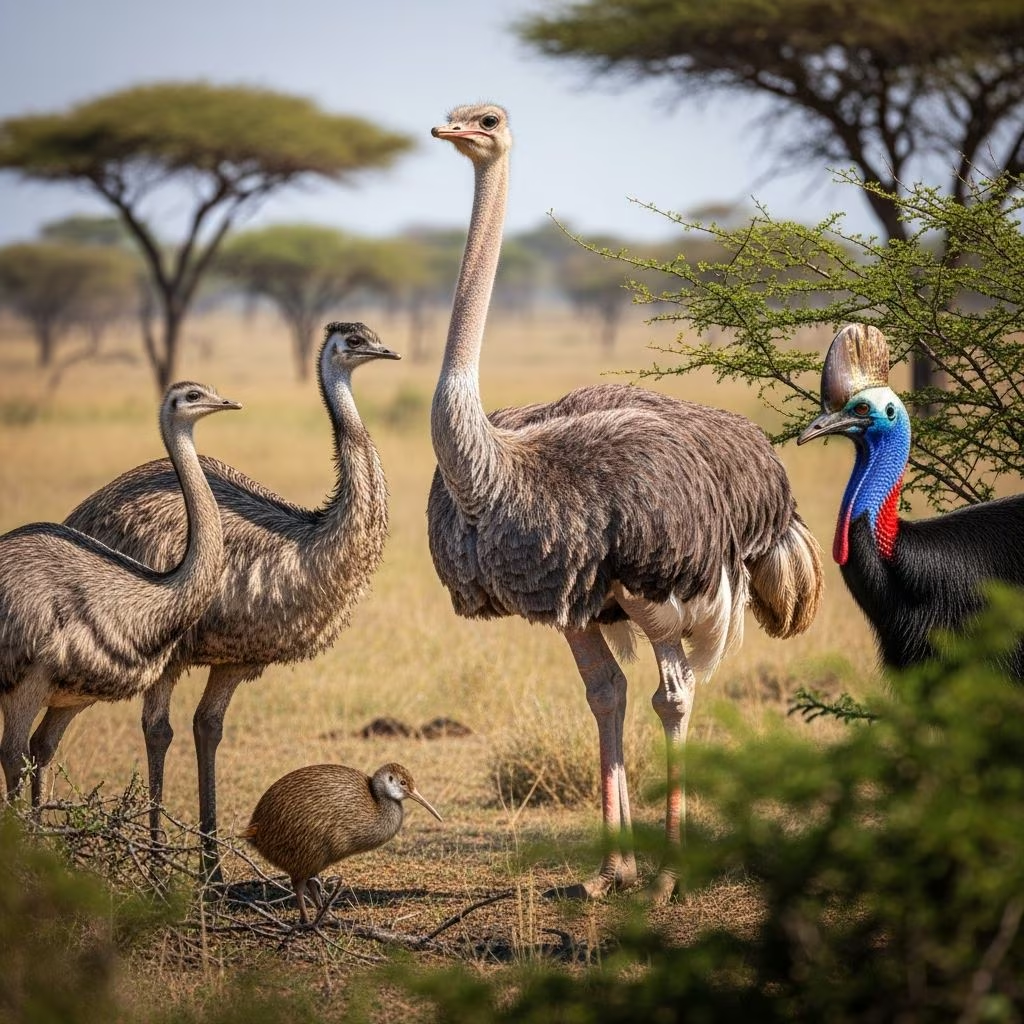
What Defines a Ratite?
Ratites represent a fascinating group of flightless birds that stand apart from all other avian species due to a single crucial anatomical feature: the absence of a keeled sternum. The term “ratite” itself derives from the Latin word “ratis,” meaning raft—a vessel with a flat, raft-like bottom rather than a keel. This anatomical distinction fundamentally separates ratites from all flying birds, as the keel serves as the critical anchor point for the powerful flight muscles necessary for airborne locomotion. Without this structure, even if ratites possessed fully developed wings and strong musculature, they would remain permanently earthbound.
The ratite group encompasses several distinct species distributed across the Southern Hemisphere, each occupying unique ecological niches and displaying remarkable adaptations to their respective environments. These birds belong to an ancient lineage and are classified within the infraclass Palaeognathae, which represents one of the most primitive groups of modern birds. What makes ratites particularly intriguing from an evolutionary perspective is that flightlessness evolved independently multiple times across different ratite lineages, suggesting that environmental conditions favored the loss of flight rather than its retention.
Geographic Distribution and Species Diversity
Ratites are not a monolithic group but rather comprise five distinct species, each with specific geographic distributions that reflect their evolutionary history and ecological requirements. The scientific classification divides ratites into four geographic suborders, each containing species uniquely adapted to their regional environments.
- African Ratites (Struthiones): The ostrich, native to Africa, represents the largest living ratite and indeed the largest living bird species on Earth. These remarkable creatures have become naturalized in Australia as well, demonstrating their adaptability to new environments.
- South American Ratites (Rheae): The rhea family comprises two species that have evolved to thrive in the expansive grasslands and pampas of South America. These birds are characteristic inhabitants of tall grass steppes and savanna-type ecosystems.
- Australian and Papua New Guinean Ratites (Casuarii): The cassowary species inhabit the tropical regions of Australia and New Guinea, primarily concentrated in rainforest environments where their unique morphology provides distinct advantages.
- New Zealand Ratites (Apteryges): The kiwi family, consisting of five species, represents the smallest ratites and the only nocturnal members of the group. These birds are found exclusively in New Zealand and demonstrate remarkable specialization for their ecological niche.
Physical Characteristics and Anatomical Adaptations
Ratites exhibit a constellation of anatomical features that distinguish them from all other bird groups, many of which represent significant departures from typical avian morphology. These adaptations reflect millions of years of evolution in the absence of flight-related constraints.
Size Variation Across Species
One of the most striking characteristics of ratites is their considerable size variation, ranging from chicken-sized kiwis to towering ostriches that exceed 2.5 meters in height. The ostrich stands as the undisputed giant of the group, reaching heights of 2.5 to 3.0 meters and weighing up to 85 kilograms, making it the tallest and heaviest living bird species. Emus and rheas occupy the intermediate size range, with emus measuring 1.5 to 1.8 meters and rheas reaching 1.5 to 1.7 meters in height. Cassowaries match or exceed rhea dimensions, typically ranging from 1.7 to 2.0 meters. The kiwi, by contrast, represents the miniature member of the ratite family, with specimens measuring only 0.3 to 0.6 meters in length.
Skeletal and Muscular Characteristics
Beyond the characteristic flat sternum, ratites possess numerous skeletal modifications that reflect their terrestrial lifestyle. These birds lack a patella—the kneecap structure found in most vertebrates—which influences their locomotor mechanics. Their wing skeletons are considerably simplified compared to flying birds, and the wishbone structure (furcula) is nearly absent in many species. The reduction in wing complexity correlates directly with the evolution of massive hindlimbs that provide the propulsive force necessary for rapid terrestrial locomotion.
Ratite legs demonstrate extraordinary muscular development, with heavily muscled thighs and powerful feet adapted for either running or defense. The foot structure varies significantly among species: ostriches possess only two toes (didactyl), with one being substantially larger than the other. Emus, rheas, and cassowaries exhibit three-toed feet (tridactyl) with nails on each digit. The cassowary possesses particularly dangerous claws—a sharp, dagger-like structure on the inner toe that serves as a formidable defensive weapon. Kiwis uniquely retain a small fourth toe pointing backward with a spur-like nail.
Feather Structure and Respiratory Adaptations
Ratite feathers possess a distinctive structure that differs fundamentally from the feathers of flying birds. While feather barbules are present in ratites, they do not interlock as they do in flight birds, resulting in the characteristic fluffy appearance that has historically made ratite feathers valuable for decorative and fashion purposes. Additionally, ratites lack functional preen glands, eliminating the need to oil and waterproof their feathers as flying birds must do.
The respiratory system in ratites remains functionally similar to that of other avian species, incorporating 10 air sacs that enable efficient oxygen extraction. However, ratites lack a true crop—the storage structure in the esophagus where other birds temporarily store food—demonstrating their divergence from typical avian digestive anatomy.
Behavioral Patterns and Social Structure
Despite their shared flightlessness, ratites exhibit remarkably different behavioral patterns that reflect their ecological requirements and evolutionary histories. Understanding these behavioral differences provides insight into how different species have adapted to their unique environments.
Locomotion and Speed Capabilities
Ratites have evolved as terrestrial locomotors par excellence. Ostriches and rheas are renowned for their speed, utilizing their powerful hindlimbs to achieve remarkable velocities across open terrain. Emus, despite their slightly smaller stature compared to ostriches, are capable sprinters that can achieve speeds up to 51 kilometers per hour, transitioning from a quick trot to an explosive sprint when threatened. Cassowaries similarly rely on their powerful legs for rapid movement through their forest habitats. The kiwi, adapted to a nocturnal lifestyle, possesses different behavioral patterns, moving methodically through leaf litter and soil in search of invertebrate prey rather than relying on speed as a primary defense mechanism.
Social Structures and Territorial Behavior
Ostriches and rheas are fundamentally gregarious birds, exhibiting diurnal activity patterns and maintaining social groupings throughout much of the year. During breeding season, males of these species become intensely territorial, defending specific areas and establishing polygamous mating systems where multiple females contribute eggs to communal nests. Cassowaries are generally more solitary or found in small family groups, particularly in their dense rainforest habitats where visibility and group maintenance would be challenging. Kiwis demonstrate extended monogamous partnerships, with mated pairs maintaining long-term bonds and demonstrating remarkably different reproductive strategies compared to their larger relatives.
Habitat Preferences and Environmental Adaptation
Each ratite species exhibits distinct habitat preferences shaped by their evolutionary history and physiological requirements. Ostriches prefer open semi-arid areas with short grass and demonstrate exceptional adaptation to hot, dry environments. Emus, by contrast, occupy diverse habitats across Australia, displaying greater environmental flexibility than ostriches. Rheas characteristically inhabit tall grass steppes and savanna ecosystems, though they require proximity to water or wetlands for successful breeding. Cassowaries and kiwis are rainforest specialists, though habitat destruction has forced kiwis to adapt to other environments with adequate humidity, appropriate soil texture, and vegetation density suitable for burrowing. Notably, all ratite species possess swimming capabilities, adding another dimension to their environmental adaptability.
Reproductive Strategies and Breeding Behaviors
Ratite reproduction represents one of the most distinctive aspects of their biology, with each species exhibiting unique breeding strategies adapted to their ecological circumstances and social structures. Male territorial behavior forms the foundation of ratite breeding systems, with males becoming highly aggressive and visually impressive during breeding season.
Territorial males in species like ostriches and rheas construct shallow nest scrapes—depressions in the ground where eggs are deposited. Multiple females visit territorial males and contribute eggs to communal clutches, resulting in mixed paternity and maternity within single nests. Only the primary female and resident male provide parental care, incubating eggs and protecting hatchlings. Male rheas assume sole responsibility for nest construction and egg incubation, while male ostriches participate in incubation exclusively during nighttime hours.
Kiwis present a striking contrast to their larger relatives, exhibiting monogamous reproductive strategies with extended pair bonding. These remarkable birds typically incubate only a single egg, either with the male providing sole incubation responsibility or both parents participating in rotation. Unlike most birds, all male ratites possess a phallus that functions during copulation, representing a primitive reproductive feature distinct from the single cloaca of most bird species.
Ratite eggs exhibit extraordinary thickness in their shells compared to eggs of flying birds, providing protection necessary for their developing young. Hatchlings emerge in a relatively advanced state of development, capable of running or walking within hours of hatching. This precocial development pattern contrasts sharply with the altricial hatchlings of many other bird species.
Evolutionary Origins and Flightlessness
The evolution of flightlessness in ratites presents a fascinating case study in adaptive evolution and ecological opportunity. Research on flightless rails suggests that flightlessness typically evolves in the absence of predators, indicating that flight generally remains necessary for avian survival and dispersal. The apparent paradox is that many ratite-inhabited landmasses contain predatory mammals, yet ratites remain flightless. The explanation lies in the K-Pg extinction event (the catastrophic impact that eliminated non-avian dinosaurs), which created a temporal window during which large predators were absent from many landmasses. This predator-free period allowed ancestral ratite lineages to evolve flightlessness and subsequently undergo selection for increased body size.
As predation pressure decreased on islands with limited raptor diversity and no mammalian predators, the selective advantage of maintaining large, powerful flight muscles diminished. The energy and resources previously devoted to flight capability could be redirected toward larger body size and more powerful hindlimbs. This represents a fundamental trade-off in avian evolution: investment in flight capability versus investment in terrestrial locomotion and other survival strategies.
Comparative Anatomy Table
| Feature | Ostrich | Emu | Rhea | Cassowary | Kiwi |
|---|---|---|---|---|---|
| Height (meters) | 2.5–3.0 | 1.5–1.8 | 1.5–1.7 | 1.7–2.0 | 0.3–0.6 |
| Toe Structure | 2 toes (didactyl) | 3 toes (tridactyl) | 3 toes (tridactyl) | 3 toes (tridactyl) | 4 toes |
| Activity Pattern | Diurnal | Diurnal | Diurnal | Diurnal | Nocturnal |
| Primary Habitat | Semi-arid grassland | Varied habitats | Grasslands/savanna | Rainforest | Rainforest/moist areas |
Frequently Asked Questions
Why can’t ratites fly if they have wings?
Ratites possess vestigial wing structures, but without a keeled sternum to anchor flight muscles, they lack the muscular development necessary for powered flight. Even with fully developed wings, the absence of this critical skeletal structure makes flight biomechanically impossible.
Are ratites related to each other?
While all ratites share the characteristic flat sternum and flightless condition, they represent a polyphyletic group, meaning they did not evolve from a single common ancestor but rather independently lost the ability to fly. They are more distantly related than their shared flightlessness might suggest.
Which ratite is the fastest runner?
Both ostriches and rheas are exceptional runners, but emus can achieve sprint speeds up to 51 kilometers per hour, demonstrating remarkable velocity despite their slightly smaller size.
How do ratites defend themselves without flight?
Ratites employ powerful kicks using their muscular hindlimbs, with cassowaries possessing particularly dangerous clawed feet. Some species also use their wings for distraction displays or display behaviors unrelated to flight.
Do all ratites have the same diet?
No—the gastric anatomy and intestinal characteristics of ratites reflect adaptations to different diets, indicating specialized feeding strategies among different species.
References
- Ratite — Wikipedia. Accessed February 24, 2026. https://en.wikipedia.org/wiki/Ratite
- Ratites or Struthioniformes: Struthiones, Rheae, Cassuarii — National Center for Biotechnology Information (PMC7152070). 2015. https://pmc.ncbi.nlm.nih.gov/articles/PMC7152070/
- Ratites or Struthioniformes — Veterian Key. Accessed February 24, 2026. https://veteriankey.com/ratites-or-struthioniformes/
- Ratite | Flightless, Ostriches, Emus — Britannica. Accessed February 24, 2026. https://www.britannica.com/animal/ratite
- Overview of Ratites – Exotic and Laboratory Animals — Merck Veterinary Manual. Accessed February 24, 2026. https://www.merckvetmanual.com/exotic-and-laboratory-animals/ratites/overview-of-ratites
- Ratites — Poultry Hub Australia. Accessed February 24, 2026. https://www.poultryhub.org/all-about-poultry/species/ratities



