

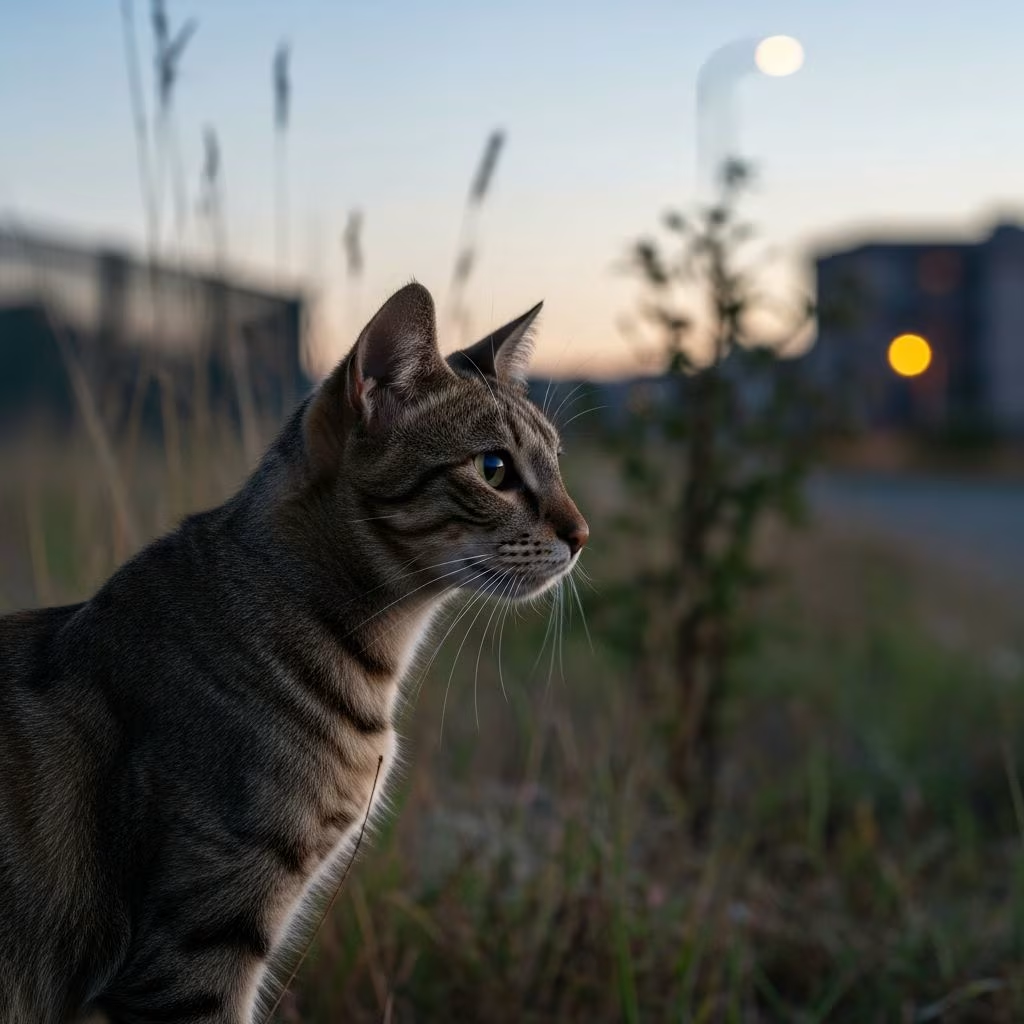
Feral cats establish expansive territories driven by survival needs, often covering hundreds of acres compared to the limited ranges of owned pets. These independent felines navigate urban, suburban, and rural landscapes, adapting their movements to food availability, shelter, and threats.
Understanding Feral Cat Movement Basics
Feral cats, descendants of domesticated animals living without human care, exhibit roaming behaviors shaped by their environment. Unlike indoor pets, they must hunt, scavenge, and defend space daily. Studies using GPS collars and camera traps reveal average daily ranges far exceeding those of house cats, with feral individuals traversing up to 388 acres or more in some cases. This contrasts sharply with domestic cats averaging just 4.9 acres per day.
Territory size varies by habitat. In resource-rich urban zones, cats maintain smaller, overlapping home ranges due to reliable food from garbage or feeders. In sparse rural or island settings, ranges expand to 0.18 to 8.05 square miles to access prey. High prey density prompts smaller territories, optimizing energy use.
Factors Influencing Territory Size and Roaming
Several elements dictate how far feral cats roam:
- Food Sources: Supplemental feeding shrinks ranges, as cats concentrate near reliable meals. Without it, they expand searches, covering vast areas for rodents and birds.
- Landscape Features: Forested areas deter cats, who prefer open developed zones. Camera surveys in suburban Arkansas found cats in 70.8% of yards, with abundance dropping near high forest cover within 400 meters.
- Predator Presence: Coyotes and dogs shift cat activity; more dogs mean diurnal patterns, while predators push nocturnal behavior.
- Human Density: Urban edges and agriculture see higher cat numbers, using these for hunting corridors.
- Reproductive Status: Intact males roam furthest during mating season, covering multiple colonies.
These dynamics create loosely organized colonies where cats shift based on resources, leading to density-dependent dispersal if individuals are removed.
Daily Activity Cycles of Free-Roaming Cats
Feral cats balance rest and action differently from pets. They sleep about 62% of the day versus 80% for owned cats, dedicating more time to high-intensity pursuits like hunting. Activity peaks vary: diurnal near cities, nocturnal in predator-heavy or late-summer areas.
Radio-tracking in Illinois showed feral cats 14% in intense activity daily, versus 3% for domestics. This vigor supports larger territories but increases mortality risks, with more feral deaths from predators or vehicles.
| Aspect | Feral Cats | Domestic Cats |
|---|---|---|
| Average Daily Range | 388+ acres | 4.9 acres |
| Sleep Time | 62% of day | 80% of day |
| High-Intensity Activity | 14% waking hours | 3% waking hours |
| Habitat Preference | Developed, low forest | Yards, homes |
Ecological Consequences of Expansive Roaming
Widespread feral cat movements pose challenges for wildlife. As ubiquitous mesopredators, they outnumber many natives except raccoons and opossums in suburbs. Annual kills reach billions of birds and mammals, pressuring ecosystems.
In yards, multiple cats (average three per site) visit regardless of features like feeders or fences, competing with natives. Their presence alters prey dynamics and may displace predators through temporal shifts.
Management Approaches for Feral Populations
Controlling roaming requires evidence-based methods. Trap-Neuter-Release (TNR) reduces aggression, noise, and ranges by curbing reproduction and fighting. Neutered males show less roaming and conflict.
CVMA endorses humane initiatives targeting overall colony reduction across areas, countering vacuum effects. Euthanasia reduces numbers faster but raises welfare concerns. Feeding and sheltering shrink territories, easing wildlife pressure.
Capture challenges include trap-shyness; solutions involve drop-traps or drop-sites. Community engagement boosts TNR success, as feral cats avoid humans.
Urban vs. Rural Roaming Comparisons
Urban Settings: Cats thrive in high-development areas, ubiquitous in yards (73.2% detection rate). Smaller ranges due to food abundance, but higher densities amplify impacts.
Rural and Agricultural: Larger territories for prey access; diurnal in fields, nocturnal elsewhere. Isolated habitats like islands show prey-optimized ranges.
Landscaping deters minimally; broad habitat management is key.
Health and Survival Insights from Tracking Data
Free-roaming cats face FeLV/FIV rates akin to owned ones. Higher activity elevates risks: predation, vehicles, disease. Studies note more feral losses. TNR improves health, longevity.
Community Strategies to Limit Roaming
- Implement colony-wide TNR to stabilize populations.
- Eliminate unsecured food sources.
- Promote owner containment; beliefs influence free-roaming allowances.
- Monitor via cameras for patterns.
Frequently Asked Questions
How large is a typical feral cat territory?
Territories range from 0.18 to 8.05 square miles, averaging 388 acres daily in studies.
Do TNR programs reduce roaming distances?
Yes, neutering shrinks ranges by lowering mating drives and aggression.
Why do feral cats prefer urban areas?
Food reliability and low forest cover support higher densities.
Can yard changes keep feral cats away?
No significant effect; landscape scale matters more.
What kills feral cats most often?
Predators like coyotes, vehicles, and unknown causes.
Key Takeaways for Cat Management
Feral cats roam extensively due to survival imperatives, with ranges dwarfing domestic ones. Landscape, resources, and threats shape patterns. Humane TNR, habitat tweaks, and community efforts mitigate impacts while preserving welfare.
References
- How Far Does Kitty Roam? New Study Covers Cat Tracks — Faunalytics (citing Discovery News/Illinois Natural History Survey). 2011. https://faunalytics.org/how-far-does-kitty-roam-new-study-covers-cat-tracks/
- Effects of landscape cover and yard features on feral and free-roaming cats — Journal of Urban Ecology, Oxford Academic. 2023. https://academic.oup.com/jue/article/9/1/juad003/7161106
- Community cats: scientific studies and data — HumanePro. Accessed 2026. https://humanepro.org/page/community-cats-scientific-studies-and-data
- Free-roaming owned, Abandoned, and Feral Cats — Canadian Veterinary Medical Association. Accessed 2026. https://www.canadianveterinarians.net/policy-and-outreach/position-statements/statements/free-roaming-owned-abandoned-and-feral-cats/
- Feral Cats — UC IPM (University of California). Accessed 2026. https://ipm.ucanr.edu/home-and-landscape/feral-cats/pest-notes/
- Free-ranging and Feral Cats — USDA APHIS. 2018 (authoritative wildlife management reference). https://www.aphis.usda.gov/sites/default/files/free-ranging-and-feral-cats.pdf



