

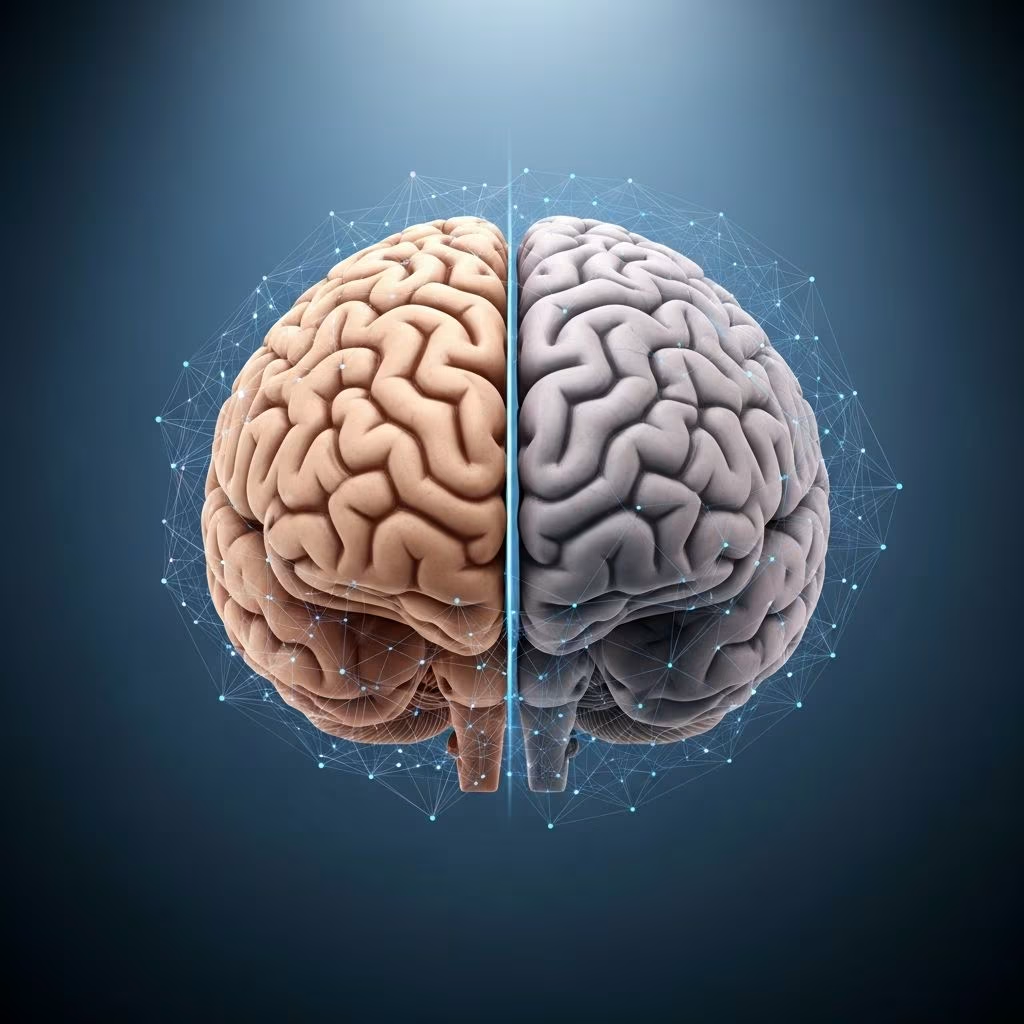
Cat brains and human brains share fundamental architectural similarities despite vast differences in scale and capability. While human brains boast billions of neurons enabling abstract reasoning and complex societies, feline brains prioritize sensory acuity and instinctual prowess suited to predation and survival.
Fundamental Architectural Parallels
Both species possess brains divided into comparable regions, including cerebral cortices with frontal, parietal, temporal, and occipital lobes. These lobes handle sensory input, motor control, and basic cognition in similar configurations. Gray and white matter organize neural pathways alike, facilitating signal transmission via neurotransmitters.
Cats exhibit cerebral folding, or gyrification, akin to humans, which expands surface area for enhanced processing power. Researchers note that cat brain structures mirror human ones in layout, supporting parallel processing of environmental data.
Size and Scale Disparities
A typical cat brain weighs about 25-30 grams, roughly 0.1% of body weight, contrasting sharply with the human brain’s 1.3-1.5 kilograms, or 2% of body mass. Feline brains measure around 83 cm² in cortical surface area, far smaller than the human expanse.
| Feature | Cat Brain | Human Brain |
|---|---|---|
| Average Weight | 25-30g | 1.3-1.5kg |
| Cortical Surface Area | ~83 cm² | >2,000 cm² |
| Body Weight Proportion | 0.1% | 2% |
Neuron Counts and Density Insights
Cats harbor approximately 250-300 million neurons in the cerebral cortex, dwarfed by the human 16-26 billion. This disparity underscores limitations in higher-order functions like long-term planning.
- Cat cortex: 250-300 million neurons, optimized for immediate sensory-motor tasks.
- Human cortex: 16-26 billion neurons, supporting language and foresight.
Despite fewer neurons, cats pack more into visual processing areas, enhancing night vision and motion detection.
Regional Proportions and Specializations
Cats feature a proportionally larger cerebellum, vital for balance, agility, and predatory leaps—comprising a greater body-weight fraction than in humans. This bolsters stalking, climbing, and pouncing instincts.
The human prefrontal cortex dominates at ~25% of brain mass for executive functions, while cats allocate just 3-3.5% there, curtailing complex decision-making.
- Olfactory Bulb: Enlarged in cats for superior scent discrimination.
- Hippocampus & Amygdala: Similar sizes aid memory and emotion processing.
- Visual Cortex: Expanded in felines for prey tracking.
Sensory Processing Superiorities
Cats excel in visual and olfactory domains. Their brains dedicate more neurons to sight, enabling low-light hunting and whisker-based spatial mapping. Whiskers transmit vibrations directly to somatosensory regions, acting as pre-touch scanners.
Orientation differs: cat brains align front-to-back (elongated), humans top-down (oval). This suits quadrupedal navigation.
Cognitive Abilities and Memory
Feline intelligence rivals a 2-3-year-old child’s, with strong short-term memory (up to 16 hours) and observational learning. Cats favor hands-on experience over visual cues, unlike humans.
Emotional centers align closely, explaining shared expressions like purring joy or hissing fear. Neurotransmitter parallels underpin problem-solving patterns.
Developmental and Aging Trajectories
Both species undergo age-related atrophy, with ventricles enlarging and volumes shrinking. Cats mirror human patterns: stable early volumes decline post-5 years (10% drop by 10 years), akin to human post-50 declines.
Pet cats, scanned at older ages (avg. 7.8 years) than colony cats (2.8 years), reveal pronounced changes, positioning them as human aging models. Sex differences emerge later, with males showing faster interthalamic adhesion shifts.
| Age Metric | Cats | Humans |
|---|---|---|
| Volume Decline Onset | After 5 years | After 50 years |
| Pet vs Colony Age | Pet: 7.8y (more atrophy) | N/A |
| Sex Differences | Males faster late-life | Males faster late-life |
Instincts Versus Learned Behaviors
Cats rely on innate wiring for hunting sequences, refined by experience. Humans emphasize cultural learning. Catnip triggers feline euphoria via nasal receptors, absent in humans.
Implications for Pet Care
Understanding these neural profiles informs enrichment: provide climbing towers for cerebellar engagement, scent puzzles for olfactory bulbs, and laser toys for visual pursuits. Monitor aging signs like disorientation, mirroring human dementia precursors.
Frequently Asked Questions
Are cat brains more complex than dog brains?
Yes, cats possess more cerebral folds and dedicated hunting regions, enhancing predatory complexity over canine pack strategies.
Can cats recognize their names?
Auditory cortex processing allows name recognition, with brain waves spiking similarly to human voice detection.
How does cat memory compare to humans?
Cats retain events up to 16 hours short-term; long-term focuses on survival cues, less on abstract recall.
Do cats feel emotions like humans?
Shared limbic structures support joy, fear, and attachment, though expression varies.
Why are pet cats good for aging studies?
Their brain atrophy trajectories align with humans, and pets reach equivalent octogenarian ages.
References
- Is a cat brain like a human brain? — CatDx. 2023. https://www.catdx.com/post/is-a-cat-brain-like-a-human-brain
- 10 Facts About Your Cat’s Brain — FirstVet. 2023. https://firstvet.com/us/articles/10-facts-about-your-cats-brain
- Cat Brain vs Human Brain: Differences Explained — Catster. 2023. https://www.catster.com/lifestyle/cat-brain-vs-human-brain/
- How Does a Cat Brain Compare With a Human Brain — Petful. 2023. https://www.petful.com/behaviors/cat-brain-compare-with-a-human-brain/
- Translating Time shows pet cats live to be natural models for human aging — PMC (NIH). 2025. https://pmc.ncbi.nlm.nih.gov/articles/PMC12324510/
- Cat intelligence — Wikipedia (informational, primary refs used). 2026. https://en.wikipedia.org/wiki/Cat_intelligence
- How Smart Are Cats? — Bond Vet. 2023. https://bondvet.com/blog/how-smart-are-cats



