

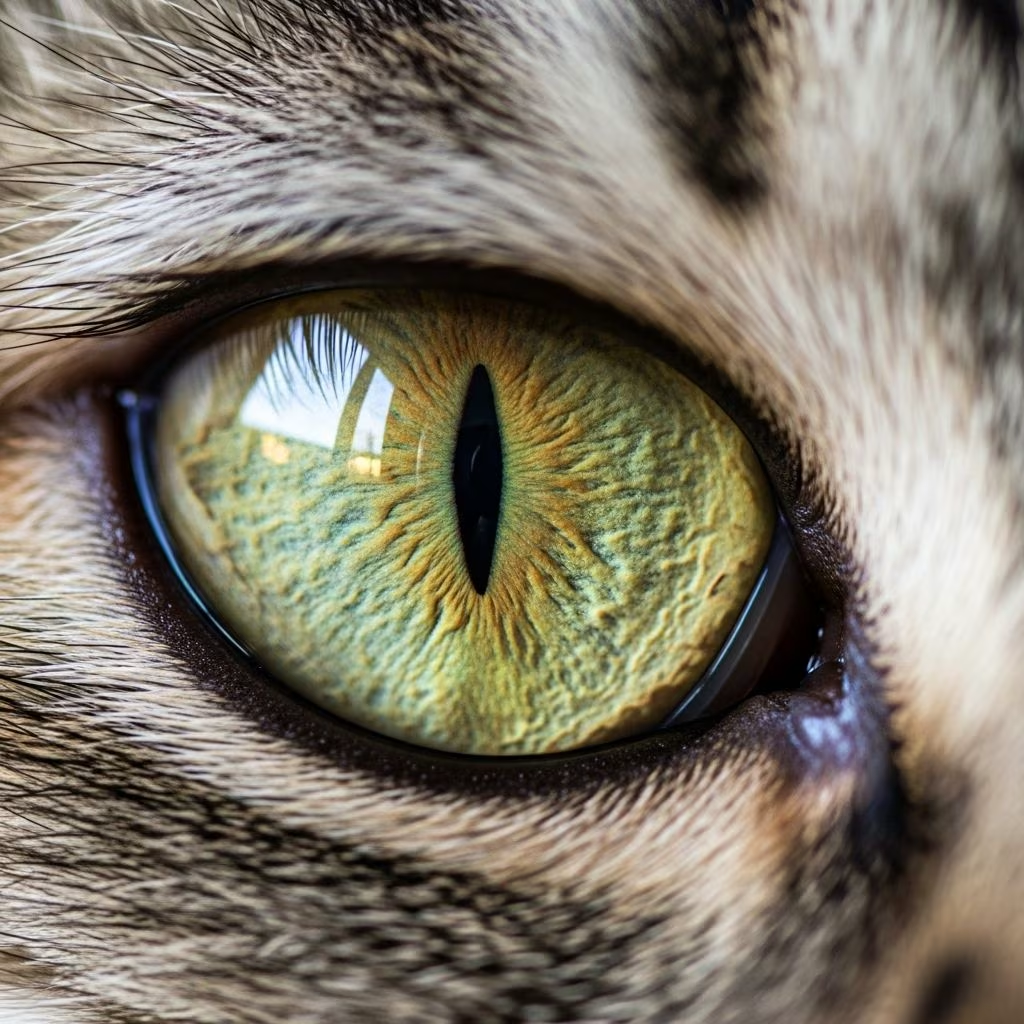
Cats possess one of the most sophisticated visual systems in the animal kingdom, finely tuned through millions of years of evolution to make them exceptional hunters. While many people assume cats see the world similarly to humans, their eyes are actually engineered quite differently, with specialized structures and cellular arrangements that grant them remarkable abilities in low-light conditions. Understanding how your cat’s eyes work reveals the intricate biological adaptations that define their predatory nature and behavior patterns.
The Foundational Structure of a Cat’s Eye
A cat’s eye shares the same basic anatomical blueprint as the human eye, consisting of interconnected components that work together to capture and process visual information. However, the proportions and specialized features of each component differ significantly, creating a visual system optimized for nocturnal hunting rather than daytime clarity.
The orbit serves as the protective bony socket that houses the eyeball, along with the muscles, nerves, and blood vessels necessary for eye movement and function. Surrounding the front portion of the eye is the sclera, commonly known as the white of the eye, which provides structural support and protection. Just beneath the eyelids lies the conjunctiva, a delicate membrane that appears light pink when healthy and helps maintain eye moisture and protection.
The outermost transparent layer is the cornea, which acts as both a protective shield and a focusing mechanism for incoming light. Behind the cornea sits the iris, the colored circular structure that controls pupil size in response to light levels. The pupil, that distinctive black area at the center, functions as an opening that regulates how much light enters the eye.
The Distinctive Vertical Pupil: More Than Meets the Eye
One of the most recognizable features of feline eyes is their vertical, slit-shaped pupils, a characteristic that distinguishes cats from humans and most other animals. These pupils are not merely aesthetic; they serve multiple critical functions that enhance a cat’s hunting prowess and visual capabilities.
When exposed to bright light, the cat’s pupil contracts into a thin, vertical slit, dramatically restricting the amount of light that reaches the retina. This mechanism protects the light-sensitive tissues from potential damage during daylight hours. Conversely, in dim conditions, the pupil dilates to a more rounded or oval shape, expanding significantly to maximize light intake for improved nighttime vision.
The vertical orientation also contributes to improved depth perception during hunting scenarios. This specialized pupil shape allows cats to better judge distance and speed when stalking prey, a critical advantage for a carnivorous hunter. The rapid expansion and contraction of these pupils enables cats to adjust nearly instantaneously to changing light conditions, allowing them to seamlessly transition from shaded areas to brightly lit spaces without the disorientation humans often experience.
The Lens and Focusing Mechanism
Positioned behind the iris, the lens functions as a dynamic focusing element that adjusts its shape to bring objects into sharp focus at various distances. In cats, this focusing capability works through the action of small muscles called ciliary muscles. When a cat focuses on nearby objects, these muscles contract and thicken the lens, increasing its refractive power. When shifting attention to distant objects, the muscles relax and the lens flattens, reducing its focusing strength.
Interestingly, the lens changes in cats appear to be more limited compared to some other mammals. Additionally, a cat’s lens sits closer to the retina than a human’s lens, creating a structural advantage that results in brighter visual images, particularly during nighttime hours.
The Retina: The Command Center of Vision
The retina represents the most functionally critical structure within the feline eye. This light-sensitive membrane located at the back of the eye contains hundreds of thousands of photoreceptor cells that convert light into electrical signals transmitted to the brain through the optic nerve.
Two primary types of photoreceptor cells populate the retina: rod cells and cone cells. Each serves distinct purposes in the visual experience:
- Rod cells dominate in cats’ retinas, numbering six to eight times more than in humans. These cells excel at detecting low-intensity light and movement, making them essential for nocturnal vision and tracking moving prey.
- Cone cells, while less abundant, provide enhanced visual acuity, assist with speed and distance judgment, and enable color vision. However, cats possess proportionally fewer cone cells than humans, resulting in lower visual resolution during daylight hours.
Within the retina exists a specialized region called the area centralis. This densely packed region contains thousands of tightly clustered photoreceptors that collectively create sharp, detailed images at the point of focus. Each photoreceptor connects to a nerve fiber; these fibers bundle together to form the optic nerve, which carries visual information directly to the brain.
The abundance of rod cells creates a fundamental trade-off in feline vision: cats sacrifice daytime visual acuity and color perception for superior night vision and motion detection capabilities. This evolutionary adaptation reflects their ancestral nature as primarily nocturnal hunters, where the ability to see in darkness and track moving prey provided significant survival advantages.
The Tapetum Lucidum: Nature’s Reflective Mirror
One of the most fascinating features unique to cats is the tapetum lucidum, a reflective layer of tissue positioned behind the retina within the choroid. This specialized structure functions like a biological mirror, reflecting incoming light back through the photoreceptor cells rather than allowing it to pass through and disappear.
This reflective property essentially gives photoreceptor cells a second opportunity to capture and process available light. In practical terms, this means that any light entering the cat’s eye has twice the chance of being detected and converted into visual signals. The result is dramatically enhanced sensitivity to low-light environments, explaining why cats can see approximately six times better than humans under dim lighting conditions.
The tapetum lucidum also produces the distinctive glowing or shining effect visible when light reflects from a cat’s eyes in darkness. This eyeshine, scientifically termed retroreflection, is a direct consequence of the tapetum’s reflective properties and serves as visible evidence of this remarkable adaptation.
Additional Structural Advantages
Beyond the primary optical structures, cats possess several other anatomical features that collectively enhance their visual capabilities:
- A larger cornea than humans allows increased light penetration into the eye. This expansive transparent window maximizes the amount of incoming light before it reaches internal structures.
- A nictitating membrane, commonly known as the third eyelid, provides additional protection against trauma and environmental irritants. This specialized membrane actively extends across the eye surface when needed.
- Skeletal muscle within the third eyelid allows cats to actively control its position, providing protective flexibility beyond the passive response typical in other species.
Comparing Feline and Human Vision
| Visual Characteristic | Cats | Humans |
|---|---|---|
| Field of View | 200 degrees (wider peripheral vision) | 180 degrees |
| Rod-to-Cone Ratio | 6-8 times more rods than cones | Roughly equal distribution |
| Night Vision Capability | Superior; 6x better than humans | Limited; dependent on available light |
| Pupil Shape | Vertical slits | Round |
| Color Vision | Limited; uncertain range | Full spectrum visible |
| Visual Acuity (Daytime) | Lower resolution | Sharper, more detailed |
| Motion Detection | Excellent | Competent |
The broader field of view in cats, spanning approximately 200 degrees compared to the human 180-degree range, grants them superior peripheral vision. This expanded visual field allows cats to monitor larger areas for potential threats or prey movement while maintaining a forward-focused gaze.
How Light Travels Through the Feline Eye
Understanding the journey of light through a cat’s eye illuminates how all these specialized structures work in concert. Light first encounters the cornea, where it begins to bend and focus. The pupil controls the quantity of light entering the interior of the eye. The lens then fine-tunes the focus to create a sharp image on the retina.
Once light reaches the retina, the rod and cone cells convert it into electrical impulses through a biochemical process. These signals travel along nerve fibers to the optic nerve, which transmits them to the visual cortex of the brain. The brain then interprets these electrical signals, constructing the visual images that constitute a cat’s perception of the world.
Implications for Feline Behavior
Understanding cat eye anatomy explains many behavioral patterns cat owners observe. The superior night vision explains why cats often become more active during twilight and early morning hours when rodents and other small prey are most active. The excellent motion detection capability drives the pouncing behavior cats display when playing with toys.
The wider field of view contributes to cats’ ability to notice small movements others might miss, and their excellent peripheral vision makes them difficult to sneak up on. The rapid pupil adjustments allow cats to navigate seamlessly from bright sunny windowsills to dark closets without apparent visual discomfort.
Common Questions About Feline Vision
Can cats see in complete darkness?
While cats possess exceptional night vision, they cannot see in absolute darkness with no light source whatsoever. Their superior low-light vision requires some minimal ambient light to function effectively. However, they can navigate and hunt in light conditions that would render humans virtually blind.
Do cats see in color?
This remains a topic of some scientific uncertainty. Cats possess cone cells responsible for color vision, but they likely perceive a more limited color spectrum than humans. Research suggests cats may see blues and greens more readily than reds, though the exact nature of feline color perception continues to be studied.
Why do cats’ eyes glow in the dark?
The glowing appearance results from the tapetum lucidum reflecting light back outward through the pupil. When a light source directly illuminates a cat’s eye at certain angles, you observe the reflection of that light bouncing off the tapetum’s reflective surface.
How far can cats see?
Cats have been documented seeing objects at distances up to 100 feet away, though their visual acuity is lower than humans at those distances. They see far more clearly at intermediate ranges, particularly distances relevant to hunting small prey.
References
- Eye Structure and Function in Cats — My Lovely Feline, Dr. Leslie Brooks. https://mylovelyfeline.com/blogs/content/eye-structure-and-function-in-cats
- Eye Structure and Function in Cats — MSD Veterinary Manual. https://www.msdvetmanual.com/cat-owners/eye-disorders-of-cats/eye-structure-and-function-in-cats
- Cat Vision: What Do Cats See? — Purina US. https://www.purina.com/articles/cat/behavior/understanding-cats/cat-vision
- How Anatomy Shapes Their Sight — Catwatch Newsletter. https://www.catwatchnewsletter.com/features/how-anatomy-shapes-their-sight/
- Cat Eyes: A Fascinating Look at Feline Vision — Fulton County Veterinary Clinic. https://fultoncountyvetclinic.com/blog/cat-eyes/
- Feline Ophthalmology Part 1: Examination of the Eye — EyeVet.ie. https://www.eyevet.ie/wp-content/uploads/2009/02/feline-ophthalmology-part-12.pdf
- Cat Vision — All About Vision. https://www.allaboutvision.com/eye-care/pets-animals/cat-vision/



