

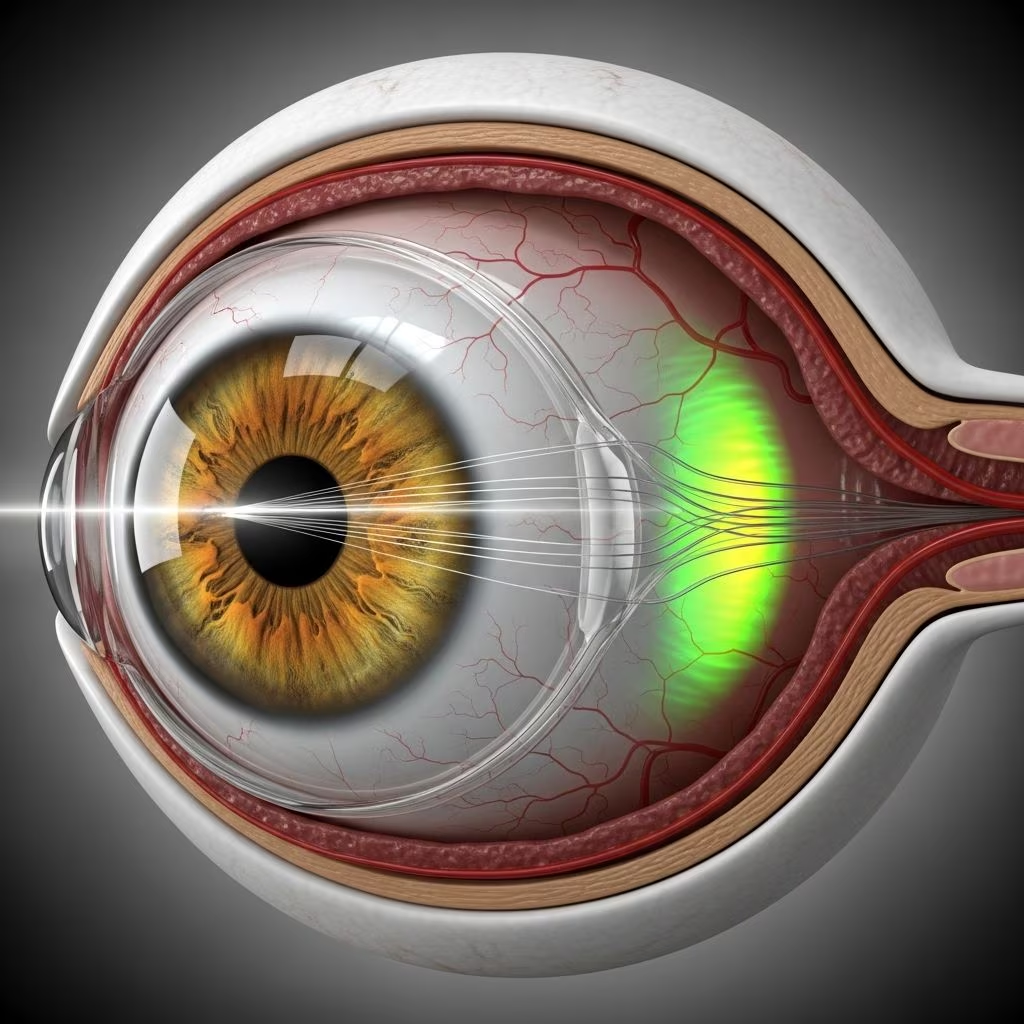
The feline eye represents one of nature’s most sophisticated optical systems, refined through millions of years of evolution to support cats’ predatory lifestyle. Unlike human vision, which relies heavily on daytime acuity, the cat’s visual apparatus has been engineered for nocturnal hunting, rapid movement detection, and exceptional low-light performance. Understanding the architectural design of feline eyes provides insight into why cats are such formidable hunters and how their vision differs fundamentally from our own.
The Protective Framework: Housing the Visual Organs
The eye does not exist in isolation but is housed and protected by a sophisticated bony structure. The orbit is a specialized cavity formed by multiple skull bones that creates a secure socket for the eyeball. This protective chamber serves multiple functions beyond simple containment. The orbit accommodates not only the eyeball itself but also the muscles that control eye movement, nerves that transmit visual signals, blood vessels that supply oxygen and nutrients, and the anatomical structures responsible for producing and draining tears.
The orbital design in cats reflects their evolutionary needs. The relatively forward-facing positioning of the orbits enables enhanced binocular vision—the overlap of visual fields from both eyes—which is critical for judging distance and speed during hunting. This is particularly important when stalking prey or leaping to capture moving targets.
Layered Architecture: The Three Tunics of the Feline Eye
The eyeball itself is not a simple sphere but rather a complex structure composed of three distinct tissue layers, each with specialized functions. These concentric layers, known as tunics, work in concert to capture, focus, and process light.
The Outer Fibrous Layer
The outermost tunic comprises two primary components. The sclera forms the structural backbone of the eye, providing rigidity and shape. Commonly referred to as the white of the eye in humans, the sclera in cats appears similarly but is largely obscured by the protective conjunctival membrane. The sclera is composed of tough, fibrous tissue that resists penetration and maintains the eye’s spherical form under internal pressure.
The cornea represents the transparent anterior portion of this outer layer. Unlike the opaque sclera, the cornea is crystal clear, allowing light to pass unimpeded into the eye’s interior. Beyond its optical transparency, the cornea performs critical protective and refractive functions. It shields the internal structures from environmental debris, UV radiation, and mechanical trauma while also contributing significantly to the eye’s focusing power by bending incoming light rays.
The Middle Vascular Layer
The middle tunic, frequently called the uveal tract or vascular tunic, is substantially thicker than the outer layer and contains the eye’s blood supply. This layer comprises three interconnected structures, each contributing to visual function.
The choroid is a thin but richly vascularized layer that lies immediately behind the retina. This network of blood vessels supplies oxygen and nutrients to the retina’s outer layers, sustaining the metabolically demanding photoreceptor cells. The choroid’s dark pigmentation absorbs excess light, preventing internal reflection that could degrade image quality—a function similar to the black interior of a camera.
The ciliary body serves dual purposes within the vascular layer. This muscular structure produces aqueous humor, the clear fluid that maintains eye pressure and nourishes the cornea and lens. Additionally, the ciliary body contains muscles that alter lens shape for focusing. In cats, this accommodation mechanism appears more limited than in humans or dogs, reflecting their evolutionary adaptation to hunting moving prey at varying distances.
The iris is the colored, circular structure that controls light admission. Cats typically have green, yellow, or amber irises, though colors vary among individuals. The iris functions as an automatic diaphragm, expanding to admit more light in darkness and contracting to restrict light in bright conditions. Notably, the feline iris can constrict into a narrow vertical slit under intense illumination, providing exceptional protection to the light-sensitive retina.
The Inner Nervous Layer
The innermost tunic is the retina, a thin, light-sensitive tissue that performs the critical function of converting optical images into electrical signals. The retina contains millions of specialized photoreceptor cells organized in layers that work in concert to detect light and transmit visual information to the brain via the optic nerve.
The Optical Pathway: Light’s Journey Through the Eye
Vision begins when light reflects from an object and enters the eye. The cornea initially refracts (bends) these light rays, directing them toward the pupil. The pupil, the black opening in the iris’s center, acts as a variable aperture that controls light quantity. Following passage through the pupil, light continues through the lens, a soft, transparent, spherical structure suspended behind the iris.
The lens fine-tunes the focus of light rays to ensure they converge sharply on the retina. In cats, specialized ciliary muscles contract to thicken the lens for near vision and relax to thin it for distant focus. Behind the lens lies the vitreous chamber, filled with vitreous humor—a gel-like substance that maintains the eye’s shape while allowing light to pass unobstructed.
Light finally reaches the retina, where the real work of vision occurs. The retina’s photoreceptor cells, classified as rods and cones, detect photons and initiate neural signals. Rods excel in dim light conditions, enabling cats’ legendary night vision, while cones function best in brighter environments and mediate color perception.
Specialized Feline Visual Adaptations
Superior Night Vision Mechanisms
Cats possess several anatomical features that confer exceptional nocturnal vision. The relative size of the cornea and pupil in cats exceeds that found in human or canine eyes, allowing substantially more light to reach the retina. Additionally, cats have evolved with a heightened rod-to-cone ratio in their retinas, creating a visual system optimized for low-light detection rather than color discrimination or fine detail.
A specialized structure known as the area centralis represents the region of highest visual acuity on the feline retina. This densely packed region contains thousands of tightly arranged photoreceptors, enabling sharp image formation in the cat’s central visual field. The area centralis is strategically positioned to capture images of moving prey during hunting.
The Third Eyelid System
Cats possess an anatomical feature absent in humans: a third eyelid or nictitating membrane. This additional protective structure originates from the inner corner of the eye and contains cartilaginous support and its own tear gland. The third eyelid provides supplementary protection to the eye surface and helps distribute tears across the cornea, maintaining moisture and optical clarity.
Supporting Protective Structures
Beyond the eyeball itself, several ancillary structures maintain ocular health and comfort. The eyelids—upper, lower, and the aforementioned third eyelid—are extensions of facial skin designed to protect the eye from mechanical trauma and environmental irritants. The inner surface of each eyelid is lined with the conjunctival membrane, a thin, vascularized tissue that also covers the visible portion of the sclera.
The lacrimal system produces and distributes tears across the eye surface. Tears serve multiple functions: they provide lubrication, supply oxygen and nutrients, contain antimicrobial compounds, and maintain the eye’s optical surface. The lacrimal system comprises the primary tear gland, the gland within the third eyelid, and a drainage system that channels tears toward the nasal cavity.
The Physiology of Feline Vision
The mechanics of vision extend beyond optics to encompass neural processing. When light strikes the retina’s photoreceptor cells, it triggers a photochemical cascade that generates electrical impulses. These signals are processed through multiple layers of retinal neurons before being bundled together to form the optic nerve. This nerve fiber bundle transmits visual information from each eye to the brain at remarkable speed.
The brain receives these electrical signals and reconstructs them into a coherent, upright visual image. Interestingly, the image projected onto the retina is actually inverted; the brain’s visual cortex performs the correction that allows cats (and humans) to perceive the world right-side up. The brain also integrates information from both eyes, enabling the depth perception and spatial awareness that makes cats such precise hunters.
How Feline Eyes Differ from Human Vision
| Visual Feature | Cats | Humans |
|---|---|---|
| Low-light sensitivity | Exceptional; rod-dominant retina | Limited; requires ambient light |
| Color vision | Limited; fewer cones | Full trichromatic vision |
| Pupil shape | Vertical slit when constricted | Circular |
| Field of view | Approximately 200 degrees | Approximately 180 degrees |
| Motion detection | Highly sensitive to movement | Moderate sensitivity |
| Lens accommodation | Limited; optimized for hunting | Broad range; versatile focus |
Frequently Asked Questions About Feline Eye Anatomy
Why do cats’ eyes glow in the dark?
Cats possess a specialized reflective layer called the tapetum lucidum, which lies beneath the retina. This mirror-like structure reflects light back through the photoreceptors, essentially giving them a second chance to absorb photons. This adaptation dramatically enhances night vision but is not explicitly detailed in most anatomical descriptions of the layered eye structure.
Can cats see color?
Yes, but their color vision is significantly more limited than humans’. While humans possess three types of cone cells (enabling perception of red, green, and blue), cats have fewer cone types. Research suggests cats perceive colors in the blue and yellow spectrum but may struggle to distinguish reds and greens, which appear more as shades of gray or brown.
Why do cats have vertical slit pupils?
The vertical slit pupil provides cats with superior light control compared to circular pupils. In bright conditions, the slit can constrict to an extremely narrow opening, protecting the light-sensitive retina from excessive illumination. In darkness, the slit dilates to become nearly round, maximizing light entry. This design offers cats greater precision in adapting to extreme variations in light intensity.
How does the third eyelid function?
The third eyelid passively sweeps across the eye surface as the eyeball retracts slightly into the orbit, particularly during sleep or relaxation. This action distributes tears, removes debris, and provides additional protection. A swollen or protruding third eyelid often indicates ocular discomfort or systemic illness and warrants veterinary evaluation.
Clinical Significance of Feline Eye Anatomy
Understanding normal feline eye anatomy is essential for recognizing abnormalities. Many common feline eye conditions—such as glaucoma, uveitis, and retinal degeneration—can be understood only through knowledge of normal anatomy. The specialized adaptations that give cats superior hunting vision also create unique vulnerabilities to certain diseases. For instance, cats’ large eyes relative to their skull size and their limited lens accommodation can predispose them to specific pathological conditions that require species-specific diagnostic and therapeutic approaches.
References
- Structure and Function of the Eyes in Cats — PetPlace. https://www.petplace.com/article/cats/pet-health/structure-and-function-of-the-eyes-in-cats
- Eye Structure and Function in Cats – Cat Owners — MSD Veterinary Manual. https://www.msdvetmanual.com/cat-owners/eye-disorders-of-cats/eye-structure-and-function-in-cats
- Eye Structure and Function in Cats — My Lovely Feline. https://mylovelyfeline.com/blogs/content/eye-structure-and-function-in-cats
- Eye Structure and Function in Cats – Cat Owners — Merck Veterinary Manual. https://www.merckvetmanual.com/cat-owners/eye-disorders-of-cats/eye-structure-and-function-in-cats
- Examination of the feline eye – functional anatomy — British Veterinary Nursing Association. https://bvna.org.uk/blog/examination-of-the-feline-eye-functional-anatomy-by-natasha-mitchell/
- Eye problems in cats – an overview — People’s Dispensary for Sick Animals (PDSA). https://www.pdsa.org.uk/pet-help-and-advice/pet-health-hub/symptoms/eye-problems-in-cats



