

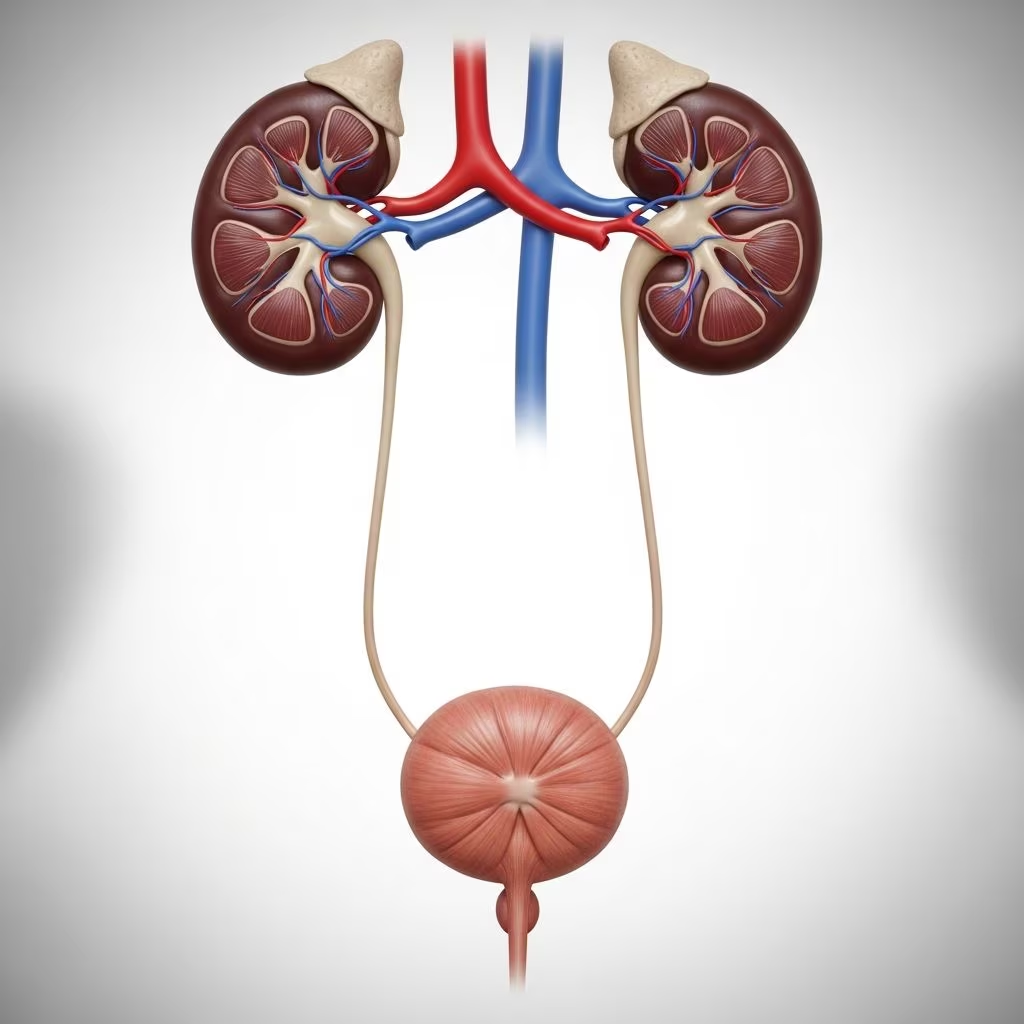
The urinary system in cats plays a pivotal role in maintaining overall health by filtering waste, regulating fluids, and ensuring proper electrolyte balance. Comprising kidneys, ureters, bladder, and urethra, this system efficiently processes blood to produce urine, which is then stored and expelled. Understanding its components and operations empowers cat owners to spot early signs of trouble and promote wellness.
Anatomy of the Cat’s Urinary Organs
Cats possess a sophisticated urinary apparatus designed for efficiency in a compact body. The kidneys, ureters, bladder, and urethra form a coordinated network that handles filtration and excretion seamlessly.
Kidneys: The Filtration Powerhouses
Positioned along the abdomen near the spine, just below the last ribs, the two bean-shaped kidneys are the starting point of urine production. Each kidney features a hilus, an indented area where blood vessels, nerves, and ureters connect. Inside, millions of nephrons—tiny functional units—perform the critical task of blood filtering.
Nephrons include a glomerulus, a cluster of capillaries that initially filters blood, and a renal tubule that refines the filtrate by reabsorbing essentials like water and salts while secreting wastes. Urine collects in the kidney’s pelvis before moving onward. Cats have a unique renal structure with a renal crest formed by fused papillae, aiding efficient drainage into the pelvis.
Ureters: Transport Channels
Thin, muscular tubes called ureters carry urine from each kidney to the bladder. Peristaltic contractions propel urine in spurts, preventing backflow through their oblique entry into the bladder wall. This design includes a natural valve mechanism.
Bladder: Storage Reservoir
The urinary bladder, a muscular sac in the lower abdomen ahead of the pelvis, expands to hold urine until voiding. Ligaments anchor it securely. A sphincter muscle at the outlet maintains continence, relaxing only on command via neural signals.
Urethra: Exit Pathway
The urethra differs markedly between sexes: short in females, ending near the vagina, and longer in males, traversing the penis. This variation affects disease susceptibility, with males prone to blockages. Innervation from the pelvic plexus and pudendal nerve controls sphincter function.
Key Functions of the Urinary System
Beyond waste elimination, the feline urinary system regulates body fluids, blood pressure, and pH balance, making it vital for homeostasis.
- Waste Removal: Kidneys filter out urea, creatinine, and toxins from protein metabolism, excreting them in urine.
- Fluid and Electrolyte Balance: Nephrons reabsorb water and ions like sodium and potassium, adjusting to dietary and hydration needs.
- Hormone Production: Kidneys secrete erythropoietin for red blood cell production and activate vitamin D for bone health.
- Acid-Base Regulation: Collecting ducts fine-tune pH by excreting hydrogen ions or bicarbonate.
The loop of Henle in nephrons creates a concentration gradient, enabling cats to produce highly concentrated urine, conserving water—a key adaptation for their obligate carnivore lifestyle.
Nephron Mechanics: Urine Formation Process
Urine creation occurs in three phases within the nephron: glomerular filtration, tubular reabsorption, and secretion.
- Filtration: Blood enters via afferent arterioles to the glomerulus, where pressure forces plasma (minus cells and proteins) into Bowman’s capsule, forming filtrate.
- Reabsorption: Proximal tubule reclaims 65% of water, sodium, glucose, and amino acids. Loop of Henle handles further water and salt adjustments; distal tubule and collecting ducts respond to hormones like ADH and aldosterone.
- Secretion: Additional wastes like drugs and excess potassium are actively transported into the tubule.
This yields concentrated urine that travels via collecting ducts to minor calyces, major calyces, renal pelvis, and ureters.
| Aspect | Male | Female |
|---|---|---|
| Length | Longer (10-20 cm) | Shorter (3-4 cm) |
| Diameter | Narrower, prone to obstruction | Wider, less blockage risk |
| Location | Through penis | Ends in vestibule |
| Disease Risk | High for crystals/stones | Higher for infections |
Common Urinary Challenges in Cats
Disruptions can lead to serious issues. Feline lower urinary tract disease (FLUTD) encompasses inflammation, stones, or blockages affecting bladder and urethra.
- Infections: Bacteria ascend the urethra, more common in females due to anatomy.
- Crystals and Stones: Struvite or calcium oxalate form in urine, blocking males severely.
- Incontinence: Sphincter weakness or nerve issues cause leaking.
- Kidney Disease: Chronic damage impairs filtration, leading to toxin buildup.
Symptoms include straining, blood in urine, frequent small voids, or no urination—emergencies requiring vet care.
Daily Care for Urinary Wellness
Proactive steps support this system:
- Provide constant fresh water, consider fountains to boost intake.
- Feed balanced diets; prescription foods dissolve stones or acidify urine.
- Maintain clean litter boxes (multiple per cat plus one extra).
- Monitor weight and urination habits; annual vet checkups catch issues early.
- Stress reduction via enrichment prevents idiopathic cystitis.
Diagnostic Approaches
Vets use urinalysis for crystals/infections, bloodwork for kidney markers (BUN, creatinine), imaging (ultrasound/X-rays) for stones/bladder issues, and sometimes cystoscopy.
Frequently Asked Questions (FAQs)
Why do male cats get urinary blockages more often?
Their narrow, longer urethra easily clogs with crystals or plugs, a life-threatening emergency.
How much should my cat urinate daily?
Typically 2-4 times, producing 20-50 ml/kg body weight; changes signal problems.
Can diet influence urinary health?
Yes, moisture-rich foods and specific nutrients prevent stone formation.
What are signs of kidney failure?
Increased thirst/urination, vomiting, lethargy, poor appetite.
Is urinary incontinence common in cats?
Rare, often from diabetes, infections, or age-related sphincter decline.
Advanced Insights: Innervation and Blood Supply
Sympathetic/parasympathetic nerves from the pelvic plexus regulate bladder contraction and urethral tone. Blood arrives via renal arteries branching to glomeruli, with efferent arterioles sustaining peritubular capillaries for reabsorption.
Cats’ ability to concentrate urine up to 4 times plasma osmolality aids desert ancestry survival, but modern indoor life increases dilute urine risks for stones.
References
- Structure and Function of the Urinary Tract in Cats — PetPlace. Accessed 2026. https://www.petplace.com/article/cats/pet-health/structure-and-function-of-the-urinary-tract-in-cats
- The Urinary System of Cats — MSD Veterinary Manual. Accessed 2026. https://www.msdvetmanual.com/cat-owners/kidney-and-urinary-tract-disorders-of-cats/the-urinary-system-of-cats
- Urinary Anatomy of the Dog and Cat (VETERINARY TECHNICIAN) — YouTube (Veterinary Technician Video). Accessed 2026. https://www.youtube.com/watch?v=0VD8zXQww7Q
- The Canine and Feline Urinary System — RadioKopVet. Accessed 2026. https://radiokopvet.co.za/the-canine-and-feline-urinary-system/
- Applied anatomy and physiology of the feline lower urinary tract — PubMed (Peer-reviewed). 1996-07-01. https://pubmed.ncbi.nlm.nih.gov/8711856/



