

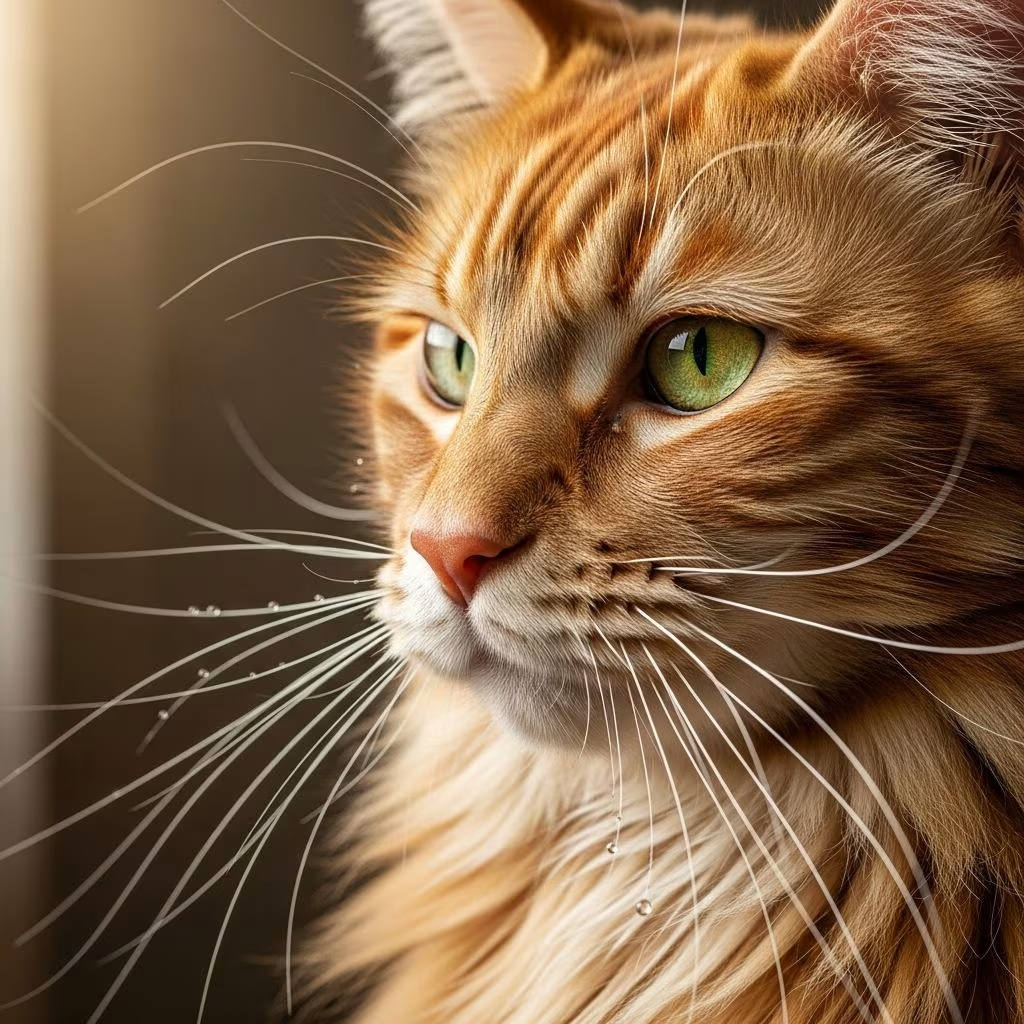
When we think about what makes cats remarkable, we often consider their agility, independence, or mysterious nature. Yet one of their most fascinating—and least discussed—features lies in a seemingly simple detail: their whiskers. These delicate sensory organs serve far more than aesthetic purposes, functioning as critical biological instruments that help cats navigate their environment with precision. In the animal kingdom, certain felines have developed whiskers of truly exceptional proportions, earning them recognition in prestigious record books and capturing the imagination of cat enthusiasts worldwide.
The story of extraordinary cat whiskers extends beyond mere curiosity; it represents a unique intersection of genetics, breed characteristics, and individual variation. Among the countless cats living around the globe, a select few have demonstrated whisker growth that defies typical expectations, pushing the boundaries of what we thought possible for these sensory appendages.
The Biological Marvel Behind Feline Whiskers
Before diving into the records themselves, understanding the biological function of cat whiskers provides crucial context for appreciating why these structures matter so profoundly. Whiskers, scientifically known as vibrissae, are far more than decorative facial features. Each whisker contains specialized nerve endings at its base, connecting directly to a cat’s nervous and muscular systems. This sophisticated neural network enables cats to perceive minute vibrations in air currents, detect nearby objects, and gauge spatial relationships with remarkable accuracy.
The sensory capabilities provided by whiskers are essential for feline survival and daily functioning. These specialized hairs help cats determine whether they can fit through confined spaces, sense approaching dangers, and maintain balance during movement. In low-light conditions where vision becomes less effective, whiskers become even more critical, allowing cats to navigate confidently through darkness. The follicles at the base of each whisker contain proprioceptors—sensory receptors that provide constant feedback about the cat’s environment and position in space.
Most domestic cats possess approximately 24 whiskers arranged in four rows on their muzzle, though individual variation exists. The typical length of a cat’s whisker is proportional to their body width, serving as a biological measuring tool. However, in exceptional cases, some cats develop whiskers that far exceed these standard proportions, creating remarkable variations that catch scientific attention.
Missi: The Finnish Feline with Record-Breaking Whiskers
The undisputed champion of whisker length belongs to a remarkable Maine Coon named Missi, whose full registered name is Fullmoon’s Miss American Pie. Missi holds the official Guinness World Record for the longest whisker ever recorded on a domestic cat. Her owner, Kaija Kyllönen, brought Missi to be measured in Iisvesi, Finland, in 2005, where officials documented a single whisker measuring an astounding 7.5 inches (approximately 19 centimeters).
To put this extraordinary measurement into perspective, Missi’s whisker is longer than a standard pencil and nearly three times the length of an average cat whisker. This exceptional growth represents a significant outlier even among Maine Coons, a breed already known for their larger-than-average size and physical characteristics. The record has stood for over two decades, remaining unbroken despite countless cats living throughout the intervening years.
Maine Coons, the breed to which Missi belongs, are naturally among the largest domestic cat breeds, with robust frames and prominent facial features. Their substantial body structure correlates with generally longer whiskers than smaller breeds, yet even within this context, Missi’s whisker length represents an exceptional occurrence. Genetic factors, individual variation, and possibly unique nutritional conditions during her growth phase may have contributed to this remarkable development.
Beyond her record-breaking whisker, Missi represents a broader phenomenon of distinctive cats earning recognition for unusual physical characteristics. Her fame reflects humanity’s enduring fascination with nature’s variations and the extremes found within species we thought we understood completely.
Notable Whisker-Bearing Felines: Britain’s Remarkable Homeless Cat
While Missi may hold the official world record, another extraordinary feline captured hearts and attention across the United Kingdom. A formerly homeless cat named Whiskers—aptly named for her most distinguishing feature—became famous for possessing what many believe to be Britain’s longest whiskers. Discovered and cared for by the Cats Protection charity at just two years old, Whiskers displayed whiskers spanning an impressive 12 inches in length.
What made Whiskers particularly striking was not only the length of her whiskers but their appearance. Her stark-white whiskers created a striking contrast against her dark coat, making them immediately noticeable and visually impressive. This color contrast enhanced her distinctive appearance and contributed to her becoming a beloved figure within the British cat rescue community.
Whiskers’ story differs from Missi’s in an important way: her path to recognition began from homelessness rather than from a registered pedigree breeding program. Her journey from street cat to record holder demonstrates that extraordinary physical characteristics can appear in any cat, regardless of breeding or background. Her recognition brought attention not only to whisker anomalies but also to the plight of homeless animals and the importance of rescue organizations like Cats Protection.
The Extended Universe of Record-Holding Felines
Missi and Whiskers occupy prominent positions in the broader landscape of feline record holders, cats who have achieved recognition for various extraordinary attributes. Understanding these other records provides context for appreciating how unique the whisker phenomenon truly is.
Size Champions: Length and Height Records
The longest domestic cat living today is Barivel, a Maine Coon residing in Italy, who measures 3 feet and 11.2 inches from head to tail. However, the record for the longest cat ever documented belongs to another Maine Coon: Mymains Steward Gilligan, nicknamed Stewie, from Nevada. In 2010, Stewie stretched to an incredible length of 4 feet and 0.42 inches.
When measuring height rather than length, the title goes to Arcturus Aldebaran Powers from Michigan, who measured 1 foot and 7 inches from floor to shoulder. These length and height records demonstrate that Maine Coons consistently dominate size-based categories, suggesting that Missi’s whisker-length record may partially reflect her breed’s natural tendency toward larger proportions.
The Smallest: A Whisker-Length Comparison
Interestingly, the world’s smallest cat ever recorded was a male blue-point Himalayan Persian named Tinker Toy from Illinois. This tiny feline measured just 2.75 inches high to the shoulder and only 7.5 inches long—precisely the same length as Missi’s record-breaking whisker. This striking comparison illustrates the vast range of feline sizes and highlights how truly extraordinary Missi’s whisker achievement becomes when considered against the smallest cat in history.
The current smallest cat record holder is Lilieput, a Munchkin cat from California, measuring 5.25 inches in height. Munchkins, a relatively recent breed developed for their distinctively short legs, represent intentional breeding for size reduction, contrasting with the natural proportional gigantism of Maine Coons.
Wealth and Fame: Unconventional Records
Beyond physical characteristics, some cats have achieved record status through accumulated wealth or fame. Blackie, a British cat, became the world’s richest cat after inheriting £7 million from his owner, antique dealer Ben Rea, when Rea passed away in 1988. This substantial inheritance made Blackie one of the most financially privileged animals in history.
However, Blackie’s fortune may soon be eclipsed. Grumpy Cat, whose real name was Tardar Sauce, became a viral internet sensation in the 2010s. The Arizona-based cat’s distinctive underbite and perpetually grumpy expression spawned memes, merchandise, books, sponsorships, and even a movie. Throughout her lifetime, Grumpy Cat accumulated an estimated fortune of around $100 million, potentially making her the wealthiest cat in recorded history.
Why Whiskers Matter: Understanding Sensory Importance
The significance of whiskers extends far beyond record-breaking length. These sensory organs represent one of the cat’s most important biological tools for navigating and understanding the world. Each whisker functions similarly to an insect’s antennae, providing constant sensory input about the environment.
The sensory function of whiskers becomes particularly crucial in several contexts:
- Spatial Navigation: Whiskers help cats determine whether they can fit through narrow openings by measuring distances and evaluating clearances.
- Nocturnal Vision Compensation: In dim lighting or darkness, whiskers compensate for reduced visual acuity, allowing cats to move confidently through low-light environments.
- Danger Detection: The sensitive follicles detect subtle air current changes, alerting cats to nearby movements or approaching threats.
- Balance and Coordination: Proprioceptive feedback from whisker follicles contributes to the cat’s remarkable balance and agility.
- Distance Judgment: Whiskers help cats accurately assess distances to objects, essential for hunting and precise movement.
Given these critical functions, trimming or cutting a cat’s whiskers can severely impair their sensory capabilities and confidence. A cat with damaged whiskers may become disoriented, hesitant in movement, and less effective at navigating their environment. This biological reality underscores why even extraordinarily long whiskers—like Missi’s—should never be trimmed or artificially altered.
Breed Characteristics and Whisker Development
The prominence of Maine Coons in whisker-related records raises important questions about breed predisposition. Maine Coons, originally developed in the northeastern United States as working cats for farms and ships, evolved larger body frames suited to harsh climates. Their size correlates with proportionally longer whiskers, which would have provided enhanced sensory advantages for their original working roles.
However, not all Maine Coons develop exceptionally long whiskers. Missi’s 7.5-inch whisker remains extraordinary even within her breed. This suggests that individual genetic variation, possibly influenced by specific hereditary factors within her lineage, contributed to her exceptional whisker growth.
Other breeds, such as the Himalayan Persian that produced Tinker Toy, represent different evolutionary pressures and selective breeding objectives. Himalayans were developed for aesthetic characteristics rather than working ability, resulting in different proportional relationships between body size and sensory organ development.
The Mystery of Record-Breaking Variations
What causes certain cats to develop whiskers or other physical characteristics so dramatically different from their peers? The answer involves a complex interplay of genetics, nutrition, environmental factors, and individual variation.
Genetic predisposition likely plays the primary role. Cats inheriting genes promoting larger body size and proportionally longer sensory organs would naturally develop longer whiskers. Missi’s whiskers may reflect a particular combination of genes within her lineage that promoted extended whisker growth.
Nutritional factors during growth phases may also influence whisker development. Optimal nutrition supports healthy, robust whisker growth, while deficiencies might limit development. Missi’s owner likely provided excellent care and nutrition, supporting maximal whisker development within her genetic potential.
Environmental stimulation and stress levels might also play roles, though these factors remain less studied in feline whisker development. Cats living in enriched, low-stress environments generally show better overall health markers, potentially supporting more robust physical development.
Frequently Asked Questions About Cat Whiskers and Records
How do whisker lengths get officially measured and verified?
Official Guinness World Record measurements follow strict protocols ensuring accuracy and preventing disputes. Measurements typically occur under witnessed conditions with standardized tools, creating verifiable documentation. Missi’s 2005 measurement in Finland followed such procedures, establishing the credibility of her record.
Can indoor cats develop longer whiskers than outdoor cats?
Whisker length depends primarily on genetics and breed rather than indoor versus outdoor living. However, indoor cats may develop longer, less damaged whiskers since they avoid environmental wear and injury risks that outdoor cats experience. Indoor cats also receive consistent nutrition and veterinary care, supporting optimal whisker development.
Do all Maine Coons have particularly long whiskers?
While Maine Coons generally have longer whiskers than many breeds due to their larger size, not all individuals develop exceptionally long whiskers. Missi represents an extreme outlier even within her breed, demonstrating that individual variation exists substantially.
What should cat owners do about their pet’s whiskers?
Cat owners should never trim, cut, or intentionally alter their cat’s whiskers. These sensory organs are essential for feline wellbeing and spatial awareness. Allowing whiskers to grow naturally—however long they may become—respects the cat’s biological needs and sensory capabilities.
Are there safety concerns with extremely long whiskers?
Cats with exceptionally long whiskers navigate their environments successfully using those whiskers’ sensory feedback. The whiskers themselves don’t pose safety risks; rather, they enhance safety by improving spatial awareness. Missi managed her extraordinary whiskers without documented problems throughout her life.
Celebrating Feline Individuality and Uniqueness
The story of Missi and other record-holding cats reminds us that individual variation within species creates remarkable diversity. These exceptional felines demonstrate that nature produces extremes and outliers that challenge our assumptions about normal parameters.
Missi’s whisker record, standing unchallenged for more than two decades, represents an achievement unlikely to be surpassed soon. Her legacy extends beyond a simple measurement; it represents the recognition that individual cats—whether purebred champions or rescued street cats like Whiskers—deserve acknowledgment and appreciation for their unique characteristics.
As cat enthusiasts continue observing their feline companions, perhaps somewhere, another cat with remarkable whiskers is growing, unaware that their sensory organs might one day challenge Missi’s long-standing record. Until that day comes, if ever, Missi the Maine Coon remains the undisputed queen of feline whisker achievement, her 7.5-inch whisker a testament to the incredible diversity found within our beloved cat species.
References
- Longest Cat Whiskers in the World: 2026 Record Holders — Catster. https://www.catster.com/lifestyle/longest-cat-whiskers-in-the-world/
- 5 Amazing Cat World Records — Petplan UK. https://www.petplan.co.uk/cat-insurance/cat-care-and-advice/cat-world-records.html
- 6 Amazing Guinness World Record-breaking Cats — Cats Protection. https://www.cats.org.uk/cats-blog/6-guinness-world-record-breaking-cats



