

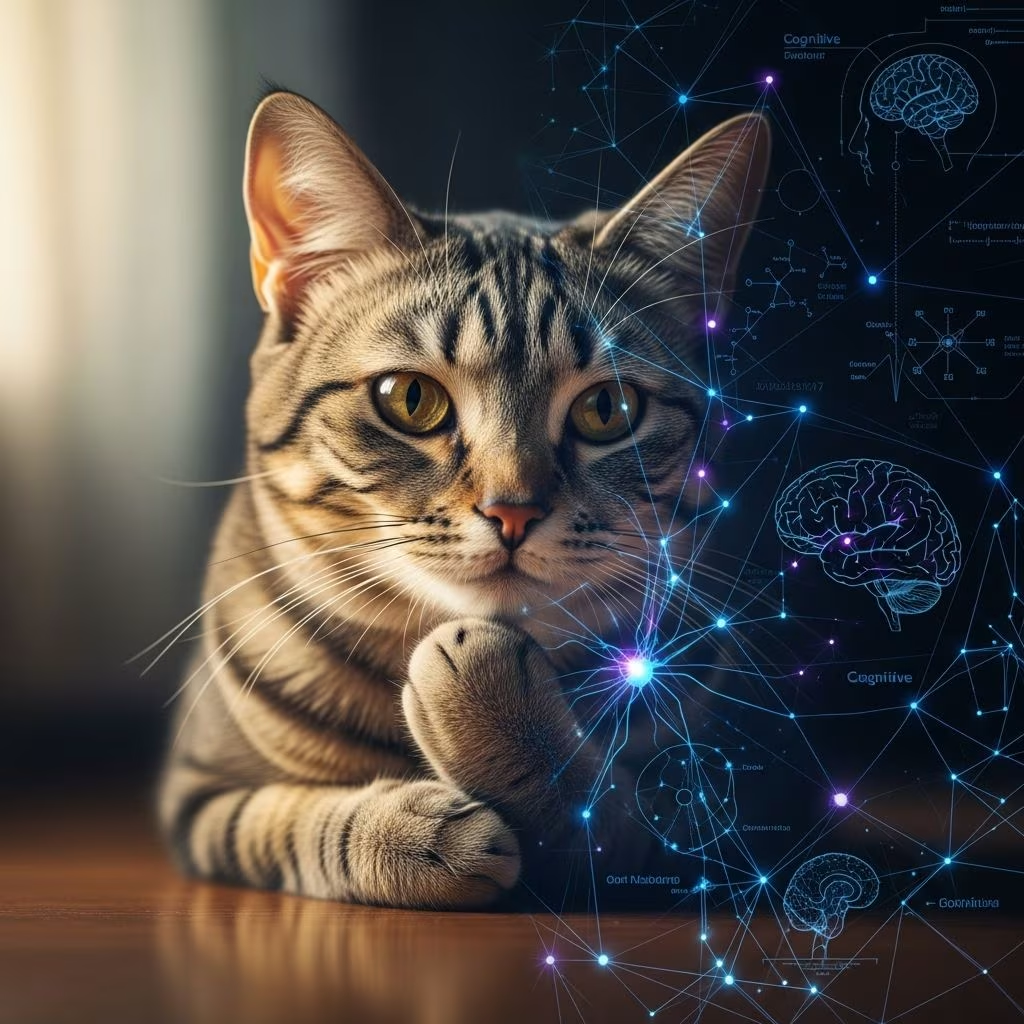
The question of whether cats possess self-awareness has fascinated researchers and pet owners alike for decades. Unlike humans who recognize themselves in mirrors and possess a clear sense of identity, cats display far more ambiguous responses when confronted with their own reflections. Scientific investigation into feline cognition has yielded intriguing, though often inconclusive, findings about the depths of cat consciousness and self-recognition capabilities.
Understanding Self-Awareness in Animals
Self-awareness represents a complex cognitive ability involving the recognition that one’s body, thoughts, and actions are distinct from others. In humans, this develops gradually during early childhood and becomes a fundamental aspect of consciousness. For animals, determining self-awareness presents significant methodological challenges because researchers must rely on behavioral indicators rather than verbal communication.
Animal behaviorists distinguish between different forms of self-recognition. The most commonly tested form involves visual self-recognition, where an animal identifies itself in a mirror. However, researchers increasingly recognize that the ability to pass traditional mirror tests may not encompass all forms of self-awareness, particularly for species that rely on different sensory modalities.
The Mirror Test: A Window Into Feline Recognition
The mirror self-recognition test has served as the primary tool for assessing self-awareness in animals since the 1970s. In this test, researchers observe how animals respond when viewing their own reflections. Species that demonstrate self-awareness typically show self-directed behaviors, such as examining marks placed on their bodies or grooming themselves in front of the mirror.
When domestic cats encounter mirrors, their responses fall into several distinct categories. Behavioral analysis of cats interacting with reflections reveals a complex pattern of reactions:
- Aggressive responses, where cats perceive the reflection as another cat and display defensive behaviors
- Curious exploration, involving approaches to the mirror, attempting to look behind it, or pawing at the glass
- Complete indifference, where cats simply ignore their reflection entirely
- Social reactions, treating the reflection as if it were another individual cat
Research examining over 200 cats across multiple videos found that approximately 45.6% of cats displayed aggressive behaviors toward their reflections, while about 49.1% showed curious, exploratory responses. This distribution suggests considerable individual variation in how cats respond to their own images, indicating that personality factors and prior experiences may influence these reactions.
What Cognitive Limitations Reveal About Cats
The generally accepted scientific consensus indicates that cats fail the traditional mirror self-recognition test. Most cats cannot establish a cognitive connection between their reflection and their own body. This cognitive limitation directly impacts their understanding of abstract concepts and their ability to recognize themselves as distinct entities with physical characteristics.
However, researchers caution against interpreting mirror test failures as evidence of complete cognitive inferiority. Cats may simply process self-recognition differently than primates or other species traditionally studied. The visual modality may be less significant for cats compared to other sensory channels they rely upon more heavily, such as olfactory or tactile information.
Studies examining cats’ awareness of their own body size provide additional insights into feline cognition. When researchers tested whether cats demonstrated hesitation before attempting to navigate through narrow apertures, cats showed remarkably little caution. Unlike dogs, which exhibited clear hesitation before trying to squeeze through openings smaller than their body width, cats appeared relatively indifferent to spatial constraints. This suggests that cats may not maintain detailed mental representations of their own physical dimensions.
The Role of Sensory Preferences in Self-Recognition
A critical consideration in evaluating feline self-awareness involves recognizing that cats may not rely primarily on visual cues for self-identification. Cats possess highly developed olfactory and tactile senses, which play dominant roles in their understanding of their environment and themselves.
Rather than visual mirrors, cats likely identify themselves through scent marking and tactile feedback. This sensory preference suggests that cats may indeed possess forms of self-awareness that existing mirror tests simply fail to detect. A cat that rubs its face against objects or engages in grooming may be asserting individual identity through mechanisms entirely different from visual self-recognition.
The distinction between different types of self-awareness becomes crucial here. Body awareness—understanding one’s physical form and its capabilities—may operate independently from visual self-recognition. Cats clearly understand their bodies’ abilities, as evidenced by their remarkable jumping accuracy, careful navigation through tight spaces when properly motivated, and precise hunting coordination.
Behavioral Indicators of Cognitive Complexity
Beyond mirror tests, cats demonstrate sophisticated cognitive abilities that suggest complex mental processes. Research published in the journal Animal Cognition reveals that cats exhibit remarkable problem-solving skills and display behaviors indicative of higher-order thinking.
These cognitive capabilities include:
- Planning and anticipatory behavior when hunting or pursuing prey
- Learning through observation and imitation of other cats or humans
- Understanding cause-and-effect relationships in their environment
- Adapting their behavior based on individual human preferences and personalities
- Remembering complex sequences of events and spatial layouts
The presence of these advanced cognitive functions suggests that cats possess at least rudimentary forms of self-awareness, even if they fail traditional mirror recognition tests. The ability to plan activities, learn from experience, and modify behavior based on anticipated consequences requires some level of self-monitoring and understanding of one’s role in the world.
Evolutionary Perspectives on Feline Consciousness
Some researchers advocate for a gradualist evolutionary perspective when considering animal self-awareness. Rather than viewing self-recognition as a binary trait that animals either possess or lack, this approach recognizes that different species may exhibit varying degrees and types of self-awareness suited to their ecological niches and evolutionary pressures.
From an evolutionary standpoint, the development of elaborate visual self-recognition may offer limited survival advantages for solitary hunters like cats. Instead, cats evolved highly sophisticated spatial awareness, sensory discrimination, and understanding of their physical capabilities—all essential for successful hunting. Their form of self-awareness, therefore, may be fundamentally different from that demonstrated by more social species.
Individual Differences and Personality Influences
An important yet often overlooked factor in self-awareness research involves individual variation among cats. Cats display distinct personalities, temperament differences, and varying levels of socialization, all of which likely influence their responses to experimental situations and mirrors.
Some cats may show greater curiosity and exploratory drive, making them more likely to investigate their reflections thoroughly. Others may demonstrate defensive or aloof temperaments, leading to aggressive responses or indifference. This individual variation complicates efforts to draw universal conclusions about feline self-awareness.
Additionally, prior experience with mirrors influences cat responses. Cats with repeated exposure to reflections may gradually modify their reactions over time, potentially developing different behavioral patterns than cats encountering mirrors for the first time. A longitudinal approach studying the same cats over extended periods might reveal progressive changes in how they respond to their reflections.
Neurological Mechanisms of Cat Awareness
Understanding whether cats possess self-awareness requires examination of the neural mechanisms supporting consciousness and recognition in feline brains. While cats have smaller brains than humans, their neural organization demonstrates remarkable sophistication, particularly in regions associated with sensory processing and spatial awareness.
The feline brain contains structures analogous to those in humans that support self-awareness and conscious experience. However, the relative size and organization of these regions differ significantly, potentially explaining why cats demonstrate self-awareness through different behavioral manifestations than humans.
Alternative Forms of Self-Recognition in Cats
Some cats display behaviors on social media platforms that suggest possible forms of self-directed awareness. Instances where cats appear to groom themselves deliberately in front of mirrors or seem to discover body parts while viewing reflections present intriguing possibilities. However, alternative explanations exist, including simple curiosity about novel stimuli or responses to unrelated environmental cues.
The challenge in interpreting these anecdotal observations lies in distinguishing genuine self-recognition from coincidental behaviors. Rigorous scientific methodology requires controlled conditions and systematic observation rather than reliance on viral videos or popular examples.
Comparing Cat Self-Awareness to Other Species
| Species | Mirror Self-Recognition | Self-Awareness Indicators | Sensory Preferences |
|---|---|---|---|
| Domestic Cats | Generally fail | Body awareness, problem-solving | Olfactory, tactile |
| Dogs | Generally fail | Body awareness, observational learning | Olfactory, auditory |
| Primates | Many species pass | Visual self-recognition, theory of mind | Visual, tactile |
| Elephants | Some pass | Complex social awareness, tool use | Visual, olfactory |
| Dolphins | Some pass | Self-directed behaviors, complex cognition | Echolocation, visual |
Frequently Asked Questions About Feline Self-Awareness
Do cats recognize themselves in mirrors?
Most scientific evidence suggests that domestic cats do not recognize themselves in mirrors in the way humans do. However, they may demonstrate other forms of body awareness and self-recognition through non-visual channels.
Can cats understand their own bodies?
Yes, cats clearly understand their physical capabilities and limitations. Their precise jumping ability, careful navigation through tight spaces, and coordinated hunting behaviors demonstrate sophisticated body awareness.
Is a cat’s failure on mirror tests evidence of low intelligence?
No. Mirror test failure does not indicate lack of intelligence. Cats may simply rely on different sensory modalities and have evolved different forms of self-awareness suited to their ecological needs.
What sensory information do cats use for self-identification?
Cats likely rely heavily on olfactory (scent) and tactile (touch) information for self-identification, rather than visual cues like humans do.
Do all cats respond the same way to mirrors?
No. Individual cats display considerable variation in how they respond to mirrors, influenced by personality, prior experience, socialization, and age.
Current State of Research and Open Questions
Despite decades of investigation, conclusive evidence regarding feline self-awareness remains elusive. While research on cat cognition provides insights into their complex minds, definitive answers about whether cats possess self-awareness similar to humans continue to elude researchers.
Future studies incorporating innovative methodologies and considering individual differences in behavior may unravel additional mysteries of feline self-awareness. Approaches that account for cats’ sensory preferences and evolutionary adaptations could yield more meaningful insights than traditional mirror tests alone.
Conclusion: The Mystery of Feline Self-Awareness
The question of cat self-awareness does not have a simple yes or no answer. Cats clearly possess complex cognitive abilities and sophisticated understanding of their bodies and environments. However, whether they possess self-awareness in the philosophical sense—a conscious recognition of themselves as distinct individuals—remains genuinely uncertain.
What seems clear is that cats experience and understand their world through mechanisms quite different from humans. Their apparent indifference to visual self-recognition may reflect not cognitive deficiency but rather different evolutionary solutions to understanding their place in their environment. As our comprehension of animal consciousness continues to evolve, cats remind us that self-awareness may manifest in diverse forms beyond the narrow parameters of traditional mirror tests.
References
- Do Cats Have Awareness of Their Own Cuteness? A Behavioral and Psychological Perspective — OreateAI. Accessed January 2026. https://www.oreateai.com/blog/do-cats-have-awareness-of-their-own-cuteness-a-behavioral-and-psychological-perspective/
- Domestic Cat Responses To Reflective Images — Animal Behavior and Cognition, Vol. 12, No. 2. https://www.animalbehaviorandcognition.org/uploads/journals/62/5%20Kim_Johns_ABC_12(2).pdf
- Exploring Feline Consciousness: Are Cats Self-Aware? — TICA (The International Cat Association). Accessed January 2026. https://tica.org/blogs/exploring-feline-consciousness-are-cats-self-aware/
- Cats are (almost) liquid!—Cats selectively rely on body size perception when navigating apertures — National Center for Biotechnology Information (NIH). 2024. https://pmc.ncbi.nlm.nih.gov/articles/PMC11519432/
- Do Cats Understand Mirrors & Their Reflection? — Hill’s Pet Nutrition. Accessed January 2026. https://www.hillspet.com/cat-care/behavior-appearance/do-cats-understand-mirrors



