

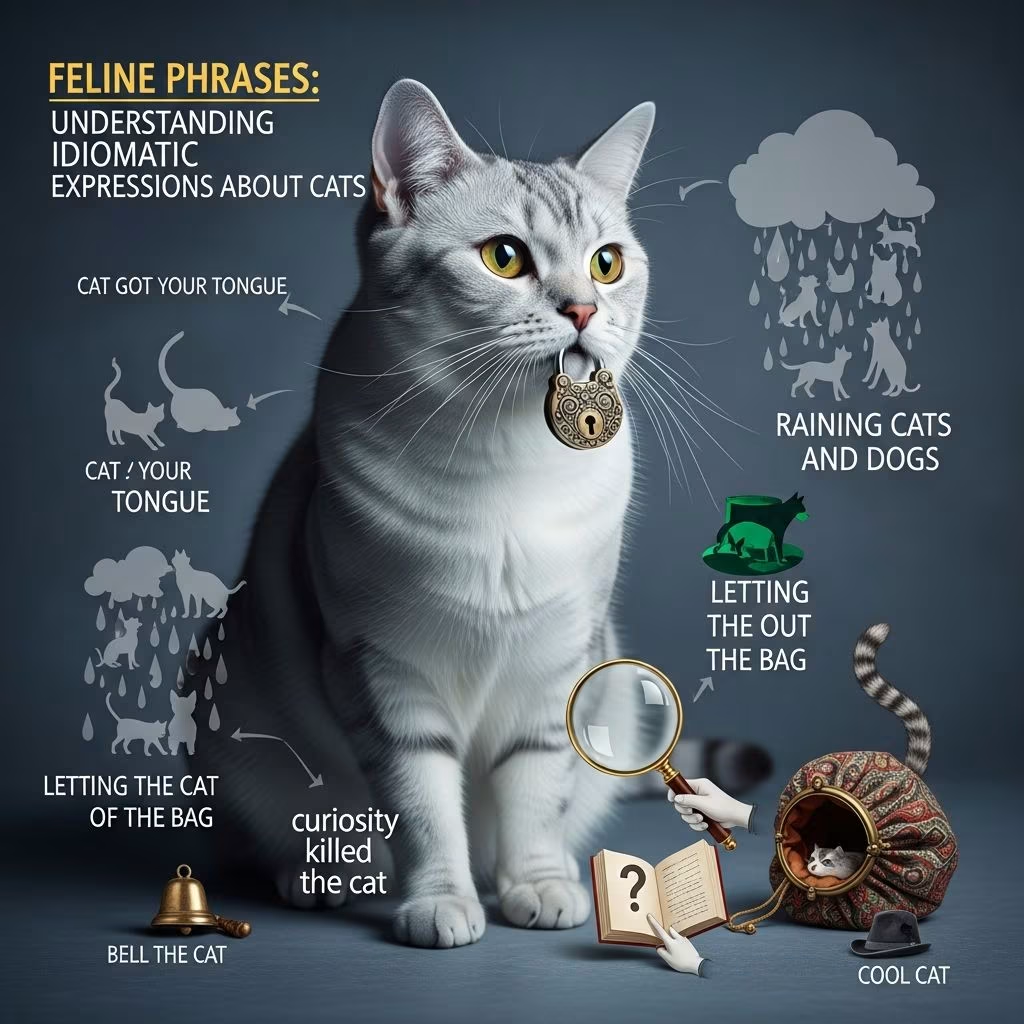
Throughout human history, cats have served as powerful symbols in our language and culture. These remarkable creatures have inspired countless expressions that remain embedded in modern conversation, yet most people never pause to consider where these phrases originated. The journey from ancient civilizations to contemporary speech reveals a fascinating tapestry of cultural practices, historical events, and evolving social trends that have shaped how we communicate about everything from secrecy to bad luck.
Our relationship with felines has evolved dramatically over millennia. What began as a practical partnership—cats controlling rodent populations in agricultural societies—eventually transformed into deep companionship and cultural reverence. This evolution is mirrored in the language we use daily, with phrases that encode centuries of human experience and observation of feline behavior.
Linguistic Connections: How Cats Shaped Our Speech
The prevalence of cat-related idioms in English and many other languages speaks to the profound impact these animals have had on human consciousness. Unlike some expressions that fade with time, cat idioms have demonstrated remarkable longevity, passing through generations while maintaining their essential meanings. This persistence suggests that these phrases tap into fundamental truths about cat behavior and human psychology.
Cats are naturally mysterious creatures, and much of our idiomatic language reflects this enigmatic quality. Their stealth, independence, and unpredictability have made them ideal metaphors for describing human situations that involve secrecy, danger, or unexpected consequences. When we examine these phrases closely, we discover that they often encode genuine observations about feline nature alongside historical events and cultural beliefs.
Silenced Tongues: The Story Behind “Cat Got Your Tongue?”
Among the most recognizable cat idioms in English-speaking cultures, this expression inquires why someone has become suddenly quiet or unresponsive. The phrase carries an almost accusatory tone, as if a feline thief has literally stolen the power of speech. Yet the actual origins of this saying are surprisingly dark and varied, reflecting different periods and societies.
Historical scholars have traced multiple potential sources for this phrase. In ancient Egypt, severe punishments for dishonesty reportedly included tongue removal, with severed tongues allegedly fed to the royal felines as a form of ultimate humiliation. This gruesome practice would have created a powerful association between cats and enforced silence in the minds of ancient Egyptians.
Medieval Europe produced a different but equally troubling explanation. During the witch trials that plagued Europe for centuries, accused witches were believed to possess animal familiars—supernatural companions granted by dark forces. These cat familiars supposedly possessed the ability to steal or paralyze victims’ tongues, preventing them from testifying against their witch masters. This belief intertwined felines with magical silencing and the suppression of truth.
A third theory, less supernatural but equally punishment-focused, references British naval traditions. The “cat o’ nine tails” was a notorious whipping instrument consisting of nine knotted rope tails. The terror inspired by this weapon was so profound that criminals would literally clam up rather than face its lashing application. The whip’s name itself may derive from the scratches it created, resembling cat scratches on skin.
Market Deceptions: “Let the Cat Out of the Bag” Explained
This expression means to inadvertently or deliberately reveal a carefully guarded secret. The vivid imagery suggests a cat escaping from confinement, which would certainly be noticeable and difficult to reverse—much like exposed confidential information.
The first documented appearance of this phrase occurred in a book review published in London Magazine during the mid-eighteenth century, where a critic complained that an author “wished that the author had not let the cat out of the bag.” This citation proves the expression had already become sufficiently common to appear in published writing by 1760.
Etymologists and linguistic historians believe the phrase’s roots extend much further back into the medieval period. The most widely accepted theory involves the practices of marketplace vendors operating in medieval town squares and fairs. When customers purchased pigs—expensive livestock in those times—dishonest merchants would often execute a clever substitution. Instead of delivering the purchased pig, these fraudulent vendors would quickly place a cat into the bag before handing it to the unsuspecting buyer. Only when the purchaser arrived home and opened the bag would the deception become apparent, by which point the dishonest vendor had vanished into the crowd.
This explanation perfectly encapsulates the meaning of the idiom: once the cat escaped the bag, concealment became impossible. The buyer could not pretend the substitution hadn’t occurred, just as a person cannot “unreveal” information once it has been shared.
Precipitation Patterns: “Raining Cats and Dogs” Origins
This dramatic expression describes exceptionally heavy rainfall, suggesting precipitation so intense that not just water but entire animals might fall from the sky. The exaggeration creates vivid mental imagery of a truly catastrophic storm.
The earliest known written reference to this phrase appears in the historical record dating to 1651. British poet Henry Vaughan included a version of the expression in his poetry collection titled Olor Iscanus. From this first documented appearance, the phrase gradually permeated English literature, appearing repeatedly in the works of subsequent writers and poets. Despite this traceable literary history, the actual original source and motivation for creating this particular expression remain shrouded in mystery.
Several theories attempt to explain the phrase’s origin, though none has achieved universal scholarly acceptance. One intriguing hypothesis suggests connections to thatched-roof architecture common in medieval and early modern Europe. According to this theory, when heavy rains saturated thatched roofs, cats seeking shelter might climb to high points on buildings and potentially slip through the weakened, waterlogged thatch, appearing to fall from the sky. Such dramatic animal drops would certainly inspire vivid descriptions of extreme weather.
Another less commonly cited theory proposes connections to Greek mythology or classical texts, though concrete evidence supporting such connections remains elusive. Regardless of its true origin, the phrase has achieved such widespread usage that its actual genesis may never be definitively determined.
Authority and Misbehavior: “While the Cat’s Away, the Mice Will Play”
This proverb encapsulates a timeless truth about human nature: when authority figures become absent, people tend to misbehave or relax rules they normally follow. The literal scenario—mice playing safely while their predator sleeps—serves as an elegant metaphor for this universal behavioral pattern.
The philosophical sentiment underlying this expression possesses remarkable antiquity. Latin scholars have identified the proverb Dum felis dormit, mus gaudet et exsi litantro, which translates to “When the cat falls asleep, the mouse rejoices and leaps from the hole.” This Latin formulation demonstrates that Roman civilization had already recognized and articulated this fundamental principle of predator-prey dynamics and its metaphorical application to authority structures.
French culture produced a parallel expression during the early fourteenth century: chat na rat regne, meaning “Where there is no cat, the rat is king.” This formulation emphasizes the alternative perspective—what happens when authority is not merely absent but entirely displaced. The French version evolved into English usage approximately simultaneously, becoming embedded in English-language culture by the medieval period.
Literary evidence confirms the phrase’s established status by the late sixteenth century. William Shakespeare incorporated this very expression into his historical drama Henry the Fifth, written in 1599. The Bard’s inclusion of the phrase in a major theatrical work demonstrates its transition from folk wisdom to sophisticated literary reference.
Excessive Inquisitiveness: “Curiosity Killed the Cat” Examined
This cautionary proverb warns against allowing inquisitiveness to exceed prudent bounds, suggesting that excessive questioning or investigation can lead to dangerous or fatal consequences. The phrase carries moral weight, implying that some mysteries deserve to remain unexplored for one’s own safety.
The earliest documented written version of this proverb appears in a theatrical work from approximately 1598. English playwright Ben Jonson included a precursor to the modern phrase in his play “Every Man in His Humour.” Jonson’s original formulation—”care’ll kill a Cat”—preserved the essential meaning but expressed it differently than the version familiar to contemporary speakers.
Over subsequent centuries, the phrase evolved and refined itself through repeated usage and retellings. The modern form “Curiosity killed the cat” became standardized through continuous repetition across generations. Interestingly, a popular completion often accompanies this expression: “but satisfaction brought it back,” which adds a redemptive counterpoint suggesting that curiosity, while dangerous, ultimately provides its own rewards.
Temporal Rest: The “Cat Nap” Phenomenon
A cat nap refers to a brief rest period, typically lasting from a few minutes to perhaps an hour. The expression describes those short, restorative sleep sessions people take during the day without entering deep sleep.
The origin of this phrase likely traces to ancient Egypt, where cats held sacred status in religious and cultural contexts. Egyptians regarded felines as divine or semi-divine creatures worthy of veneration and emulation. Because cats could seemingly sleep anywhere and anytime throughout the day without becoming lethargic at night, ancient Egyptians may have sought to replicate this feline sleep pattern. This desire to mimic the behavior of revered animals led to the practice of taking multiple short naps throughout the day, following the feline example.
The phrase encodes both respect for feline behavior and the practical recognition that strategic short rest periods could enhance overall alertness and productivity. Unlike Western sleep culture, which traditionally emphasized one consolidated nighttime sleep period, the cat nap acknowledges human flexibility regarding rest timing and duration.
Modern Expressions and Contemporary Usage
Several other cat-related expressions continue gaining traction in contemporary speech. “The cat’s meow” and “the cat’s pajamas” emerged during the 1920s as slang terms indicating excellence or high approval. Flappers—young women challenging social conventions—adopted the word “cat” to describe individuals they considered fashionable or exciting. These phrases achieved their widest popularity in the comic strip “Indoor Sports,” which introduced them to mainstream audiences. Though vintage by contemporary standards, these expressions experienced revival during the 1960s and maintain occasional usage in nostalgic or deliberately retro contexts today.
The expression “more than one way to skin a cat” demonstrates how idioms evolve and sometimes soften over time. An older British expression, “There’s more than one way of killing a cat than choking it with cream,” initially described foolish methodology before evolving into its current form emphasizing multiple solution approaches.
Why Felines Dominate Our Figurative Language
Cats possess characteristics that make them ideal subjects for metaphorical expression. Their mysterious independence, unpredictable behavior, and seemingly supernatural grace have inspired both admiration and unease throughout human history. Unlike dogs, which demonstrate obvious loyalty and obedience, cats maintain psychological distance while remaining physically present, creating cognitive and emotional complexity.
The nocturnal nature of cats, their ability to move silently, and their predatory instincts combine to create an aura of danger and inscrutability. These very qualities make felines perfect vehicles for expressing abstract concepts involving secrecy, danger, or things beyond human control.
Additionally, cats’ tendency toward strategic stillness followed by explosive action mirrors human patterns of preparation and execution. Their nine lives—arising from their seemingly miraculous survival abilities—inspired philosophical reflection on resilience and second chances.
The Enduring Legacy of Feline Expressions
The survival and continued usage of cat idioms across centuries and cultures demonstrates something profound about human-feline relationships. These expressions function as linguistic fossils, preserving within themselves memories of historical practices, cultural beliefs, and observed animal behavior from eras that have passed away.
Whether rooted in ancient Egyptian punishments, medieval marketplace fraud, thatched roof architecture, or naval traditions, these phrases have transcended their specific historical origins to become universal expressions of concepts that remain perpetually relevant. The fact that we continue using these expressions suggests something timeless in both feline nature and human experience.
As language continues evolving in the digital age, these venerable cat expressions maintain remarkable staying power. New phrases will inevitably emerge, yet these ancient idioms show little sign of disappearing from common usage. They represent a linguistic bridge connecting contemporary speakers to generations of humans who shared their homes and societies with mysterious, graceful, and captivating felines.
References
- The Origins Behind Your Favorite Cat-Related Phrases & Idioms — I Heart Cats. Accessed February 2026. https://iheartcats.com/cattycorner-the-origins-behind-your-favorite-cat-related-phrases-idioms/
- How Cat Sayings Originated — Brant Animal Clinic. 2021-07-15. https://burlingtonvets.ca/2021/07/15/how-cat-sayings-originated/
- 6 Common Cat Sayings & Their Origins — Hill’s Pet Nutrition. Accessed February 2026. https://www.hillspet.ca/en-ca/cat-care/resources/origins-of-6-common-cat-sayings
- Cat got your tongue? Find out how cats contribute to popular sayings — Farmers’ Almanac. Accessed February 2026. https://www.farmersalmanac.com/cat-got-your-tongue-find-out-how-cats-contribute-to-popular-sayings
- Fun Cat Sayings and Their Quirky Origins Explained — Hobesound Veterinary Hospital. Accessed February 2026. https://www.hobesoundvet.com/cat-sayings-how-they-originated/
- My top 10 cat proverbs — Sophie Ella Fine Art. Accessed February 2026. https://www.sophieellafineart.com/blog/my-top-10-cat-proverbs
- The Truth Behind Your Favorite Pet Sayings & Idioms — Zoetis Petcare. Accessed February 2026. https://www.zoetispetcare.com/blog/article/pet-sayings-idioms



