

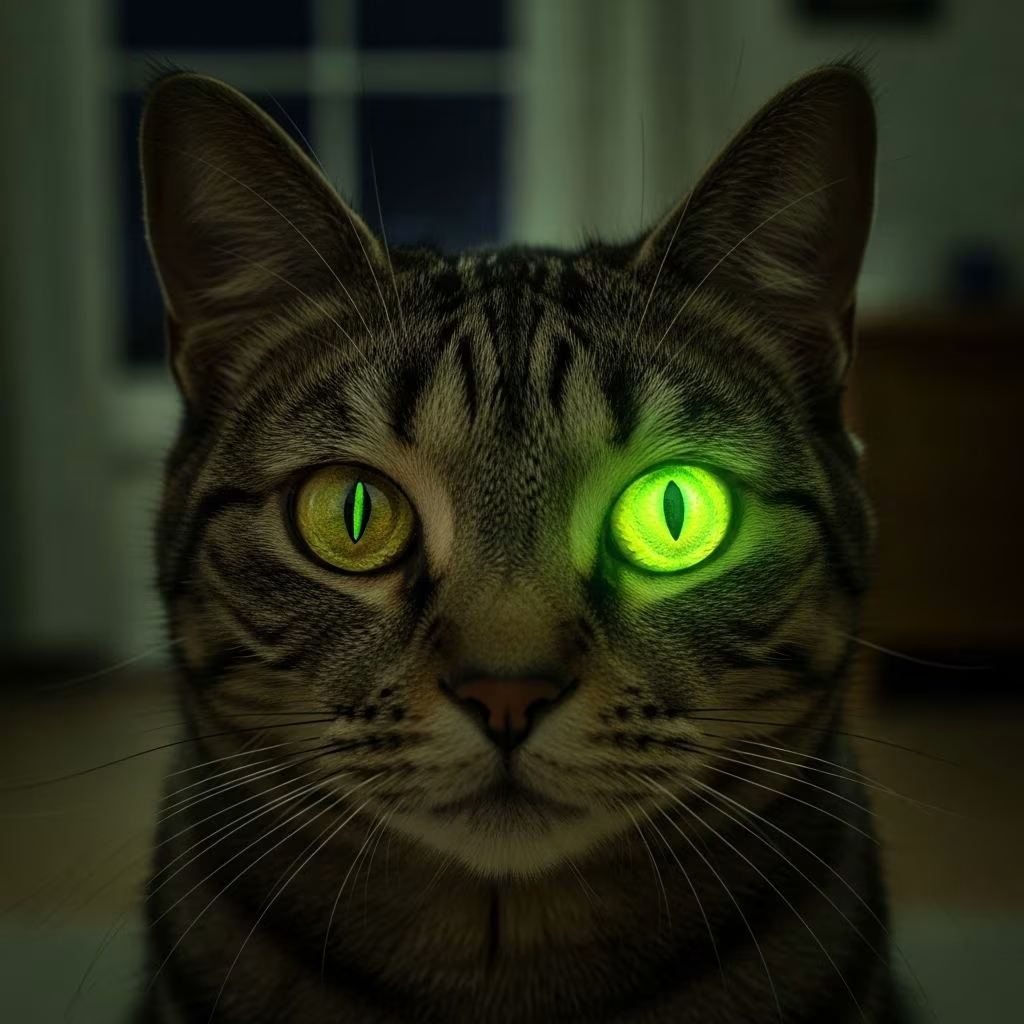
One of the most captivating mysteries of feline behavior is their seemingly supernatural ability to navigate darkness. Many cat owners have witnessed their pets moving effortlessly through dimly lit rooms or spotted their eyes glowing eerily in photographs. Yet the reality of feline vision is grounded in fascinating biology rather than magic. Cats cannot see in complete darkness, but they possess extraordinary visual capabilities in low-light environments that far exceed human perception. Understanding the science behind this adaptation provides insight into why cats evolved as such successful hunters and why they remain most active during dawn and dusk.
The Evolutionary Context of Feline Vision
Cats are crepuscular animals, meaning they are most active during the twilight hours of dawn and dusk rather than during full daylight or complete darkness. This temporal preference shaped their evolutionary development over thousands of years. As their ancestors hunted small prey during these transitional periods, natural selection favored individuals with superior low-light vision. The advantage was substantial: the ability to see when potential prey and competing predators struggled in dim conditions provided a significant survival edge.
This evolutionary trajectory explains why modern domestic cats inherited eyes optimized for low-light conditions rather than for daylight clarity. Their visual system represents a specialized adaptation to specific environmental conditions rather than a general-purpose camera designed for all lighting situations. This specialization means that while cats excel in dimness, they actually perform worse than humans in bright daylight.
Structural Adaptations: The Foundation of Night Vision
Rod and Cone Cell Distribution
The fundamental difference between feline and human vision begins at the cellular level within the retina. The retina contains two primary types of light-sensitive cells: rods and cones. Each serves a distinct purpose in visual perception.
Rod cells are specialized for detecting light in dim conditions and perceiving motion. They contain a light-sensitive protein that responds to minimal amounts of light, making them invaluable for low-light vision. Cats possess 6 to 8 times more rod cells than humans, giving them substantially superior sensitivity to subtle light. This abundance of rods explains why cats can detect the slightest movement in nearly dark environments—a skill essential for hunting nocturnal prey.
In contrast, cone cells provide color vision and perform optimally in bright conditions. Humans possess more cone cells than cats, which is why humans see rich, vibrant colors during daylight but struggle in darkness. Cats, with fewer cone cells, experience a more muted color palette dominated by blues and grays, but this trade-off allows them superior performance in low light.
The Tapetum Lucidum: Nature’s Reflective Mirror
Behind the retina of a cat’s eye lies a specialized layer of reflective tissue called the tapetum lucidum. This structure functions as a biological mirror, bouncing light that has already passed through the retina back toward the photoreceptor cells. This recycling mechanism gives rod cells a second opportunity to absorb and register incoming light.
The significance of this adaptation cannot be overstated. While human eyes absorb light once as it strikes the retina, cats’ eyes utilize the tapetum lucidum to capture approximately 50% more light than would otherwise be available. This doubling effect dramatically enhances their ability to perceive detailed shapes and movements in low-light environments.
The tapetum lucidum also produces the striking phenomenon many cat owners observe: the glowing appearance of cats’ eyes when illuminated by flashlights or camera flashes. This eyeshine is not bioluminescence but rather light reflecting off the tapetum lucidum back toward the light source. Interestingly, humans lack this reflective layer entirely, which is why our eyes do not glow in photographs regardless of lighting conditions.
Pupil Size and Shape Dynamics
Cats possess distinctive vertically-oriented slit-shaped pupils that differ markedly from human round pupils. These specialized pupils offer multiple advantages for feline vision across varying light conditions.
In bright daylight, cats’ pupils contract into narrow vertical slits that restrict light entry, protecting their sensitive retinas from excessive illumination. This adaptation explains why cats often appear to squint in sunshine—their pupils are working to limit light exposure. The vertical shape also enhances their ability to judge distance and depth with precision, crucial capabilities for accurate hunting and pouncing.
Conversely, in low-light conditions, cats’ pupils dilate dramatically to nearly full circles. This expansion maximizes the opening through which light can enter the eye. The degree of pupil dilation cats achieve exceeds human capability; research indicates that cats can experience a 135 to 300-fold change in pupil area, compared to only a 15-fold change in humans. This superior adaptability allows cats to function across a dramatically wider range of lighting conditions than humans can tolerate.
Corneal and Lens Characteristics
Beyond the retina, cats’ overall eye structure differs from human eyes in ways that further enhance low-light vision. Cats possess large corneas and lenses relative to their skull size. These optical components work together with the dilatable pupils to gather and focus maximum available light onto the retina.
The combination of these physical features—large pupils, substantial corneas, and efficient lenses—creates an integrated system optimized for light collection in dim environments. Each component contributes to the overall capability that allows cats to navigate spaces where humans would be essentially blind.
Comparing Feline and Human Low-Light Performance
While cats excel in darkness, their visual experience differs significantly from human perception. Understanding these differences provides perspective on what the world looks like from a cat’s point of view.
Visual Clarity in Dim Light: In near-darkness, cats perceive greater detail and can identify objects and movements that remain invisible to humans. However, their vision in these conditions appears somewhat blurry compared to how humans see in bright daylight. The trade-off reflects their biological optimization for low-light detection rather than daylight acuity.
Color Perception: Cats perceive fewer colors than humans due to their rod-dominated visual system. Their world appears in muted tones of blue and gray rather than the vibrant spectrum humans experience. This limitation matters little for hunting, as nocturnal and crepuscular prey detection relies more on motion recognition than color identification.
Motion Detection: Cats demonstrate exceptional sensitivity to even the slightest movement. This capability derives from the abundance of rod cells that respond rapidly to changes in light patterns. Such sensitivity proves invaluable for detecting prey movement in dim environments and contributes significantly to cats’ reputation as skilled hunters.
Superior Night Vision Than Dogs: While both cats and dogs possess the tapetum lucidum and rod-rich retinas, cats actually achieve better night vision than canines. This advantage stems from cats’ larger eyes relative to skull size, superior pupil dilation capability, and more efficient tapetum lucidum structure. The difference reflects cats’ evolutionary role as solitary nocturnal hunters compared to dogs’ more generalist visual adaptations.
How Cats Navigate Different Lighting Environments
Performance in Bright Conditions
Interestingly, cats perform less effectively in bright daylight than humans do. Their pupils shrink to narrow slits to protect the retina from excessive light, reducing their visual clarity. In effect, cats experience bright daylight through a permanent pair of sunglasses, resulting in slightly washed-out or less detailed perception compared to human daylight vision. This represents the biological cost of their optimization for low-light environments.
Performance in Low-Light Conditions
The specialized adaptations discussed earlier converge in low-light environments where cats dramatically outperform humans. The combination of abundant rod cells, the reflective tapetum lucidum, and dilated pupils creates a system capable of extracting usable visual information from minimal ambient light. This is where cats’ evolutionary advantages become most apparent and where their hunting prowess demonstrates practical application.
Practical Implications for Cat Owners
Understanding feline night vision offers practical insights for providing optimal environments for companion cats:
- Lighting Design: Cats naturally prefer twilight-like conditions, so providing dim-lit areas where they can rest comfortably aligns with their biological preferences. Excessively bright environments may cause discomfort.
- Activity Patterns: Recognizing cats’ crepuscular nature explains why many cats display increased activity during early morning and evening hours. This behavior reflects their inherent biological rhythm rather than random restlessness.
- Prey Drive: The combination of low-light vision advantages and motion detection sensitivity explains why cats often stalk and pounce on moving objects in dimly lit spaces. These behaviors represent the expression of evolutionary adaptations developed for hunting.
- Vertical Space: Cats’ superior low-light vision makes vertical spaces particularly appealing, as they can navigate and hunt in upper areas where lighting is often dimmer than ground level.
The Limitations of Feline Night Vision
Despite their remarkable capabilities, cats face genuine constraints. Complete darkness presents an insurmountable barrier. Without any ambient light—even the minimal moonlight or starlight available in very dark conditions—cats cannot see. Their eyes, however sophisticated, still require some photons of light to detect and process.
Additionally, while cats’ eyes can dilate substantially to increase light entry, this dilation reduces visual acuity. The larger the pupil opening, the less sharp and detailed the resulting image becomes. This represents an optical trade-off inherent in camera systems, whether biological or mechanical, where gathering maximum light and maintaining focus are competing objectives.
Scientific Applications of Feline Vision
The remarkable properties of cat eyes have inspired technological innovation. Researchers have studied the tapetum lucidum to improve camera performance in low-light conditions, developing artificial reflective layers that enhance image capture similarly to how cats’ eyes function. Such biomimicry demonstrates how understanding natural adaptations can yield practical technological advances.
Frequently Asked Questions
Can cats see in complete darkness?
No. While cats possess exceptional low-light vision, they cannot see in absolute darkness without any light source. Their visual system requires at least some ambient light—from moonlight, starlight, or artificial sources—to function.
Why do cats’ eyes glow in photos?
The glow results from light reflecting off the tapetum lucidum, the reflective layer behind their retina. When camera flash illuminates a cat’s eye, light bounces off this mirror-like structure and reflects back toward the camera, creating the distinctive eyeshine.
Do all cats have the same night vision ability?
Most cats possess similar basic eye structures optimized for low-light vision. However, individual variation exists, and age-related changes in cats’ eyes can affect their visual capability over time.
Can cats see colors at night?
Cats perceive muted shades of blue and gray rather than vibrant colors, even in daylight. At night, color perception becomes even less relevant as their vision system prioritizes motion detection and light sensitivity.
How does cat night vision compare to other animals?
Cats possess superior night vision to humans and dogs, though their capabilities remain inferior to some truly nocturnal animals adapted for darkness. Their vision represents an optimal balance for crepuscular hunting rather than extreme specialization for complete darkness.
References
- How Do Cats See In The Dark? Understanding Feline Night Vision — Sam’s Cats and Dogs. https://samscatsanddogs.com/everett/blog/how-do-cats-see-in-the-dark-the-science-behind-your-cats-night-vision
- Why do cats’ eyes glow in the dark? — Popular Science. https://www.popsci.com/environment/why-cat-eyes-glow/
- Can Cats See in the Dark? — Chewy. https://www.chewy.com/education/cat/general/can-cats-see-in-the-dark
- Can Cats See in the Dark? Cat Night Vision Facts — Purina. https://www.purina.co.za/care-and-advice/cat/behaviour-and-training/cat-see-in-dark
- How good is your pet’s night vision? — Wisdom Panel. https://www.wisdompanel.com/en-us/blog/how-good-is-your-pets-night-vision
- Cat and Human Vision Differences — The Refined Feline. https://www.therefinedfeline.com/how-does-a-cats-vision-differ-from-a-humans/
- The Spooky Science of Glowing Eyes in Cats — Panthera. https://panthera.org/blog-post/spooky-science-glowing-eyes-cats



