

The Myth vs. Reality: Can Cats Actually See in Complete Darkness?
One of the most persistent myths about cats is that they possess built-in night vision goggles, allowing them to see perfectly in pitch-black environments. However, the reality is more nuanced and equally fascinating. Cats cannot see in total darkness, but they have evolved remarkable visual capabilities that allow them to navigate and hunt in extremely low-light conditions far more effectively than humans. Rather than having magical night vision, cats are equipped with biological adaptations that make them consummate low-light hunters.
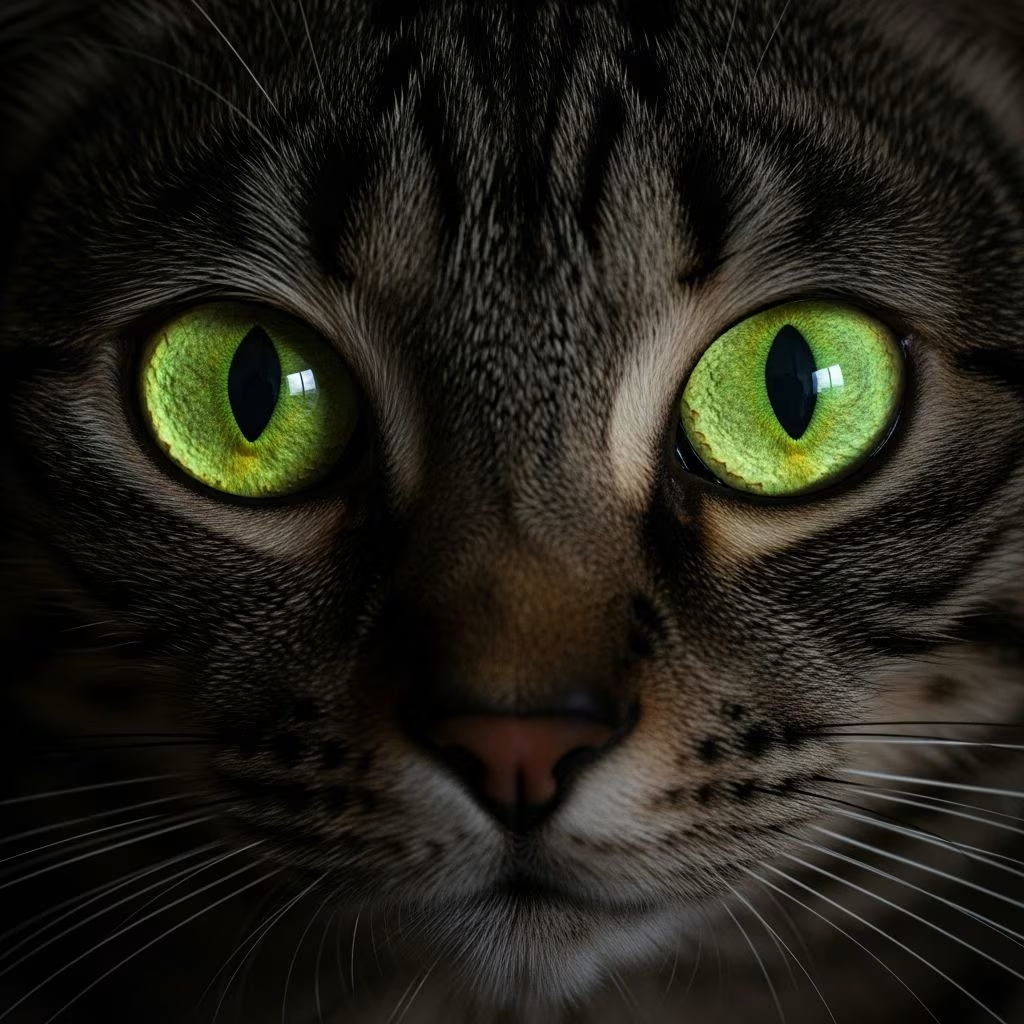
The misconception likely stems from observing cats moving confidently through dimly lit spaces, their eyes catching light and creating that characteristic glowing effect. This ability to thrive in near-darkness is the result of millions of years of evolutionary refinement as crepuscular predators—animals most active during dawn and dusk when lighting is naturally minimal.
Understanding the Superior Light Sensitivity of Feline Eyes
The key to understanding feline vision lies in appreciating how dramatically different cat eyes are from human eyes at the cellular level. Cats require only one-sixth of the light that humans need to see effectively, making their low-light perception substantially superior. This remarkable difference comes from fundamental architectural differences in how their eyes are constructed and the types of light-sensing cells they contain.
This heightened sensitivity isn’t random or accidental—it represents a deliberate evolutionary trade-off. Cats sacrificed some visual capabilities in favor of others, prioritizing the sensory tools that mattered most for their survival as nocturnal and crepuscular hunters. Understanding these anatomical features helps explain why your cat seems so comfortable prowling through dimly lit hallways while you fumble for a light switch.
Rod Cells: The Foundation of Night Vision
At the cellular level, a cat’s superior night vision begins with the composition of photoreceptors in their retina. Eyes contain two primary types of light-sensing cells: rod cells and cone cells. Each serves a different purpose and responds to different lighting conditions.
Cats possess a dramatically higher concentration of rod cells compared to humans. Their eyes contain 6 to 8 times more rod cells than human eyes, making them extraordinarily sensitive to dim light and motion. These rod cells are specifically optimized for detecting light in low-illumination environments and are responsible for the superior night vision that cats are known for.
The downside of this rod-heavy architecture is that cats have comparatively fewer cone cells. Cone cells are responsible for color vision and fine detail recognition in bright light. This is why cats have limited color perception compared to humans—they see the world in more muted tones, primarily in shades of blue and gray rather than the full spectrum of colors visible to human eyes.
- Rod cells enable vision in low-light conditions
- Cats have 6-8 times more rod cells than humans
- Rod cells help detect movement and shapes in dim environments
- The trade-off: fewer cone cells means reduced color perception
- Cats cannot distinguish as many colors as humans can
The Tapetum Lucidum: Nature’s Reflective Mirror
Behind the retina of a cat’s eye lies a remarkable structure that many people aren’t aware of: the tapetum lucidum, a reflective layer of tissue that functions like a biological mirror. This structure is perhaps the most distinctive feature that separates feline vision from human vision and plays a crucial role in their night vision capabilities.
The tapetum lucidum works by bouncing light back through the retina a second time after it enters the eye. This dual-pass approach means that incoming light gets two opportunities to be absorbed by rod cells rather than just one. The effect is remarkably efficient—this reflective layer allows the retina to absorb more than 50% of available light, compared to the amount that human eyes can capture in the same conditions.
This is also the reason why cat eyes seem to glow or shine in photographs taken with flash, or when headlights illuminate them at night. The light reflects off the tapetum lucidum and bounces back outward, creating that eerie, luminescent effect. Different cat breeds may show slightly different colored eye-shine depending on the exact composition of their tapetum lucidum, ranging from green to yellow to amber tones.
Humans do not possess a tapetum lucidum, which is one of the primary reasons our night vision is so much more limited than that of cats. Some other animals, such as dogs, deer, and many nocturnal creatures, also have this reflective layer, which underscores its importance for low-light vision across the animal kingdom.
Pupil Dilation: Maximizing Light Capture
Another critical adaptation that enables cats to see so well in low light involves their pupils. Cat pupils can dilate to nearly full circles, allowing maximum light to enter the eye. This is in stark contrast to the vertical slit-like pupils cats display during daylight hours, which serve the opposite function—controlling how much light enters when conditions are bright.
The flexibility of feline pupils is extraordinary. Cats can experience a 135 to 300-fold change in pupil size, whereas humans can only achieve about a 15-fold change. This means cats can adapt their eyes to function effectively across a much wider range of light levels than humans can manage. In dim conditions, their pupils expand dramatically, creating larger openings for light to pass through and reach the light-sensing cells within.
Combined with their large cornea and lens—which are about 50% larger than human corneas and lenses—these dilated pupils work together to gather as much available light as possible. This anatomical combination is why cats maintain visual functionality in conditions where humans would be essentially blind.
Comparing Feline and Human Visual Capabilities
| Visual Feature | Cats | Humans |
|---|---|---|
| Low-Light Sensitivity | 6-8 times better; needs only 1/6 the light | Poor in low light; requires more illumination |
| Color Vision | Limited; primarily blue and gray tones | Full spectrum; sees all colors clearly |
| Daytime Visual Clarity | Moderate; less detail-oriented | High; sharp and detailed |
| Night Vision | Excellent in low-light conditions | Limited and difficult |
| Motion Detection | Superior; highly sensitive to movement | Moderate; less sensitive to subtle motion |
| Pupil Dilation Range | 135-300 fold change | 15 fold change |
| Field of Vision | 200 degrees (excellent peripheral vision) | 180 degrees (more forward-focused) |
| Near-Sightedness | Naturally near-sighted; focused on close objects | Can focus on distant objects clearly |
While humans clearly dominate in daytime visual clarity and color perception, cats have evolved to be superior in virtually every aspect related to low-light vision and motion detection. This represents a clear evolutionary optimization for their role as twilight and nighttime hunters.
What the World Looks Like Through a Cat’s Eyes at Night
Understanding the mechanical advantages of cat vision is one thing, but what does the actual visual experience look like from a feline perspective? Researchers and veterinarians have developed a reasonable understanding of how cats perceive their environment during low-light hours.
Muted colors and contrast: Cats perceive the world in shades of blue and gray, without the vibrant color palette that humans see. This isn’t a limitation in their evolutionary context—colors simply don’t provide hunting advantages for crepuscular predators. Instead, cats rely on detecting contrast and brightness variations to locate prey.
Enhanced motion sensitivity: While overall visual detail may be slightly blurry compared to what humans see in daylight, cats possess extraordinary sensitivity to movement. Even the slightest motion—such as a mouse rustling through grass or a dust bunny tumbling across a floor—registers immediately in their visual system. This motion detection is one of their most potent hunting tools.
Expanded peripheral awareness: With a field of vision of 200 degrees compared to humans’ 180 degrees, cats see more of their surroundings simultaneously. This wider peripheral vision helps them detect approaching threats and locate prey without turning their heads, providing a significant survival advantage.
Reduced visual acuity: While cats see better in low light, their visual clarity is less detailed than human vision in bright conditions. Humans can see objects with five times more detail from the same distance. This reduced sharpness is a trade-off cats accept in exchange for superior low-light and motion detection capabilities.
Near-Sightedness and Hunting Adaptations
An interesting aspect of feline vision is that cats are naturally near-sighted. They focus most effectively on objects that are relatively close to them, making them specially adapted for the close-range hunting that characterizes their predatory behavior. While humans can see distant objects with greater clarity, cats have evolved to excel at precisely the distances where they hunt—typically within a few feet of their prey.
This near-sightedness, combined with their superior motion detection and low-light vision, creates an ideal visual system for a predator that relies on stalking and pouncing on small moving targets. When a mouse or insect moves nearby, a cat’s visual system is perfectly optimized to detect that movement and calculate the precise distance needed for a successful pounce.
The Role of Other Senses in Feline Night Navigation
While vision is certainly important for cats navigating darkness, it’s crucial to recognize that feline night activity relies on more than just what their eyes can see. Cats possess other sensory systems that work in concert with their visual capabilities to create a comprehensive low-light navigation and hunting system.
Whiskers (vibrissae): These sensitive facial hairs detect air currents and allow cats to navigate tight spaces and sense nearby objects without relying on vision alone. Whiskers provide tactile feedback that complements visual information, particularly useful in very dim conditions.
Hearing: Cats have exceptional hearing, with the ability to detect high-frequency sounds that most humans cannot perceive. This auditory capability helps them locate prey by sound alone, reducing their reliance on vision.
Smell: The olfactory system of cats is extraordinarily sensitive, providing crucial information about their environment that doesn’t depend on light levels at all.
These senses work together with their specialized vision to make cats formidable nocturnal and crepuscular hunters, suggesting that their success in low-light environments depends on sensory integration rather than vision alone.
Evolutionary Perspective: Why Cats Developed Superior Night Vision
The development of feline night vision capabilities represents millions of years of evolutionary optimization. Cats descended from small carnivores that hunted during dawn, dusk, and night—times when many potential prey animals were more active and when predation competition was lower. Cats that possessed better low-light vision had a survival advantage: they could locate and capture prey more effectively, increasing their chances of successful reproduction and passing on their genes.
Over countless generations, natural selection favored cats with better rod cell concentration, more effective pupils, and reflective retinal layers. Those with superior color vision but poor night vision were at a disadvantage during their most active hunting hours, so this trait became less common in the cat population.
This is why cats today have sacrificed color perception for night vision—it’s not an arbitrary trade-off but rather the result of selective pressures that made low-light hunting capabilities far more valuable for survival than distinguishing between different colors.
Common Questions About Feline Night Vision
Can cats see in complete darkness?
No. While cats require far less light than humans, they cannot see in absolute darkness with no light source whatsoever. However, in conditions where humans would be essentially blind, cats can still perceive shapes and navigate effectively.
Why do cat eyes glow in the dark?
The glow is caused by light reflecting off the tapetum lucidum, the reflective layer behind their retina. When light from a camera flash or headlights hits their eyes, some of that light bounces back outward, creating the distinctive eye-shine.
Can cats see ultraviolet light?
Yes, unlike humans, cats can perceive some ultraviolet light frequencies, which may help them detect the urine trails of prey and other markers invisible to human eyes.
Are all cats’ night vision abilities the same?
While all cats share the same basic anatomical adaptations for night vision, individual variation does exist based on genetics, age, and eye health. Some cats may have slightly better vision than others, but all healthy cats have dramatically superior low-light vision compared to humans.
Practical Implications for Cat Owners
Understanding feline vision has practical implications for how we care for and interact with our cats. While your cat can navigate dark rooms far better than you can, they still appreciate adequate lighting for safety. Even with superior night vision, obstacles and hazards can cause injury. Providing soft lighting in areas where cats spend time at night is a thoughtful way to ensure their safety while respecting their natural nocturnal tendencies.
Additionally, recognizing that cats perceive motion more acutely than static objects explains why interactive toys and games that involve movement are so engaging for cats. Their visual system is literally wired to respond to motion, making it a primary source of stimulation and enjoyment.
References
- How Do Cats See In The Dark? Understanding Feline Night Vision — Sam’s Cats and Dogs. Accessed January 29, 2026. https://samscatsanddogs.com/everett/blog/how-do-cats-see-in-the-dark-the-science-behind-your-cats-night-vision
- Can Cats See in the Dark? Cat Night Vision Facts — Purina US. https://www.purina.com/articles/cat/behavior/understanding-cats/can-cats-see-in-the-dark
- How Cats See In The Dark — Night Vision, Eye Secrets, And What Science Says — YouTube. https://www.youtube.com/watch?v=xshzvq4OZUU
- Can cats see colour? How cat vision works — ManyPets. https://manypets.com/uk/articles/can-cats-see-colour/
- Can Cats See in the Dark? Feline Night Vision Facts — Hill’s Pet. https://www.hillspet.com/cat-care/behavior-appearance/can-cats-see-in-the-dark
- The Spooky Science of Glowing Eyes in Cats — Panthera Foundation. https://panthera.org/blog-post/spooky-science-glowing-eyes-cats



