
Feline Nervous System: 3 Core Divisions Explained
Explore the intricate feline nervous system, from brain functions to nerve pathways, and how it powers your cat's agility and senses.
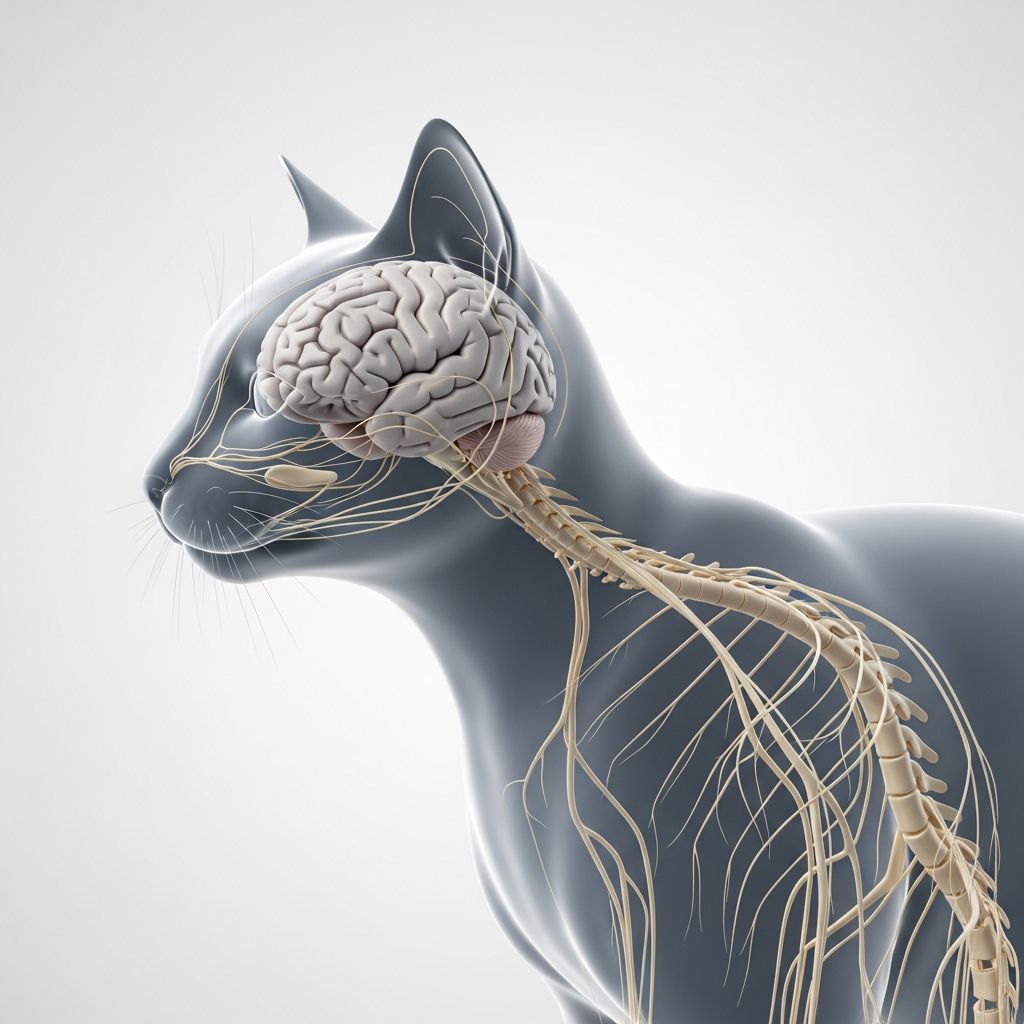
The nervous system in cats serves as the master control network, orchestrating everything from graceful leaps to rapid responses to danger. Comprising the central, peripheral, and autonomic divisions, it processes sensory data, coordinates movements, and regulates vital involuntary processes.
Core Divisions of the Cat’s Nervous Network
Cats possess a highly efficient nervous system divided into three primary parts. The central nervous system (CNS) includes the brain and spinal cord, acting as the primary processing hub. The peripheral nervous system (PNS) consists of nerves extending from the CNS to the body’s extremities, while the autonomic nervous system (ANS) manages unconscious functions like heartbeat and digestion.
- CNS: Protected core for decision-making and signal relay.
- PNS: Bridges CNS to muscles and sensory organs.
- ANS: Oversees automatic bodily operations.
Central Nervous System: The Command Center
The CNS forms the backbone of feline neurology, encased in protective structures. The brain, weighing about one ounce, houses billions of neurons with extensive connections for precise control. It receives sensory inputs, processes them, and issues commands.
Brain Anatomy and Roles
The feline brain features distinct regions: the cerebrum, cerebellum, and brainstem. The cerebrum, the largest section, splits into right and left hemispheres linked by the corpus callosum. These hemispheres contain four lobes—frontal for voluntary motion, parietal for sensory interpretation, occipital for vision, and temporal for memory and behavior.
The cerebellum, positioned at the brain’s rear, fine-tunes balance, posture, and coordinated actions, essential for a cat’s acrobatic prowess. The brainstem anchors the brain to the spinal cord, managing critical functions like breathing and heart rate via cranial nerves.
| Brain Region | Primary Functions | Key Features in Cats |
|---|---|---|
| Cerebrum | Thinking, movement, senses | Hemispheres with four lobes; processes complex behaviors |
| Cerebellum | Coordination, balance | Attached to brainstem; vital for agility |
| Brainstem | Basic life support | Origin of cranial nerves; regulates vital signs |
Advanced imaging like 3 Tesla MRI reveals fine details in cats, such as cerebellar nuclei, optic radiation, and cranial nerves, previously only visible post-mortem.
Spinal Cord Structure and Segmentation
Extending from the brainstem, the spinal cord relays signals between brain and body. It traverses the vertebral column, with segments aligning variably to vertebrae—cervical (C1-C8), thoracic (T1-T13), lumbar (L1-L7), sacral (S1-S3), and coccygeal.
For instance, C3 spans much of VC2 and VC3 vertebrae, while lumbar segments like L4 occupy VL4. This “descension” in thoracic regions aids precise motor control. The cord contains tracts of axons for sensory and motor transmission, enabling reflexes and limb movements.
Peripheral Nervous System: Extending Reach
The PNS links the CNS to limbs, organs, and skin via cranial and spinal nerves. Cranial nerves (12 pairs) originate from the brainstem, handling head functions: optic for vision, facial for expressions.
Spinal nerves exit the cord through intervertebral gaps, innervating the body. Key examples include the radial nerve for forelimbs and femoral for hindlimbs, crucial for locomotion. Motor neurons in the cord form tracts to peripheral nerves, driving voluntary actions.
- Cranial nerves: Sense and motion in head/neck.
- Spinal nerves: Body-wide control from neck to tail.
Autonomic Nervous System: Silent Regulator
The ANS governs involuntary processes, split into sympathetic (fight-or-flight) and parasympathetic (rest-and-digest) branches. Sympathetic activation dilates pupils, accelerates heart rate, and redirects blood flow.
Sympathetic trunks run along the spine, with ganglia like the middle cervical (sometimes subtle in cats). The vagus nerve branches from these trunks, influencing heart and digestion. This system ensures survival during stress or calm.
Neuron Mechanics: Signal Transmission
Neurons, the system’s units, feature cell bodies, dendrites (signal receivers), and axons (signal senders). Electrical impulses travel axons, releasing neurotransmitters at synapses to activate adjacent cells, muscles, or glands.
Sensory neurons relay environmental data to the CNS; motor neurons carry responses outward. This chain underpins reflexes, like paw withdrawal from heat.
Protective Mechanisms and Barriers
The CNS is shielded by meninges, cerebrospinal fluid (shock absorption), skull/vertebrae, and the blood-brain barrier, blocking toxins but challenging drug delivery. Issues like trauma or infection can disrupt these, causing seizures, incoordination, or dullness.
Common Neurological Indicators in Cats
Brain problems may show as behavior shifts, seizures, or ataxia. Spinal issues manifest in weakness or paralysis. Early vet detection via exams or MRI aids management.
Neurological Health Maintenance
Prevent issues with balanced nutrition, parasite control, and safe environments. Regular check-ups catch subtle signs. Research advances, like neurochemical spinal mapping, enhance diagnostics.
Frequently Asked Questions (FAQs)
What does the cat brain control?
The brain oversees senses, movement, behavior, and vital functions through its cerebrum, cerebellum, and brainstem.
How is the spinal cord segmented in cats?
It includes cervical, thoracic, lumbar, sacral, and coccygeal regions, with specific vertebral alignments.
What are cranial nerves?
Twelve pairs from the brainstem managing head senses and motions, like vision and facial movement.
What’s the fight-or-flight response in cats?
Sympathetic ANS activation boosting heart rate, dilating pupils for threat responses.
Can MRI image cat brains effectively?
Yes, high-resolution 3T MRI visualizes nuclei, tracts, and nerves in vivo.
Advanced Insights from Research
Studies detail spinal neurochemistry, with choline acetyltransferase in motor and visceral nuclei. MRI atlases show auditory pathways (cochlea to temporal lobe) and motor tracts. Dissections reveal vagus and sympathetic paths.
References
- Getting On A Cat’s Nerves: A Look Into the Feline Nervous System — Animal Almanac Blog. 2016-09-07. https://animalalmanacblog.wordpress.com/2016/09/07/getting-on-a-cats-nerves/
- Feline Nervous System — Willamette Veterinary Hospital. N/A. https://wilvet.com/interactive-animal/feline/nervous/
- Neurochemical atlas of the cat spinal cord — Frontiers in Neuroanatomy. 2022. https://www.frontiersin.org/journals/neuroanatomy/articles/10.3389/fnana.2022.1034395/full
- High resolution MRI anatomy of the cat brain at 3 Tesla — PMC (PMC4060963). 2014. https://pmc.ncbi.nlm.nih.gov/articles/PMC4060963/
- Part 4: Nerves and Ganglia – Dissection Lab Guide for Dog and Cat — University of Minnesota Pressbooks (.edu). N/A. https://pressbooks.umn.edu/dogcatanatomylabguide/chapter/part-4-nerves-and-ganglia/
Similar Articles








Read full bio of medha deb




