
Feline Musculoskeletal System: Anatomy, Function, And Agility
Explore the intricate systems enabling cats' remarkable agility and athletic prowess
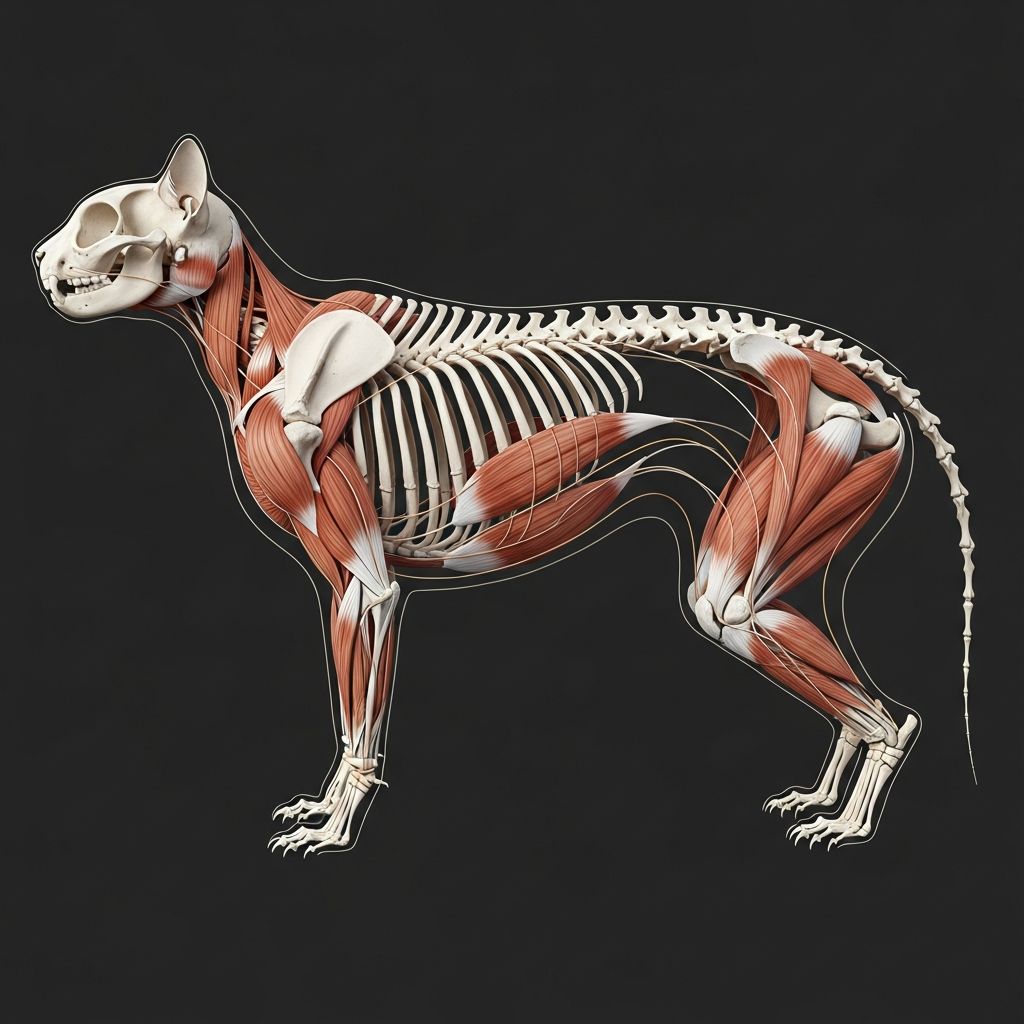
The remarkable athletic abilities of domestic cats stem from a sophisticated and highly specialized musculoskeletal system. This integrated network of bones, muscles, ligaments, and joints creates a biomechanical masterpiece that enables cats to move with precision, jump with explosive power, and navigate complex environments with effortless grace. Understanding the structural components that comprise the feline musculoskeletal system provides insight into why cats are among nature’s most agile predators, whether in the wild or within our homes.
The Skeletal Scaffold: Foundation of Feline Movement
The feline skeleton forms the rigid infrastructure upon which all movement and stability depend. Comprising 230 bones, this framework is engineered for a balance between lightweight construction and exceptional strength. The skeletal system serves multiple critical functions: it provides attachment points for muscles, protects vital organs, stores mineral reserves, and produces blood cells within bone marrow.
The vertebral column represents the most significant component of feline skeletal architecture. This spinal structure contains seven cervical vertebrae in the neck region, thirteen thoracic vertebrae in the chest, and between twenty-three and thirty-two lumbar vertebrae extending through the lower back and tail region. This unusual abundance of vertebrae, particularly in the lumbar and tail sections compared to other mammals, grants cats their characteristic spinal flexibility. The intervertebral discs situated between each vertebra act as shock absorbers and allow movement in multiple directions simultaneously.
The rib cage protects the heart, lungs, and other thoracic organs while remaining lightweight enough to facilitate rapid breathing during physical exertion. The limb bones are structured with careful attention to both strength and maneuverability. The forelimbs feature the humerus, radius, and ulna, while the hind limbs contain the femur, tibia, and fibula—each positioned to optimize specific movement patterns.
Three Distinct Muscle Tissue Systems
Cats possess three fundamentally different types of muscle tissue, each serving specific physiological roles and operating under different control mechanisms.
Skeletal Muscle: The Engine of Voluntary Movement
Skeletal muscles represent the most visible and numerous muscle tissue type in cats. These striated muscles possess a characteristic striped appearance under microscopic examination and operate under conscious voluntary control through the somatic nervous system. Unlike other tissue types, skeletal muscles contract rapidly and with considerable force, making them ideal for locomotion, climbing, hunting, and precise movements.
The structural organization of skeletal muscle follows a hierarchical pattern. Individual muscle fibers, which are actually single multinucleated cells, bundle together within connective tissue sheaths called fascicles. Multiple fascicles combine to form the complete muscle, surrounded by an outer connective tissue layer. Within each fiber, smaller contractile units called myofibrils contain sarcomeres—the fundamental contractile elements composed of protein filaments that slide across one another to generate muscular contraction.
Skeletal muscles function in opposing pairs around joints. As one muscle contracts to move a limb in one direction, its antagonistic partner relaxes, allowing that movement. This paired arrangement enables precise, controlled motion. The biceps and triceps of the forelimb exemplify this relationship: the biceps flexes the elbow while the triceps extends it.
Smooth Muscle: Involuntary Control of Internal Systems
Smooth muscle tissue lacks the striated appearance of skeletal muscle and operates involuntarily under autonomic nervous system control. Located in the walls of blood vessels, digestive tract, and urinary organs, smooth muscle contracts slowly and maintains sustained contractions for extended periods. This tissue type facilitates critical internal functions including blood circulation regulation, food movement through the digestive system, and urine transport through the urinary tract.
Cardiac Muscle: The Specialized Heart Tissue
Cardiac muscle, found exclusively in the heart wall, combines characteristics of both skeletal and smooth muscle. It exhibits striation like skeletal muscle but operates involuntarily like smooth muscle. Cardiac muscle cells interconnect through specialized junctions that synchronize contraction, enabling the heart to function as a unified pump that maintains circulation throughout the body.
Functional Roles of the Musculoskeletal System
The integrated musculoskeletal system performs five essential functions that sustain feline life and behavior:
- Movement and Locomotion: Skeletal muscles contract to move bones across joints, enabling walking, running, climbing, jumping, and pouncing—behaviors fundamental to feline survival and daily activity.
- Postural Support and Stability: Muscles maintain the body’s alignment against gravity and stabilize joints to prevent unwanted movement, allowing cats to maintain balance on narrow surfaces and during complex maneuvers.
- Thermoregulation: Muscular activity generates heat through metabolic processes and through shivering during cold exposure, helping cats maintain their body temperature within optimal ranges.
- Internal Transport: Smooth muscle contractions move blood through vessels, propel food through the digestive tract, and facilitate urine movement through the urinary system.
- Organ Protection: The skeletal framework and muscular layers cushion and shield vital organs from impact and injury.
Major Muscle Groups and Their Functional Specializations
Forelimb Musculature
The forelimbs require specialized muscles that enable both powerful strokes and precise foot placement. The supraspinatus and infraspinatus muscles stabilize the shoulder joint and initiate forelimb movement. The biceps brachii flexes the elbow, while the triceps brachii extends it. The deltoid muscles control shoulder movement in multiple directions. These forearm muscles are supplemented by an intricate network of flexor and extensor muscles that control digit positioning, allowing cats to place their paws with millimeter precision during climbing, hunting, and grooming activities. The retractable nature of feline claws depends on specialized muscles within the paw that extend and retract the claw sheaths.
Hind Limb Musculature
The hind limbs generate the propulsive force necessary for jumping, running, and kicking. The gluteal muscle group, among the most powerful muscles in the feline body, extends the hip and initiates jumping movement. The quadriceps femoris muscle, running along the anterior thigh, extends the knee during push-off and landing phases. The hamstring group, located on the posterior thigh, flexes the knee and assists with hip extension. The gastrocnemius and soleus muscles of the lower leg, connected via the Achilles tendon, provide the final push-off force. This muscular arrangement enables cats to leap distances up to six times their body length—an extraordinary athletic feat relative to body size.
Core and Axial Musculature
The abdominal muscles form the core of feline stability. The rectus abdominis runs along the ventral surface of the abdomen and provides spinal flexion. The external and internal oblique muscles enable rotation and lateral flexion of the spine. The transversus abdominis, the deepest abdominal layer, compresses the abdomen and supports internal organs. Dorsal spinal muscles, including the longissimus dorsi and iliocostalis, extend and laterally flex the spine. These muscles work collectively to maintain proper spinal alignment, facilitate rotation during mid-air maneuvers, and protect internal organs from impact.
The Extraordinary Spinal Flexibility
Cats possess spinal flexibility that far exceeds that of most mammals, a characteristic that defines much of their physical capability. The abundance of vertebrae combined with flexible intervertebral discs and powerful spinal musculature allows the feline spine to extend, flex, and rotate through ranges of motion that appear almost serpentine. This flexibility serves multiple purposes: it enables the famous “righting reflex” that allows falling cats to reorient their bodies mid-fall, permits rotation of the spine while the pelvis remains stationary during balance adjustments, and facilitates the compression and extension cycles necessary for powerful jumping.
The spinal ligaments, including the supraspinous and interspinous ligaments, stretch under load and recoil like elastic springs, storing and releasing energy during movement. This elastic property reduces the muscular effort required for movements and enhances the power of jumping and twisting motions. The extensive innervation of spinal muscles enables rapid, near-instantaneous adjustments to maintain balance and compensate for changing terrain or unexpected perturbations.
Joints: The Articulation Points of Movement
Joints represent the connection points where bones articulate, allowing movement while maintaining structural integrity. Different joint types permit different ranges and types of movement. Ball-and-socket joints, such as the hip and shoulder, allow movement in multiple planes and rotational movement. Hinge joints, like the elbow and knee, permit movement primarily in one plane—flexion and extension. Pivot joints, such as those in the upper cervical spine, allow rotational movement. Gliding joints between carpal and tarsal bones enable sliding movements that provide additional flexibility.
Joints are reinforced by ligaments, which are tough fibrous connective tissues that prevent excessive movement and provide stability. Articular cartilage lines the bone surfaces within joints, creating smooth, low-friction surfaces that facilitate movement and absorb shock. Synovial fluid within joint capsules lubricates the articulating surfaces, reducing friction during movement.
Muscle Physiology and Movement Generation
Muscular contraction occurs through the sliding filament mechanism. Thick filaments composed of the protein myosin interact with thin filaments composed of actin, pulling them toward the center of the sarcomere. This overlapping action shortens the sarcomere and produces muscular force. The energy source for this process is adenosine triphosphate (ATP), produced through aerobic and anaerobic metabolic pathways. Different muscle fiber types possess varying oxidative capacity and contractile speed, enabling some muscles to sustain activity (slow-twitch fibers) while others excel at rapid, powerful contractions (fast-twitch fibers).
Comparative Adaptations: Cats Versus Other Mammals
| Feature | Cats | Humans | Dogs |
|---|---|---|---|
| Vertebral Count | 23-32 lumbar | 5 lumbar | 7-8 lumbar |
| Spinal Flexibility | Extreme flexibility | Limited | Moderate |
| Gluteal Size | Proportionally smaller | Proportionally larger | Moderate |
| Jumping Capability | 6x body length | Limited vertical jump | Variable by breed |
| Stance | Quadrupedal | Bipedal | Quadrupedal |
Frequently Asked Questions
Why can cats jump so much higher than dogs of similar size?
Cats possess proportionally more powerful hind limb muscles, particularly in the gluteal and quadriceps regions, combined with elastic Achilles tendons that store and release energy efficiently. Their lighter body weight relative to muscle mass, plus the flexibility provided by their spinal structure, contributes to exceptional jumping ability.
What enables the cat’s “righting reflex”?
The righting reflex combines visual input from the eyes, vestibular (balance) information from the inner ear, and rapid muscular adjustments coordinated by the spinal cord. The flexible spine allows cats to twist their upper and lower body independently, enabling them to reorient toward the ground during falls.
How do cats maintain such precise balance on narrow surfaces?
A highly developed proprioceptive system (body awareness) combined with powerful core muscles enables continuous micro-adjustments of posture. The tail acts as a dynamic counterbalance, shifting position to maintain center of gravity. Sensitive paw pads provide constant feedback about surface characteristics.
Why are cats more flexible than humans?
The abundance of spinal vertebrae and the mobility of intervertebral discs provide cats with greater overall spinal range of motion. Additionally, cats possess relatively loose fascial connections between muscle groups and highly elastic ligaments, facilitating greater flexibility.
Conclusion: The Integrated System of Feline Excellence
The feline musculoskeletal system represents an elegant integration of specialized skeletal structures, distinct muscle tissue types, flexible joints, and coordinated neural control. Every component—from the abundant spinal vertebrae to the powerful hind limb muscles, from the precise digital muscles to the elastic connective tissues—has evolved to support the feline lifestyle of precision, power, and agility. Understanding these anatomical features deepens appreciation for the remarkable biological engineering that enables cats to perform the extraordinary feats of athleticism that characterize their species, whether hunting prey in natural environments or navigating modern domestic spaces with characteristic grace.
References
- Muscles of a Cat: Structure of the Muscular System — PetPlace.com. https://www.petplace.com/article/cats/pet-health/structure-and-function-of-the-muscular-system-in-cats
- Inside the Feline Form: A Deep Dive into the Muscle Anatomy of a Cat — Saint Augustine University. https://explore.st-aug.edu/exp/inside-the-feline-form-a-deep-dive-into-the-muscle-anatomy-of-a-cat
- Cat Anatomy — Wikipedia. https://en.wikipedia.org/wiki/Cat_anatomy
- Musculoskeletal Oddities in the Cat: An Overview of Some Curious Conditions — National Center for Biotechnology Information (NCBI). https://pmc.ncbi.nlm.nih.gov/articles/PMC11148911/
- Components of the Musculoskeletal System in Cats — Merck Veterinary Manual. https://www.merckvetmanual.com/cat-owners/bone-joint-and-muscle-disorders-of-cats/components-of-the-musculoskeletal-system-in-cats
Similar Articles








Read full bio of Sneha Tete




