

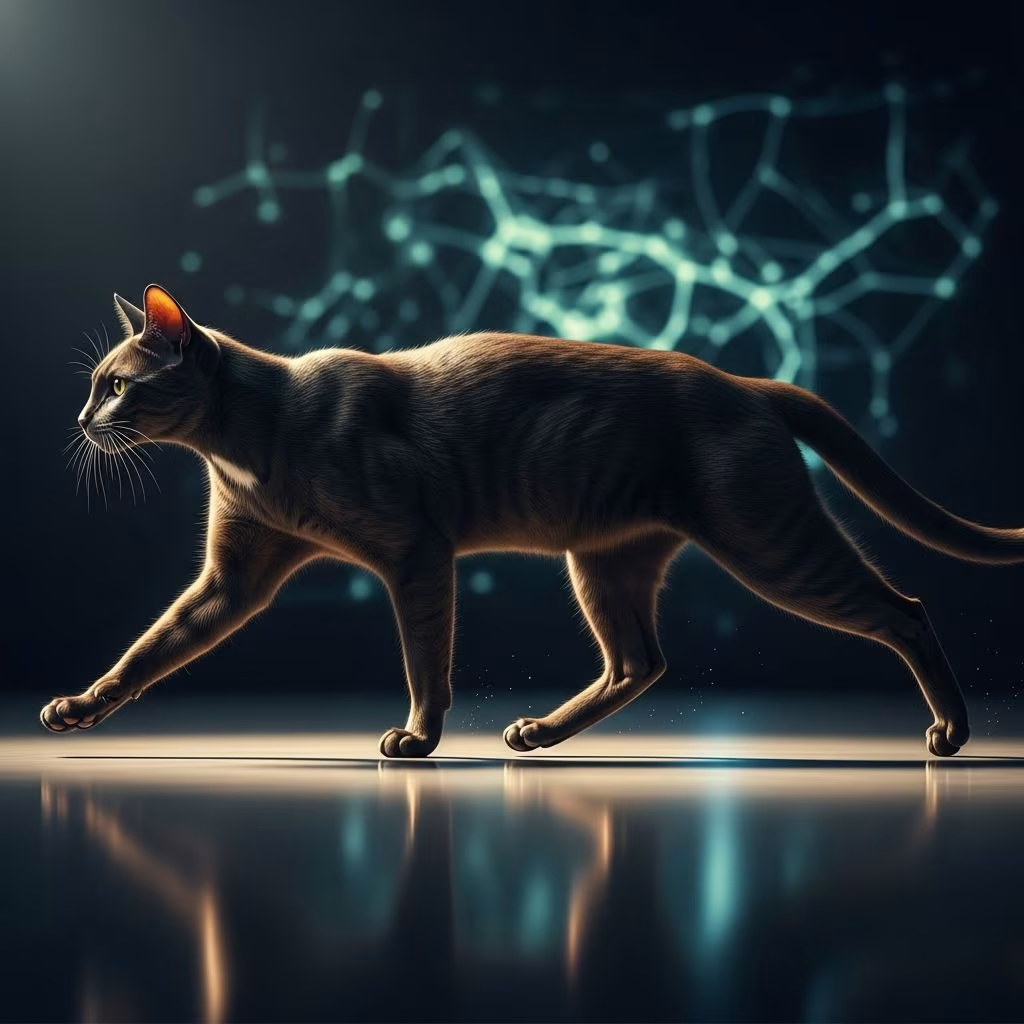
When you watch a cat move through your home or observe it stalking prey in the yard, you witness a masterpiece of evolutionary adaptation. The fluid grace, the silent footfalls, the explosive bursts of speed—these are all made possible by a fundamental difference in how cats are built compared to humans. Unlike people, cats do not place their feet flat on the ground. Instead, they walk on their toes, a locomotor strategy that fundamentally shapes their physical capabilities and hunting success. This distinctive way of moving is called digitigrade locomotion, and it is one of the defining characteristics that separates cats from many other mammals, including humans.
Understanding how cats walk reveals much about their evolution, their hunting prowess, and their unique place in the animal kingdom. The anatomy supporting digitigrade movement extends far beyond the paws—it influences their spine, their muscles, their joints, and even their claws. This comprehensive physical adaptation has allowed cats to become some of nature’s most efficient and effective predators, capable of moving with both incredible speed and remarkable quietness.
Understanding Locomotion Classification in Animals
Before diving into the specifics of how cats move, it is helpful to understand the broader framework for classifying animal locomotion. Scientists categorize how different animals walk based on which parts of their feet contact the ground. This classification system reveals fundamental differences in body structure and evolutionary strategy among mammalian species.
There are three primary categories of locomotion:
- Plantigrade movement: Animals that place the entire sole of their foot on the ground, including the heel, ball, and toes. Humans, bears, and elephants are plantigrades, as are many aquatic birds.
- Digitigrade movement: Animals that walk on their toes and digits while holding their heels and hocks elevated above the ground. Cats, dogs, and most flying birds employ this strategy.
- Unguligrade movement: Animals that walk exclusively on the tips of their toes, which have evolved into hooves. Horses, cattle, sheep, giraffes, and antelope are ungulates.
Each classification reflects different evolutionary pressures and behavioral needs. Understanding these categories provides insight into why cats move the way they do and what advantages their particular locomotor style offers in their lifestyle as hunters and ambush predators.
The Distinctive Anatomy of Digitigrade Animals
While cats, dogs, humans, and horses all share the same fundamental skeletal components—ankles, knees, elbows, wrists—the arrangement and proportions of these bones differ dramatically. These anatomical variations directly translate into the different ways these animals move through their environments.
In digitigrade animals like cats, the bones in the foot are organized in a way that effectively lengthens the limb. The carpals and tarsals (wrist and ankle bones) are considerably longer than in plantigrade animals. The hock, which corresponds to the human ankle, sits much higher up on the leg. What might appear to be a cat’s “foot” actually corresponds only to human toes and fingers—the visible paw pad and toes are the primary weight-bearing structures. This anatomical arrangement means that a cat’s functional leg is significantly longer than a human leg of similar overall length.
This lengthening of the effective foot creates what engineers call mechanical advantage. The elongated structure acts as a lever, increasing stride length and enabling rapid acceleration. The higher positioning of the hock and the flexible arrangement of the foot bones also allow for greater range of motion in multiple directions, facilitating the quick, precise movements necessary for hunting.
The Paw: A Specialized Hunting Tool
The cat’s paw is far more than a simple foot—it is a specialized hunting tool refined over millions of years of evolution. Each paw serves multiple functions simultaneously: weight-bearing platform, sensory organ, grooming tool, and weapon for capturing prey.
A typical cat possesses 18 digits in total: five toes on each front paw and four on each back paw. The fifth toe on the front paw, located higher on the leg, is the dewclaw. Because of its elevated position, the dewclaw does not contact the ground during normal walking and does not bear weight. However, it plays an important role in gripping prey and climbing surfaces.
Beneath each toe lies sensitive paw pad tissue that is hairless and extremely responsive to pressure and texture. These pads serve as sensory receptors, allowing cats to detect minute vibrations and understand the terrain beneath them. The pads also provide traction, allowing cats to maintain grip on various surfaces during rapid movement and abrupt directional changes.
Attached to each digit is a sharp, curved claw. Unlike human fingernails, which attach only to soft tissue, cat claws connect directly to bone. This anatomical relationship means the claw is an integral part of the skeletal structure, not merely a peripheral structure. The curve of the claw provides excellent gripping power for climbing, prey capture, and balance. The ability to extend and retract these claws gives cats remarkable versatility—they can move silently when claws are retracted, or deploy formidable weapons when needed.
Spinal Flexibility: The Engine of Feline Agility
While the limbs provide the framework for digitigrade movement, the spine provides the engine. The cat’s vertebral column possesses remarkable flexibility compared to many other mammals. Each vertebra has specialized disks between them composed of elastic, flexible cartilage that allows compression and extension without injury. Additionally, the vertebrae themselves are arranged in a way that permits greater rotation and bending than in human spines.
This extraordinary spinal flexibility serves multiple functions. It enables cats to contort their bodies into seemingly impossible positions, allowing them to slip through tight spaces or twist mid-fall to right themselves. During running and jumping, the spine compresses and extends like a coiled spring, adding force to each stride and increasing jump height. The flexibility also allows cats to make sharp directional changes without losing speed, a critical capability when hunting nimble prey or evading threats.
The combination of flexible spine, elongated digitigrade limbs, and powerful muscles in the hindquarters creates an animal capable of explosive acceleration, rapid directional changes, and sustained high-speed running. This physical foundation supports the hunting behaviors that cats have refined over their evolution.
Speed and Stealth: The Advantages of Digitigrade Locomotion
The digitigrade posture offers cats two critical advantages that have made them successful predators: speed and stealth. These two capabilities often seem contradictory—speed typically involves impact and noise, while stealth requires silence. Yet cats achieve both simultaneously through their unique anatomy.
The elevated hock position and elongated foot bones create a lever system that provides significant mechanical advantage. When a cat pushes off the ground, the leverage amplifies the force generated by the leg muscles, resulting in rapid acceleration and impressive sprint speeds. The flexible spine compounds this advantage by allowing the hindquarters to drive forward with greater power, and by permitting the animal to extend its stride length beyond what would be possible with a rigid spine.
Simultaneously, the digitigrade stance enables quiet movement. Because cats walk on their toes and pads rather than their heels, they avoid the heel-strike impact that creates noise in human walking. The sensitive paw pads allow cats to test the ground before placing full weight, enabling them to avoid branches, loose gravel, or other noise-making surfaces. The ability to retract their claws means they move without the clicking sounds that would result from exposed nails on hard floors.
For a predator that hunts by stealth, these capabilities are essential. A cat can approach prey silently, then burst into explosive speed when the moment for attack arrives. No other mammal of similar size combines speed and silence so effectively.
Ground Reaction Forces and Body Mechanics
When any animal moves, the ground exerts a reaction force in response to the animal’s weight and movement. These ground reaction forces (GRFs) vary significantly among different types of locomotion. In most animals, the GRF is approximately two to three times the animal’s body weight per limb. However, digitigrade animals like cats experience considerably higher GRFs.
Because a digitigrade animal’s weight is concentrated on a smaller surface area—just the toes and pads rather than the entire foot—the pressure per unit area is substantially greater. In cats, this can result in GRFs reaching approximately six times the animal’s body weight per limb. While this might seem like a disadvantage, it actually contributes to the animal’s athletic capabilities. The concentrated force allows for more powerful push-offs and greater explosiveness in movement.
The anatomy of the digitigrade limb is specifically adapted to handle these elevated forces. The bones are arranged in a way that efficiently distributes stress, the muscles are positioned to generate maximum force, and the flexible joints allow for shock absorption without injury. Over their lifetime, cats rarely suffer from the joint problems or stress injuries that might result from such high loading forces, a testament to the efficiency of their anatomical design.
Comparing Cursorial Strategies: Hunters Versus Herbivores
Both digitigrade carnivores like cats and unguligrade herbivores like horses are classified as cursorial animals—species that cover long distances quickly. However, the strategies these animals use to achieve speed differ markedly, reflecting their different ecological roles.
Ungulates such as horses maximize speed by increasing stride length through lengthening and streamlining their limbs. They support their large body frames with rigid spines designed for stability rather than flexibility. Most ungulates are large herbivores that must be able to stand for extended periods while grazing and digesting food. They rely on speed as a predator-avoidance strategy, so they evolved to maximize straightline running speed and endurance.
Digitigrade carnivores like cats achieve speed through different means. Rather than lengthening the stride, cats use flexibility and elasticity in their limbs and spinal column. Their flexible spine allows acceleration and deceleration while turning, enabling them to pursue evasive prey that dodges and changes direction rapidly. Their limbs are adapted for maneuverability as much as raw speed. This strategy works perfectly for a predator that hunts in complex environments—forests, grasslands, or human homes—where prey rarely runs in a straight line.
This comparison illustrates how evolution shapes locomotion to match lifestyle. Herbivores that escape predators through sustained running favor different anatomical solutions than carnivores that capture prey through agility and precision.
The Muscular Foundation of Feline Movement
The bones and joints provide the framework, but muscles provide the power. Cats possess specially adapted musculature throughout their bodies that contributes to their distinctive movement. The large, powerful muscles in the hindquarters generate the force needed for running and jumping. The muscles along the spine allow the extraordinary flexibility that characterizes feline movement. Smaller, more precise muscles in the shoulders and forelimbs allow for the fine motor control needed for balance, climbing, and prey manipulation.
The muscle fiber composition of cat muscles also differs from humans. Cats have a higher proportion of fast-twitch muscle fibers, which generate rapid contractions and explosive power—ideal for sudden acceleration and jumping. This muscle composition supports the burst-speed hunting style that cats employ, where they accelerate rapidly from a crouch to capture prey.
Frequently Asked Questions About Feline Locomotion
Why do cats walk on their toes?
Cats evolved digitigrade locomotion because it provided significant hunting advantages. Walking on the toes and balls of the feet allows cats to move both quickly and silently—two essential capabilities for a predator that hunts by stealth. The digitigrade posture also provides mechanical leverage that enables rapid acceleration and impressive jumping ability.
Are cats the only digitigrades?
No. Cats share digitigrade locomotion with many other animals, including dogs, most birds, and numerous other mammals. However, the specific adaptations vary. Birds have digitigrade feet but lack the paw pads that cats use. Dogs have digitigrade locomotion similar to cats but with less flexible spines. The digitigrade strategy appears frequently in evolution wherever speed and agility provide survival advantages.
Do cats have different gaits?
Yes. Like other mammals, cats use different gaits depending on their speed and purpose. At slow speeds, cats use a walk where they move their legs in a specific pattern. At moderate speeds, they shift to a trot. At high speeds, cats use a gallop, where all four feet briefly leave the ground simultaneously. Some cats can also use a pace gait, where they move both legs on the same side of the body together. The flexible spine allows smooth transitions between these gaits.
Why are cats so good at jumping?
The combination of digitigrade hind legs, powerful hindquarter muscles, and flexible spines gives cats exceptional jumping ability. The leverage provided by the elevated hock position amplifies the force generated by leg muscles. The flexible spine allows the hindquarters to drive upward with maximum force. Cats can jump to heights four to six times their body length, a capability that would be impossible with the anatomy of plantigrade walkers like humans.
Conclusion: Evolution’s Perfect Predator Design
The way cats walk is not a superficial characteristic but rather a fundamental expression of their evolution as hunters. Digitigrade locomotion, supported by elongated foot bones, an elevated hock position, a flexible spine, and specialized muscles, creates an animal optimized for predation. The anatomy that enables silent stalking also enables explosive acceleration. The flexibility that allows contortionist movement also contributes to speed and maneuverability. Every component works together to produce an animal that combines speed with stealth, power with precision, and flexibility with strength.
Understanding how cats walk provides insight into why cats behave the way they do, why they are such effective hunters despite their modest size, and why they have been so successful across diverse environments worldwide. The next time you observe your cat moving through your home, you can appreciate the millions of years of evolutionary refinement that went into crafting every flex of the spine, every extension of the limbs, and every silent placement of the paw.
References
- Digitigrade — Wikimedia Foundation, Inc. Updated January 2026. https://en.wikipedia.org/wiki/Digitigrade
- Cat Anatomy — Wikimedia Foundation, Inc. Updated January 2026. https://en.wikipedia.org/wiki/Cat_anatomy
- What Movement and Gait Tell You About Your Cat — Fear Free Happy Homes. Accessed January 2026. https://www.fearfreehappyhomes.com/what-movement-and-gait-tell-you-about-your-cat/
- What Is a Digitigrade? Our Vet Explains Cat Locomotion — Catster. Accessed January 2026. https://www.catster.com/ask-the-vet/what-is-digitigrade-cat-vet-answer/



