

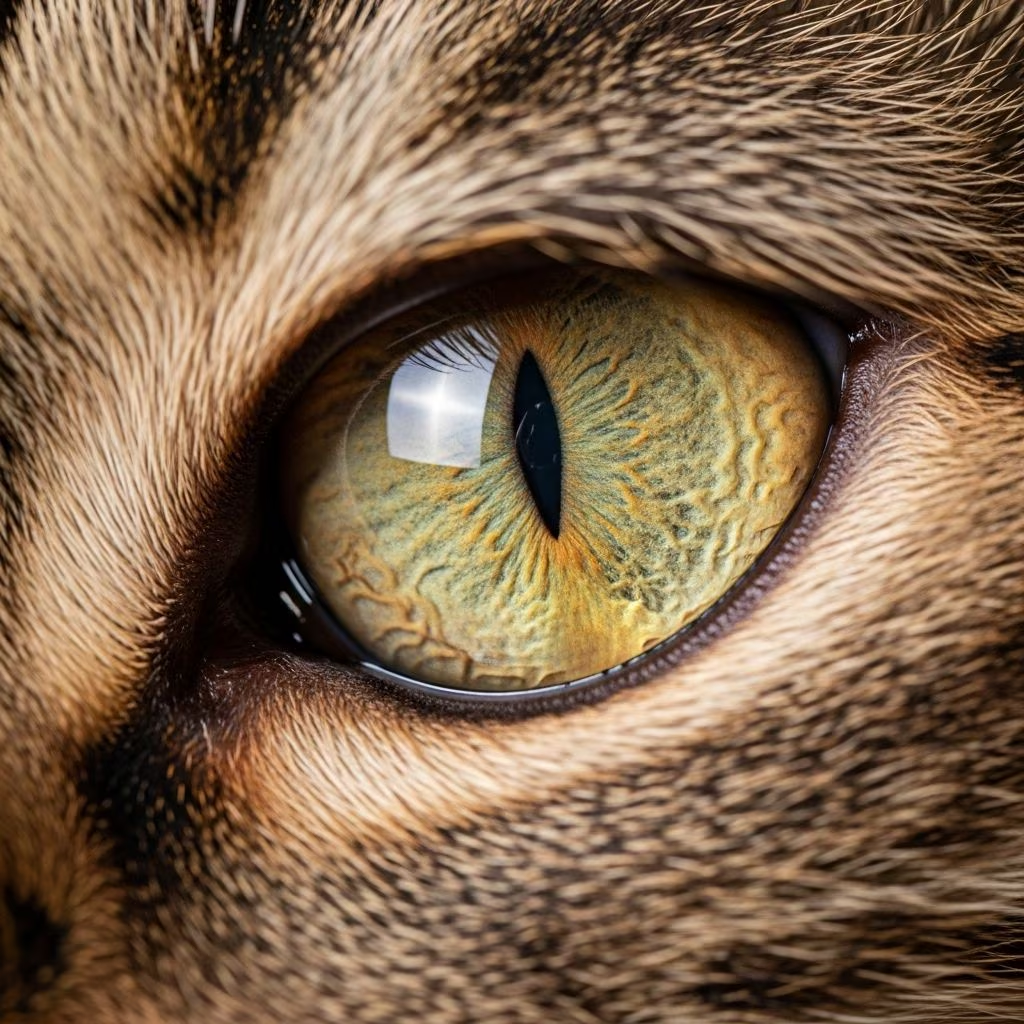
The lens is a critical optical component of the feline eye, working in concert with the cornea to focus light precisely onto the retina. When the lens becomes compromised—whether through displacement, structural changes, or degenerative processes—it can significantly impact your cat’s vision and overall ocular health. This guide explores the various lens disorders affecting cats, their underlying mechanisms, clinical presentation, and the spectrum of management approaches available to veterinary professionals and cat owners.
The Lens: Structure and Function in Feline Vision
The feline lens is a transparent, biconvex structure suspended within the eye by delicate protein fibers called zonules. These zonular fibers maintain the lens in its optimal position, allowing it to adjust shape for accommodation and maintain proper focus. The lens is composed of lens fibers that are continuously produced throughout life, with older fibers being compressed toward the center. Understanding the lens’s architectural complexity is essential for comprehending how various pathological processes can disrupt normal vision.
The lens contributes approximately one-third of the eye’s refractive power, making it indispensable for clear vision. Any deviation from its normal anatomical position or optical clarity can result in visual degradation and related complications affecting other ocular structures.
Lens Displacement: When Position Goes Wrong
Lens displacement, also referred to as lens luxation or subluxation depending on severity, represents one of the most significant lens pathologies in feline patients. This condition occurs when the zonular fibers that normally anchor the lens weaken or rupture, allowing the lens to shift from its proper location within the eye.
Distinguishing Partial from Complete Displacement
Lens displacement exists on a continuum. Subluxation indicates partial displacement where the lens remains partially supported by remaining zonular fibers, while the lens maintains some connection to its normal anatomical position. In contrast, luxation describes complete displacement where zonular support is entirely lost. The lens may move forward (anterior luxation) into the anterior chamber, or backward (posterior luxation) toward the vitreous.
Anterior luxation represents an ocular emergency. When the lens moves forward into the anterior chamber, it physically blocks aqueous humor circulation, rapidly elevating intraocular pressure and triggering glaucoma. This progression can occur within hours of initial displacement, making prompt recognition and treatment critical for vision preservation.
Primary Causes of Displacement
Multiple etiological factors can precipitate lens displacement in cats:
- Zonular degeneration: Age-related weakening of the zonular fibers is common in elderly cats, representing a primary degenerative process rather than a secondary consequence of other disease.
- Chronic anterior uveitis: Persistent inflammation within the eye gradually damages zonular structures, undermining lens support.
- Glaucoma: Elevated intraocular pressure can mechanically damage zonular fibers through increased tension.
- Advanced cataract formation: As lens proteins accumulate and the lens becomes denser, swelling and physical changes can stress zonular attachments.
- Ocular trauma: Direct injury to the eye can acutely rupture zonular fibers.
- Inherited zonular weakness: Some cat breeds may have genetic predisposition to zonular insufficiency.
Clinical Recognition: Signs of Lens Displacement
Cat owners and veterinarians should remain alert for specific clinical indicators suggesting lens displacement. Early detection is paramount, as prompt intervention can prevent vision loss and alleviate pain.
Observable Symptoms
- Pupillary abnormalities: The affected eye’s pupil may appear enlarged, irregularly shaped, or asymmetrical compared to the contralateral eye.
- Corneal changes: The cornea may appear cloudy, hazy, or swollen (edema), indicating elevated intraocular pressure.
- Visible lens displacement: The lens itself may be visibly displaced from its normal central position, appearing in the anterior chamber or shifted within the vitreous.
- Conjunctival redness: The white portion of the eye becomes injected and inflamed.
- Excessive tearing and squinting: Pain manifestations include increased lacrimation and blepharospasm.
- Behavioral changes: Affected cats may paw at the affected eye, prefer dimmed lighting, or display reluctance to move (photophobia and proprioceptive hesitation from vision loss).
- Vision loss evidence: Progressive collision with objects, reluctance to navigate dimly lit areas, or altered movement patterns suggest functional vision impairment.
The severity and progression of clinical signs vary based on whether displacement is anterior or posterior, and whether secondary glaucoma develops. Anterior luxations typically cause acute, severe presentations, while posterior luxations may produce more insidious clinical courses.
Diagnostic Approach and Evaluation
Accurate diagnosis requires systematic ophthalmological assessment. A comprehensive examination should include multiple complementary diagnostic modalities:
Examination Techniques
| Diagnostic Method | Purpose | Clinical Application |
|---|---|---|
| Ophthalmic Examination | Direct visualization of anterior and posterior eye structures | Identifies lens position, assesses chamber depth, evaluates iris and pupil |
| Tonometry | Measures intraocular pressure | Detects glaucoma development; critical for emergency cases |
| Slit-Lamp Biomicroscopy | High-magnification detailed examination of anterior segment | Visualizes subtle zonular damage, assesses lens clarity and position |
| Ultrasound Imaging | Non-invasive visualization of posterior segment structures | Evaluates retinal position, detects detachment, assesses vitreous |
| Fundoscopy | Examination of retina and optic nerve | Assesses for retinal damage, detachment, or atrophic changes |
These diagnostic tools collectively establish the diagnosis, determine severity, and identify secondary complications that inform treatment decisions.
Secondary Complications: Understanding the Cascade
Lens displacement frequently triggers cascading ocular pathology. Understanding these potential sequelae is essential for comprehensive management:
Glaucoma Development
Anterior lens luxation creates a mechanical obstruction to aqueous humor outflow, precipitating rapid pressure elevation. Intraocular pressures may exceed 40-50 mmHg (normal is 15-25 mmHg), causing both acute pain and chronic damage to retinal ganglion cells and the optic nerve. This represents the most common and severe complication of anterior luxation.
Uveitis and Inflammation
Lens movement stimulates inflammatory responses affecting the iris, ciliary body, and anterior chamber. The lens is perceived as a foreign body, triggering immune-mediated inflammation. This creates a cycle where inflammation damages zonular fibers further, potentially precipitating complete luxation in subluxated cases.
Additional Sequelae
Lens displacement can also precipitate:
- Retinal detachment from vitreous traction and altered intraocular pressure dynamics
- Hyphema (bleeding into the anterior chamber)
- Cataract formation from lens epithelial cell damage
- Progressive vision loss and eventual blindness
- Chronic pain requiring long-term management
Medical Management Strategies
Conservative pharmaceutical approaches are appropriate for specific clinical scenarios, particularly early-stage subluxation without glaucoma or posterior luxation.
Glaucoma Medications
When intraocular pressure elevation is detected or anticipated, medications reducing aqueous humor production prove highly effective:
- Carbonic anhydrase inhibitors: Dorzolamide and brinzolamide administered topically every 8 hours reduce aqueous humor synthesis, effectively lowering pressure.
- Beta-blockers: Timolol (every 12 hours) decreases aqueous humor production through ciliary body effects.
- Miotic agents: Latanoprost and demecarium bromide constrict the pupil, increasing lens-iris contact area and providing mechanical support to prevent progression from subluxation to complete luxation. These agents simultaneously provide excellent pressure control.
The combination of miotic therapy with pressure-reducing medications offers synergistic benefits in lens instability, addressing both mechanical support and glaucoma prevention.
Anti-inflammatory Therapy
Controlling inflammation is equally critical. Topical corticosteroids (prednisolone acetate or dexamethasone in alcohol) are generally preferred over topical nonsteroidal anti-inflammatory drugs, as NSAIDs may paradoxically exacerbate glaucoma. In cats specifically, oral pain management with buprenorphine addresses discomfort associated with inflammation and photophobia, improving quality of life during medical management.
Long-term Medical Management
Many cats adapt to posterior luxation or anterior luxation without glaucoma, becoming apparently pain-free after weeks of appropriate medical therapy. Provided glaucoma does not develop and pain resolves, medical management can continue indefinitely. However, this approach carries ongoing risk of glaucoma development, lens-induced uveitis, and retinal complications, making informed owner discussion about long-term surgical options essential.
Surgical Interventions and Procedural Options
Surgical lens removal becomes indicated in specific clinical scenarios where medical management proves insufficient or when vision preservation is possible.
Extracapsular Lens Extraction
Phacoemulsification represents the most commonly performed extracapsular technique. This microsurgical procedure removes the lens nucleus and cortex while leaving the lens capsule intact. This approach maintains some structural anatomy and may be preferable when residual zonular support exists or when capsular tension rings can be inserted to provide 360-degree mechanical support.
Intracapsular Lens Extraction
When complete zonular loss has occurred, intracapsular lens extraction (ICLE) removes the entire lens including its capsule. The “open sky” surgical approach involves creating a superior corneal incision of 120-180 degrees, allowing complete lens removal. Historical studies report immediate post-operative vision in approximately 72% of cases, declining to 61% at three months and 53% at twelve months, reflecting progressive retinal or optic nerve degeneration from secondary complications.
Mechanical Lens Repositioning
In selected cases, anterior luxated lenses have been successfully repositioned posteriorly using cotton swab pressure applied to the cornea, avoiding needle penetration. This non-surgical approach achieved successful posterior reduction in 17 of 20 eyes in one series, though long-term success requires pharmacological support with miotic agents. Vision outcomes were modest, with approximately 54% retaining functional vision at last assessment.
Prognosis and Long-term Expectations
Vision outcomes following lens displacement vary considerably based on several factors:
- Timing of intervention: Early detection and treatment offer substantially better prognosis than delayed intervention allowing secondary complications to develop.
- Presence of glaucoma: Pre-existing glaucoma indicates retinal damage and dramatically worsens prognosis. Vision loss from glaucoma-related optic nerve damage is irreversible.
- Retinal detachment: Detached retina precludes vision restoration, fundamentally altering prognosis toward management of remaining vision.
- Surgical candidacy: Vision potential and freedom from severe inflammation determine candidacy for lens removal.
- Bilaterality: Lens displacement frequently affects both eyes, though often not simultaneously, necessitating monitoring of the contralateral eye.
A favorable prognosis requires early detection, prompt treatment initiation, and absence of advanced secondary complications. Conversely, delayed diagnosis frequently results in permanent vision loss or necessitates eye removal in cases of irreversible damage.
Post-treatment Care and Monitoring
Following medical or surgical intervention, systematic monitoring ensures optimal outcomes. Immediate post-operative evaluation within 24 hours establishes baseline healing, followed by comprehensive re-examination at three-month intervals. Referral to veterinary ophthalmology specialists facilitates advanced evaluation for secondary glaucoma, retinal detachment, and other complications.
Continued pharmacological management may be necessary indefinitely, with periodic pressure measurements and inflammation assessment guiding medication adjustments.
Cataracts: When Lens Clarity Deteriorates
Beyond displacement disorders, cataract formation represents another significant lens pathology in aging cats. Cataracts result from progressive protein aggregation and cross-linking within lens fibers, causing progressive opacity. When significant inflammation accompanies cataracts, surgical intervention may be contraindicated, emphasizing the importance of early cataract evaluation and management before advanced inflammatory changes develop.
Conclusion: Comprehensive Feline Lens Care
Feline lens disorders present complex diagnostic and therapeutic challenges requiring systematic evaluation and individualized treatment planning. Whether addressing displacement, cataract formation, or associated inflammatory changes, prompt recognition and evidence-based management optimize outcomes and preserve quality of life. Cat owners should remain vigilant for ocular changes and seek immediate veterinary evaluation when abnormalities develop, particularly when pupillary changes, corneal cloudiness, or behavioral alterations suggest lens pathology. Collaboration between primary care veterinarians and ophthalmology specialists ensures comprehensive care addressing both the primary lens disorder and its potentially devastating sequelae.
References
- Lens Instability (Luxation/Subluxation) In the Dog & Cat — MSPCA Angell Animal Medical Center. https://www.mspca.org/angell_services/15148-2/
- Lens Luxation in Cats: A 2025 Vet Guide to Symptoms, Causes, Treatment — Ask a Vet. 2025. https://askavet.com/blogs/news/lens-luxation-in-cats-a-2025-vet-guide-to-symptoms-causes-treatment-
- Dislocated Eye Lens in Cats — PetMD. https://www.petmd.com/cat/conditions/eyes/c_ct_lens_luxation
- How To Treat Lens Luxation In Dogs And Cats — PetCareRx. https://www.petcarerx.com/article/how-to-treat-lens-luxation-in-dogs-and-cats/1721
- Lens Luxation — Animal Vision Care & Surgical Center. https://animalvisioncare.com/eye-conditions/feline/lens-luxation/
- Disorders of the Lens in Cats — Cat Owners — MSD Veterinary Manual. https://www.msdvetmanual.com/cat-owners/eye-disorders-of-cats/disorders-of-the-lens-in-cats



