

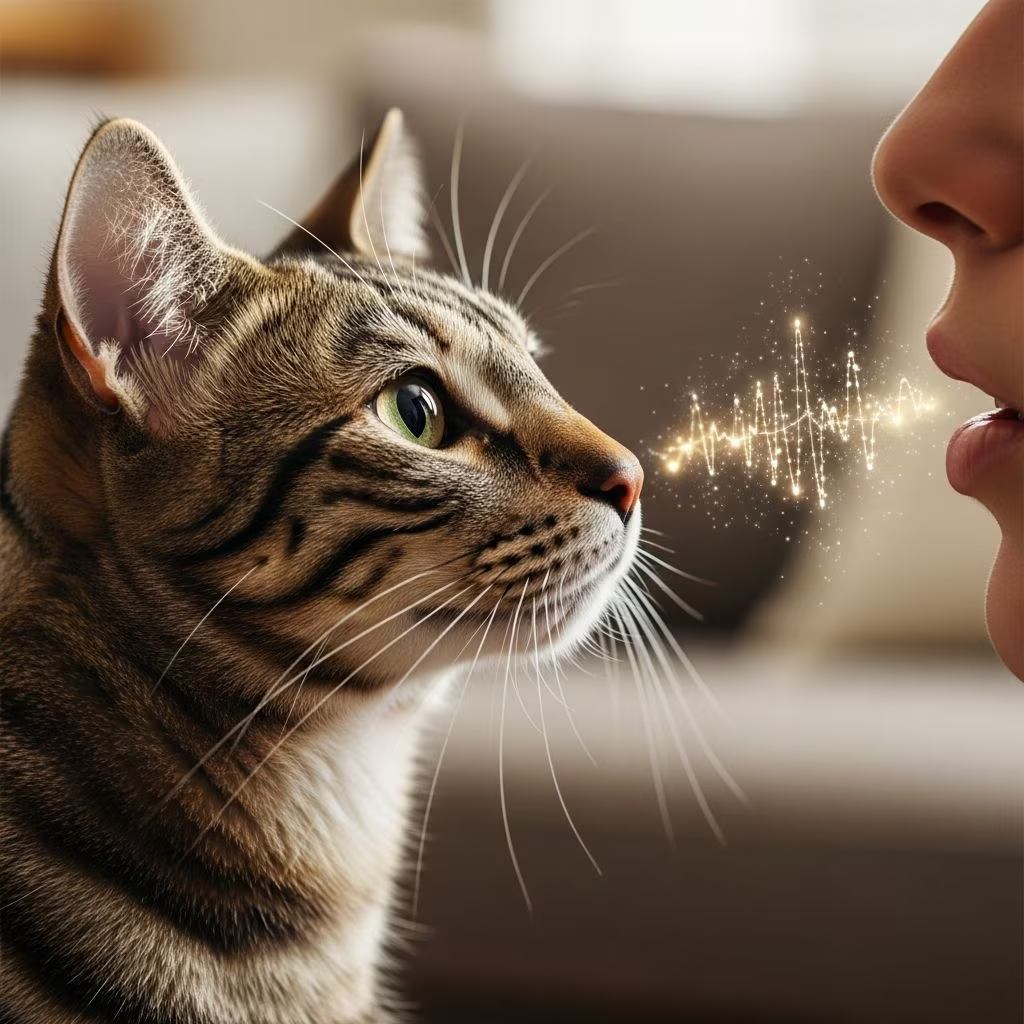
For generations, pet owners have wondered whether their feline companions actually understand what they’re saying. The common stereotype suggests that cats are aloof creatures who selectively ignore their humans, choosing only to acknowledge communication when it suits them. However, recent advances in animal cognition research have revealed a far more nuanced picture of how cats process and respond to human language.
The Complexity of Feline Linguistic Perception
Contrary to the assumption that cats only recognize basic words like their names or “treat,” scientific evidence demonstrates that feline cognitive abilities extend far beyond simple word recognition. Cats possess a sophisticated capacity to distinguish between different types of human communication and respond selectively based on context and familiarity.
Research examining animal cognition has focused on a fascinating distinction: how cats differentiate between adult-directed speech (communication between two humans) and cat-directed speech (communication specifically aimed at felines). This differentiation reveals that cats are not merely passively hearing sounds—they are actively processing the intent and target of human communication.
Acoustic Discrimination and Speaker Recognition
One of the most compelling findings in recent cat cognition studies involves the animal’s ability to recognize and respond differently to various vocal patterns. When humans engage in person-to-person conversation, cats demonstrate a notable ability to identify this communication style and, in most cases, consciously ignore it. This selective attention suggests that cats understand the contextual significance of different speech patterns.
When unfamiliar individuals speak in cat-directed tones, cats typically show limited responsiveness. However, when their own human caregivers use cat-directed speech—characterized by higher pitches, exaggerated intonation, and slower cadence—cats demonstrate clear comprehension and intentional interaction. This selective responsiveness indicates that cats recognize not just the linguistic patterns but also the identity of the speaker.
Word-Image Association and Learning Capacity
Perhaps the most surprising discovery in recent feline cognition research involves cats’ ability to form associations between sounds and visual representations. Studies published in peer-reviewed journals demonstrate that cats can learn to connect spoken words with corresponding images at a rate that rivals human infant language acquisition.
What makes this finding particularly significant is that cats accomplish this learning without reward-based training incentives. Unlike dogs, which are motivated by a desire to please their human companions, cats appear to be intrinsically motivated to understand their environment. This independent motivation suggests that cats possess a natural inclination toward processing human language elements, even without external reinforcement.
The ability to form these associations without explicit training indicates that cats may naturally “eavesdrop” on human conversations, gradually building a mental lexicon of words and their meanings simply through exposure and observation.
Multimodal Communication Preferences
Research examining how cats respond to different forms of human communication has revealed important insights about their communicative preferences. While vocal communication is one channel through which humans interact with cats, scientific studies indicate that felines show marked preferences for visual and combined visual-vocal communication modalities.
When interacting with unfamiliar humans, cats demonstrate significantly faster approach times and more positive engagement in response to visual and combined communication methods compared to purely vocal interaction. This preference reflects cats’ natural evolutionary tendency to rely heavily on visual and chemical communication cues when interacting with other cats.
Additionally, cats display enhanced engagement when they perceive that a human is actively paying attention to them, as opposed to situations where humans are ignoring them or not directing communication their way. This awareness of human attention states suggests a sophisticated understanding of social dynamics.
Recognition of Individual Identity and Emotional Context
Beyond recognizing individual words, cats demonstrate the capacity to identify specific humans through both vocal and visual cues. They can mentally map their owner’s location based solely on hearing their voice, suggesting complex cross-modal cognitive processing. This ability to integrate information from different sensory channels indicates that cats create detailed mental representations of their human companions.
Furthermore, research demonstrates that cats can recognize and interpret human emotional expressions, modulating their own behavior in response to the perceived emotional valence of their human’s state. This emotional attunement suggests that cats understand communication at a deeper level than simple word recognition—they grasp the emotional context and intent behind human expression.
The Nature of Feline Language Comprehension
Frequently Asked Questions About Cat Language Understanding
- Do cats actually understand what specific words mean?
- Cats demonstrate word recognition and sound-image association abilities, but their comprehension differs from human language understanding. They learn words through acoustic patterns and contextual associations rather than through semantic meaning in the human sense.
- Why do cats ignore their names sometimes?
- Cats can recognize their names but choose when to respond based on their own motivations and preferences. This selective responsiveness reflects feline independence rather than inability to understand.
- How many words can a cat understand?
- While the exact number varies by individual cat, research suggests cats can associate multiple words with meanings and concepts. The precise count depends on exposure and individual cognitive capacity.
- Is cat-directed speech more effective than normal speech?
- Yes, cats respond more readily to cat-directed speech because they recognize it as communication specifically directed toward them. This specialized speech pattern enhances engagement and responsiveness.
Practical Implications for Cat Communication
Understanding how cats process language has practical implications for cat owners seeking to strengthen communication with their pets. The research suggests that cats benefit from consistent, clear communication that takes their perceptual preferences into account.
When addressing your cat, incorporating visual cues alongside vocal communication creates more effective engagement. Making eye contact, using hand gestures, and maintaining awareness of your own attentional state—whether you’re looking at or away from your cat—all influence how readily they respond to your communication attempts.
The finding that cats naturally associate words with visual referents suggests that pointing at objects while naming them may enhance your cat’s ability to build associations between sounds and their meanings. This approach mirrors how human infants naturally learn language through multimodal exposure.
Individual Variations in Language Comprehension
It’s important to recognize that language comprehension varies significantly among individual cats, much as it does among humans. Factors including age, temperament, prior experiences, and the strength of the human-cat bond influence how readily a cat engages with human communication.
Cats who have spent significant time with particular humans develop increasingly sophisticated understanding of that person’s speech patterns, preferences, and communication style. This deepening comprehension reflects the development of a rich intersubjective relationship rather than simple mechanistic word recognition.
The Evolution of Feline Social Cognition
The cognitive abilities that allow cats to understand human communication represent the development of what researchers call “human-compatible socio-cognitive skills.” These capacities emerged as cats adapted to living in human environments over thousands of years of domestication.
Rather than being “hard-wired” from birth, these language comprehension abilities appear to develop through a combination of evolutionary predisposition and individual learning experiences. Cats possess the neurological infrastructure to process and respond to human communication, and they refine these abilities through exposure and interaction.
Limitations and Open Questions
While recent research has expanded our understanding of feline language comprehension, significant questions remain. Scientists are exploring whether cats understand the semantic meanings of words or merely associate acoustic patterns with contexts and outcomes. Additional research aims to determine whether cats can distinguish between human languages and whether their comprehension extends to more complex linguistic structures.
The challenge in studying feline language understanding stems partly from cats’ lack of the strong social motivation that drives dogs to perform in experimental settings. Researchers have had to develop novel experimental approaches that account for feline independence and intrinsic rather than social motivation.
Conclusion: Rethinking Feline Intelligence
The accumulating evidence from cognitive research fundamentally challenges the stereotype of cats as indifferent to human communication. Cats demonstrate sophisticated abilities to recognize, discriminate, and respond to human language in ways that reflect genuine comprehension rather than simple conditioned responses.
Your cat’s apparent aloofness or selective responsiveness should not be interpreted as failure to understand but rather as an expression of feline autonomy. Cats understand far more than they choose to reveal, and they respond on their own terms according to their own priorities and preferences.
By understanding how cats process human communication—through sound recognition, visual integration, emotional context awareness, and individual speaker identification—pet owners can enhance their interactions with their feline companions. The science of feline cognition reveals that cats are listening, learning, and engaging with human language in surprisingly sophisticated ways.
References
- Multimodal Communication in the Human–Cat Relationship — PMC/National Institutes of Health. 2023. https://pmc.ncbi.nlm.nih.gov/articles/PMC10177025/
- Cats beat babies at word-association game — Science Magazine. 2024. https://www.science.org/content/article/cats-beat-babies-word-association-game
- Cats can associate sounds and images, a basic precursor of language — PNAS (Proceedings of the National Academy of Sciences). 2024. https://www.pnas.org/post/journal-club/cats-can-associate-sounds-and-images-basic-precursor-language
- Can Cats Understand Words? — PetMD. 2024. https://www.petmd.com/cat/general-health/can-cats-understand-words
- Researchers: Cats can eavesdrop on human conversations — sort of — Mind Matters. 2024. https://mindmatters.ai/brief/researchers-cats-can-eavesdrop-on-human-conversations-sort-of/



