

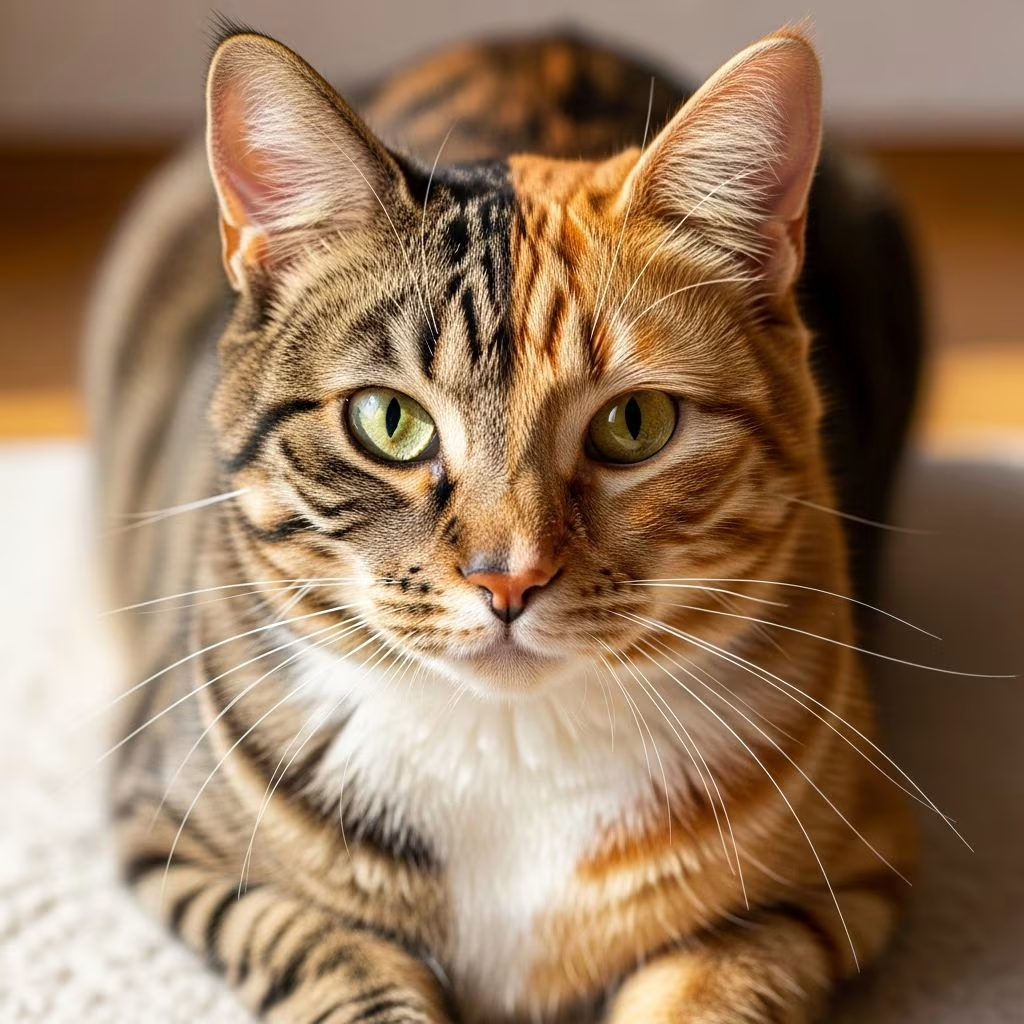
The mesmerizing variety in cat coats—from sleek black Persians to tabby-striped alley cats—stems from intricate genetic mechanisms. These genes orchestrate pigment production, pattern formation, fur length, and texture, creating endless combinations that define each cat’s appearance.
Foundational Pigments in Feline Fur
At the core of cat coat coloration lie two primary pigments: eumelanin, responsible for black and brown hues, and phaeomelanin, which produces red and orange tones. The B locus gene governs eumelanin variations, with the dominant B allele yielding black, recessive b for chocolate, and b¹ for cinnamon.
Dilution further modifies these pigments via the D gene. Dominant D maintains intense colors, while recessive dd lightens black to blue-gray, chocolate to lilac, and cinnamon to fawn.
| Gene Locus | Dominant Allele | Effect | Recessive Allele | Effect |
|---|---|---|---|---|
| B (Eumelanin) | B | Black | b | Chocolate |
| b¹ | Cinnamon | |||
| D (Dilution) | D | Full intensity | d | Diluted (e.g., blue) |
The Role of Sex-Linked Orange Gene
The orange or red coloration is uniquely tied to the X chromosome through the O locus. Males (XY) need only one O allele for orange fur, explaining why most ginger cats are male—about 80% according to genetic observations. Females (XX), however, require OO for full orange, with Oo producing tortoiseshell or calico patterns due to X-inactivation, where cells randomly express one X chromosome, creating patches of orange and non-orange fur.
- O allele (dominant): Triggers phaeomelanin, replacing eumelanin with red pigment.
- o allele (recessive): Allows eumelanin expression (black/brown).
- Tortoiseshell effect: Oo females show mosaic black and orange due to cellular mosaicism.
Agouti and Tabby Patterns: Nature’s Stripes
The agouti gene (A locus) creates the banded hairs typical of tabby coats, alternating eumelanin and phaeomelanin bands for a ticked appearance. Dominant A produces agouti (ticked or tabby base), while recessive aa results in solid colors by uniformly pigmenting hairs.
Tabby patterns—mackerel (striped), classic (swirled), and ticked—are influenced by multiple genes, including Taqpep for stripe formation. A threonine-to-asparagine mutation at residue 139 drives tabby phenotypes in domestic cats.
- Mackerel tabby: Narrow stripes, most common wild-type pattern.
- Classic tabby: Bold swirls and marbling.
- Ticked tabby: Rare, uniform ticking without stripes, fixed in breeds like Abyssinian (Ti^A allele).
White Coats and Spotting Variations
White areas arise from KIT gene mutations disrupting melanocyte migration. Dominant white (W^D) causes full white coats, often with blue eyes and deafness risk, overriding all other colors.
White spotting (W^S) produces variable patches, from bicolor to nearly all-white, also KIT-linked. Recessive gloving in Birmans (wg) adds white paws.
Albinism via TYR gene (C locus) leads to white fur: dominant C for full color, recessive c^s for temperature-sensitive points (Siamese), and c for complete albinism.
| White Type | Gene | Characteristics | Health Notes |
|---|---|---|---|
| Dominant White | KIT (W^D) | Full white, masks colors | Deafness risk, blue eyes |
| Spotting | KIT (W^S) | Patches, variable | Generally healthy |
| Colorpoint | TYR (c^s) | Dark extremities | Temperature-sensitive |
Shaded, Silver, and Tipped Coats
Silver coats inhibit eumelanin in hair roots via the I gene, creating bright tips over smoky undercoats. Combined with wide-band factors (wb), this yields chinchilla (tipped) or shaded patterns.
Golden variants involve CORIN gene, reversing silver to produce warm bases. Tabby genes like T^a mask patterns in shaded cats.
Coat Length: From Shorthair to Longhair
Fur length is primarily controlled by the FGF5 gene. Dominant L allele codes short coats; recessive l mutations produce long fur. Four distinct l mutations exist: one ubiquitous in longhaired breeds, others breed-specific (Ragdoll, Norwegian Forest, Maine Coon).
- Short hair (L): Most domestic cats.
- Long hair (l/l): Persians, Maine Coons; requires two recessive alleles.
Texture Variations in Feline Fur
Beyond length, texture genes create unique feels. The Wh gene (dominant) bends hairs for wiry coats in American Wirehairs. A hypothetical Yuc gene reduces undercoat in York Chocolates, emphasizing guard hairs.
These traits enhance breed diversity, from plush Persians to curly Selkirks (yet unmentioned but implied in genetic breadth).
Genetic Interactions and Breeding Insights
Coat traits rarely act alone; epistasis (gene masking) is common. Dominant white hides all else, while agouti modifies tabby expression. Breeders use Punnett squares to predict outcomes, vital for health screening against deafness or cancer in white cats.
DNA tests from labs like UC Davis confirm genotypes for breeding programs.
Health Implications of Coat Genes
Certain alleles link to conditions: KIT whites risk deafness (up to 80% in blue-eyed dominants), colorpoints may have vision issues. Awareness aids responsible ownership.
FAQs on Cat Coat Genetics
Why are most orange cats male?
The O gene on X chromosome means males need one copy; females need two, skewing ratios.
Can two black cats have orange kittens?
Yes, if both carry hidden O alleles; black masks orange in non-OO combos.
What’s the rarest cat coat genetically?
True ticked tabbies or specific longhair mutations are scarce outside fixed breeds.
Do coat genes affect personality?
No direct link; patterns are cosmetic, behavior polygenic.
How to test my cat’s coat genetics?
Vet genetics labs like UC Davis offer kits for color, length loci.
Understanding these genetics deepens appreciation for cats’ diversity, guiding breeding, adoption, and care.
References
- Cat coat genetics — Wikipedia. 2023-10-15. https://en.wikipedia.org/wiki/Cat_coat_genetics
- Cat Coat Genetics and Science — Basepaws. 2023-01-01. https://basepaws.com/blog/cat-coat-genetics
- The Genetics of Cat Colours and Coat Types — Melbourne Cat Vets. 2023-05-20. https://www.melbournecatvets.com.au/post/the-genetics-of-cat-colours-and-types-unlocking-the-mystery-of-feline-fur-part-1
- Cat Genetics: A Progressive Look at Coat Colors & Patterns — Liz’s Kitty Bootcamp. 2020-08-24. https://lizskittybootcamp.com/2020/08/24/cat-genetics-a-progressive-look-at-coat-colors-patterns/
- Feline Coat Color — Veterinary Genetics Laboratory, UC Davis. 2024-01-10. https://vgl.ucdavis.edu/resources/cat-coat-color
- Cat Genetics 2.0: Colours — Labogenvet. 2023-11-05. https://labgenvet.ca/en/cat-genetics-2-0-colours/



