

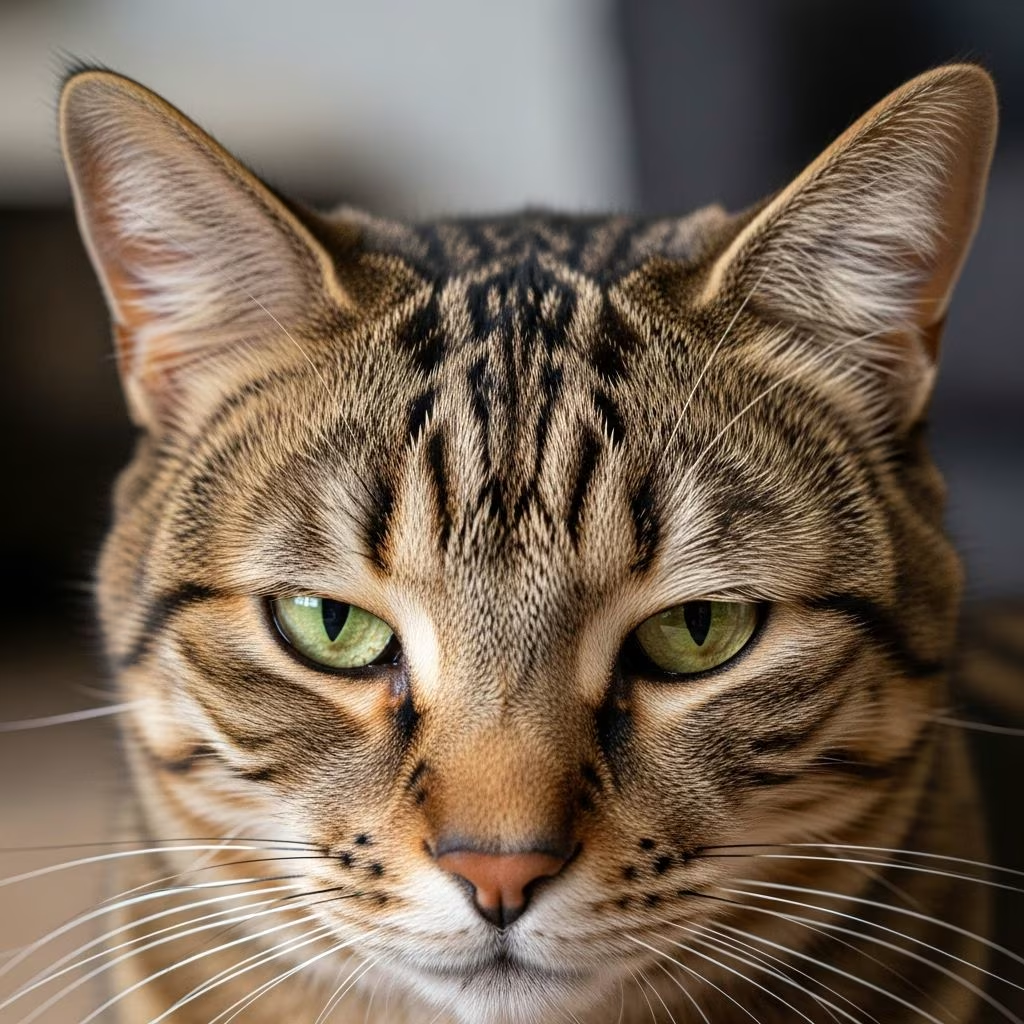
Among the most captivating features of feline companions is the distinctive marking that appears on the foreheads of tabby cats. This mysterious letter-shaped pattern has intrigued cat lovers and scientists alike for generations, spawning both scientific investigation and imaginative folklore. Whether your domestic companion displays bold tiger stripes or delicate swirled patterns, chances are you’ve noticed that unmistakable symbol etched across their brow. Understanding this remarkable characteristic requires exploring both the molecular biology underlying feline coat patterns and the cultural narratives that have grown around these beloved animals throughout history.
Unveiling the Universal Tabby Gene
A surprising truth about cat genetics is that virtually every domestic cat carries the tabby gene within their DNA. This revelation fundamentally changes how we understand feline diversity. Rather than being a rare or special trait, tabby patterning represents one of nature’s most basic blueprints for feline coat design. The cats we perceive as solid-colored or patterned in other ways often possess dormant tabby genetics that remain hidden beneath other coat characteristics.
When a cat displays suppressed tabby markings, these animals are sometimes called “diluted tabbies,” referring to the genetic masking that obscures their underlying pattern. A solid black cat or a calico feline may actually be a tabby underneath—the visual expression simply remains concealed by other genetic factors that take precedence in determining coat appearance. However, even among these genetically masked tabbies, one marking frequently refuses to disappear entirely: the distinctive frontal “M.”
The Genetic Architecture Behind Feline Coat Patterns
The complexity of tabby markings involves multiple genetic components working in concert. Two primary gene locations, along with various modifying factors, orchestrate the development of feline coat patterns. The agouti gene locus and the tabby locus, each containing multiple alleles, collaborate to determine whether a cat will display mackerel stripes, classic blotched patterns, ticked coats, or spotted variations.
A particularly important discovery in feline genetics involves the DKK4 gene, which plays a crucial role during fetal development. During the early stages of kitten gestation, this gene activates in specific regions while remaining dormant in others, essentially creating a developmental map across the growing feline body. Where the DKK4 gene expresses itself, skin tissue thickens, and these thickened regions subsequently produce darker pigmentation. The inactive areas, by contrast, generate lighter-colored fur. This biological process creates what amounts to a predetermined pattern that emerges as the kitten develops, similar to how a topographical map guides the placement of roads and pathways.
The Taqpep Gene and Pattern Variation
While the DKK4 gene establishes the basic framework for tabby markings, another genetic player—the Taqpep gene—determines the specific visual characteristics of those patterns. Cats inheriting one version of this gene typically display narrow, well-defined stripes characteristic of mackerel tabbies. Conversely, cats carrying a mutant variant of the Taqpep gene develop the large, flowing whorls and swirls associated with classic tabby patterns. Interestingly, the swirl variant appears more frequently among feral cat populations, suggesting possible evolutionary advantages in wild environments.
The Four Fundamental Tabby Patterns
Genetic researchers have identified four distinct tabby coat variations, each with characteristic features:
- Mackerel Tabby: Features thin, parallel stripes running along the body, resembling the striped pattern of a mackerel fish. These cats display prominent facial markings and slender bands across their torso and limbs.
- Classic Tabby: Characterized by thick, swirling bands that create whorled patterns, often with distinctive bullseye-like markings on the sides of the body. This pattern is the most common among modern domestic cats, with approximately 80% carrying the recessive allele responsible for this appearance.
- Ticked Tabby: Displays minimal visible stripes except possibly on the legs and tail. Instead, individual hair shafts contain alternating bands of light and dark coloring, creating a speckled appearance.
- Spotted Tabby: Features discrete spots rather than continuous stripes or whorls, distributed across the body in organized patterns.
The Persistent Mystery of the Frontal M
Despite extensive genetic research, scientists have not definitively determined why the “M” marking appears across virtually all tabby varieties, regardless of their other coat characteristics. The most plausible explanation relates to the geometry of feline facial structure. Tabby cats typically develop fine, delicate markings across their faces and legs, while their torsos display bolder, more dramatic patterns. The limited surface area available on a cat’s forehead essentially concentrates these thin lines into a configuration that naturally resembles the letter “M”. Rather than serving a specific biological function, the marking appears to be an incidental consequence of how feline facial dimensions accommodate tabby patterning.
Ancient Legends and Cultural Narratives
Throughout human history, the “M” marking has inspired numerous explanations rooted in mythology and religious tradition. While these accounts lack scientific basis, they reveal much about how different cultures have revered and interpreted feline characteristics.
The Christian Account of Maternal Gratitude
One widespread legend connects the tabby marking to the Christian nativity story. According to this narrative, Jesus was born in a manger and lacked adequate blankets to maintain warmth during the cold night. Despite Mary’s efforts to warm her newborn through physical closeness and by encouraging nearby animals to provide body heat with their proximity, the infant continued to shiver. As circumstances grew increasingly desperate, a compassionate tabby cat entered the stable and positioned itself beside the baby, using its own body warmth and soothing purrs to calm the distressed child. Grateful for this act of comfort and companionship, Mary blessed the cat by stroking its forehead, and her touch allegedly left behind the impression of her initial as a permanent mark of appreciation and honor.
Egyptian Symbolism and Celestial Connection
Another cultural tradition attributes the marking to ancient Egyptian reverence for cats. According to this mythology, the “M” was intentionally placed on tabby cats’ foreheads to symbolize their elevated status within society as well as their mystical connection to lunar cycles and celestial forces. The Egyptian Mau breed, recognized as one of the oldest continuously existing cat bloodlines, purportedly maintained this sacred marking for centuries as a testament to feline nobility. Some scholars have proposed that the “M” might reference “Mau,” the Egyptian word for cat itself, though this linguistic connection remains speculative.
Islamic Tradition
Additional folklore suggests the “M” commemorates the Prophet Mohammed’s fondness for tabby cats, though historical documentation supporting this claim remains limited. This tradition reflects the historical importance of cats within Islamic culture and their frequent depiction in Islamic art and literature.
Evaluating the Credibility of Ancient Explanations
While these narratives possess considerable charm and cultural significance, they warrant skeptical examination. A fundamental logical problem undermines these mythological accounts: none of the historical figures referenced—whether Mary, Mohammed, or the ancient Egyptian rulers—would have possessed familiarity with the Roman letter “M” as it exists in modern alphabets. This anachronistic inconsistency strongly suggests these stories represent post-hoc attempts to explain an otherwise mysterious biological phenomenon through familiar cultural frameworks rather than authentic historical records.
Visual Identification Across Tabby Variations
Locating the “M” marking requires attention to facial anatomy and lighting conditions. On purebred mackerel tabbies with bold, distinct patterns, the marking typically appears clearly and unmistakably. However, cats with suppressed tabby genetics or diluted coloration may require closer examination from different angles and under varying light conditions to reveal the characteristic shape. Observers should focus attention on the area between and slightly above the cat’s eyes, where the marking develops most prominently across all tabby varieties.
Hereditary Transmission of Tabby Traits
Because the tabby gene demonstrates dominant inheritance patterns, only a single parent carrying tabby genetics is necessary for offspring to inherit tabby markings. Kittens receiving the tabby allele from either mother or father will express the phenotype to varying degrees depending on the specific combination of alleles inherited from both parents. This explains why tabby cats appear so frequently in domestic cat populations and why the trait persists persistently even when breeding programs attempt to develop cats with alternative coat characteristics.
Understanding Genetic Dominance in Feline Coloration
The relationship between tabby genetics and other coat color genes illustrates important principles of feline inheritance. The agouti gene, which controls black pigment production, influences how tabby patterns appear in differently colored cats. Cats carrying the orange color gene will consistently express tabby patterning, though sometimes in muted form, particularly among cream and dilute blue-cream varieties where pigment density affects pattern visibility. This means that even when tabby markings appear subtle or nearly invisible in certain color combinations, the underlying genetic blueprint remains active.
Frequently Asked Questions About Tabby Markings
Do all tabby cats have the M marking?
While the “M” marking appears across virtually all recognized tabby patterns, some cats with heavily diluted genetics may display an extremely faint version that requires careful examination to observe. Additionally, cats where tabby genetics are masked by other coat characteristics may not show any visible “M,” though the genetic information remains present in their DNA.
Can the M marking indicate a cat’s specific tabby type?
No, the “M” appears consistently across all four tabby patterns. Distinguishing between mackerel, classic, ticked, and spotted varieties requires examining the body markings rather than the facial “M” alone.
Is the tabby pattern present in all domestic cats?
Yes, every domestic cat carries the tabby gene, though not all cats display visible tabby markings. Solid-colored cats and those with calico or other patterns often possess dormant tabby genetics masked by other coat determinants.
Do male and female tabby cats show the M marking differently?
Generally, the “M” marking appears consistently regardless of biological sex, though some variations in marking intensity may occur based on overall coat color intensity and individual genetic expression patterns.
Appreciating Feline Diversity Through Genetic Understanding
The investigation into why tabby cats possess this distinctive frontal marking reveals the sophistication of feline genetic systems. What initially appears as a simple curiosity becomes, upon closer examination, a window into developmental biology, inheritance patterns, and the complex interplay of multiple genes determining phenotypic expression. Whether we attribute the “M” to mathematical happenstance or embrace the cultural narratives surrounding it, this marking represents one of nature’s most enduring and recognizable features in the animal kingdom.
The Enduring Appeal of the Tabby Marking
For cat enthusiasts and geneticists alike, the “M” marking continues to fascinate. Each time we observe this symbol on a feline companion’s forehead, we encounter a physical manifestation of millions of years of evolutionary development and thousands of years of human cultural interpretation combined. Whether rooted in genetic necessity or mythological imagination, the tabby cat’s frontal marking remains one of domesticated animals’ most distinctive and beloved characteristics.
References
- Why Do Tabby Cats Have an “M” on Their Foreheads? — Cats.com. https://cats.com/why-do-tabby-cats-have-an-m-on-their-foreheads
- Tabby Cat — Wikipedia. https://en.wikipedia.org/wiki/Tabby_cat
- How Do Tabby Cats Get Their Stripes? — Smore Science. https://www.smorescience.com/how-do-tabby-cats-get-their-stripes/
- The Tabby Cat — NC DNA Day Blog. 2023-12-04. https://ncdnadayblog.org/2023/12/04/the-tabby-cat/



