

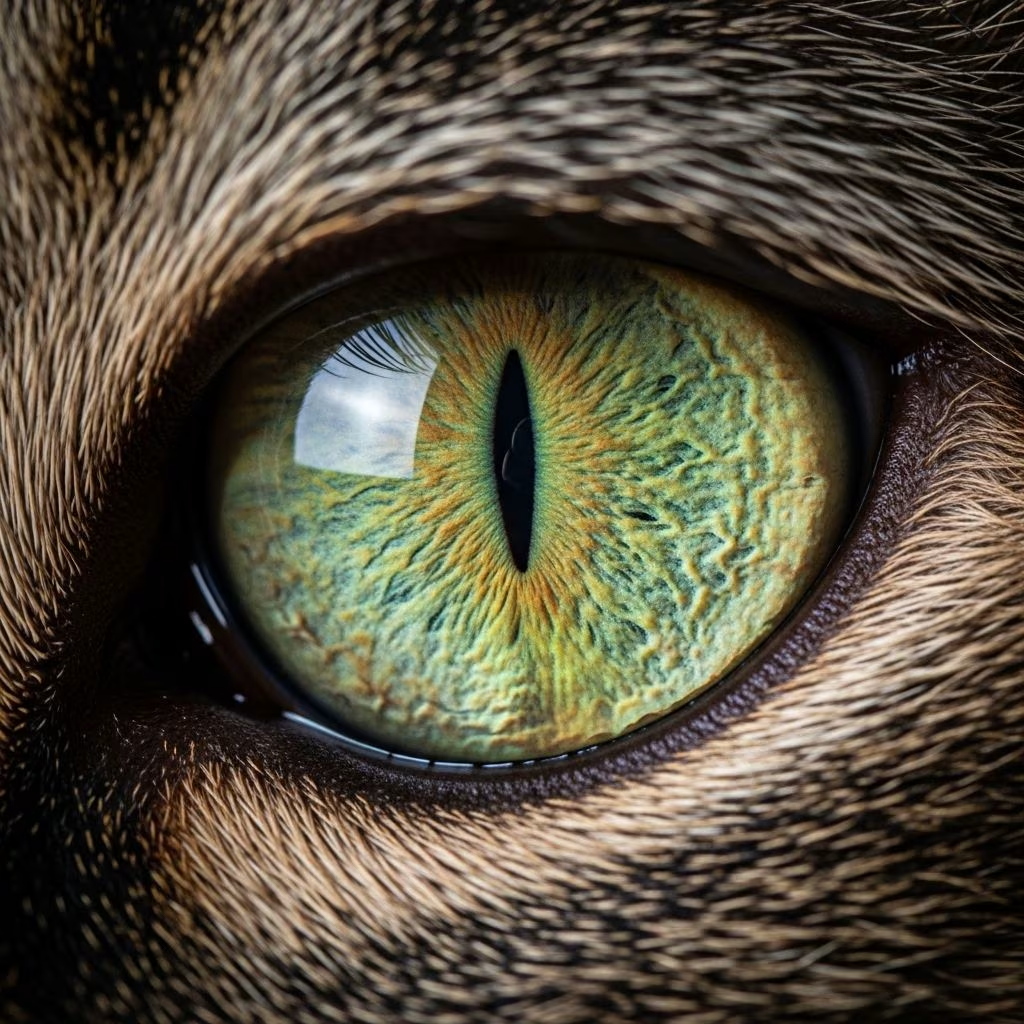
Cat eyes captivate with their glowing allure and piercing gaze, evolved for survival in the wild. These organs surpass human vision in key ways, enabling cats to thrive as nocturnal hunters. This article delves into their intricate design, visual prowess, and health essentials, drawing from veterinary insights to illuminate why feline eyesight remains a biological wonder.
The Architectural Blueprint of Cat Eyes
At the core of a cat’s visual system lies a sophisticated structure divided into protective outer layers, nutrient-rich middle sections, and light-sensitive inner components. The outermost fibrous layer includes the sclera, providing structural integrity like the white of the eye, and the cornea, a transparent dome that shields the interior while refracting incoming light.
Beneath this, the vascular tunic—known as the uveal tract—nourishes the eye. It comprises the choroid, a vascular bed supporting the retina; the ciliary body, which produces aqueous humor for pressure maintenance and lens adjustment; and the iris, the pigmented curtain controlling light entry. The innermost retina converts light into neural signals via photoreceptors, transmitting them through the optic nerve to the brain.
Internally, chambers maintain shape and clarity: the anterior and posterior hold aqueous humor for nourishment, while the vitreous chamber’s gel stabilizes the eyeball. This layered design ensures resilience against impacts during hunts or play.
Positioning and Protective Frameworks
Cats’ eyes sit forward-facing in bony orbits, bony sockets formed by multiple skull bones housing muscles, nerves, and vessels for precise movement. This placement grants a wide field of view with binocular overlap for depth perception, ideal for pouncing on prey.
- Orbits: Secure the eyeball, allowing rotation for scanning environments.
- Eyelids: Skin extensions with conjunctival lining to wipe and moisten the surface.
- Conjunctiva: Thin, vascular membrane covering the sclera and lining lids for lubrication.
Unique to felines, the nictitating membrane—or third eyelid—slides from the inner corner, offering extra shielding during sleep, illness, or rough terrain traversal. It houses a tear gland for added moisture.
Light Regulation: The Dynamic Pupil and Iris
The iris, with its vibrant hues, encircles the pupil—a adjustable aperture. In bright light, the pupil narrows to a vertical slit via sphincter muscles, minimizing glare; in darkness, it dilates round for maximum light capture. This elliptical constriction, rarer in mammals, sharpens focus on moving objects, aiding predatory accuracy.
Compared to dogs or humans, cat corneas and pupils are larger, funneling more photons for enhanced low-light performance.
Focus Mechanism: Lens and Ciliary Mastery
Behind the iris, the lens—a biconvex, elastic structure—fine-tunes focus. Ciliary muscles thicken it for near vision or thin it for distance, though cats favor close-range acuity suited to stalking. This accommodation supports judging prey proximity.
Photoreception: Rods, Cones, and the Tapetum Glow
The retina’s photoreceptors—rods for dim light and motion, cones for color and detail—cluster in the area centralis for high-resolution central vision. Cats possess fewer cones, perceiving blues and greens but limited reds, prioritizing sensitivity over vibrancy.
The tapetum lucidum, a reflective choroid layer, bounces unabsorbed light back through the retina, amplifying night vision sixfold and causing eyeshine. This adaptation turns twilight into huntable daylight for felines.
| Feature | Cat Eyes | Human Eyes |
|---|---|---|
| Pupil Shape | Vertical slit (constricted) | Circular |
| Low-Light Aid | Tapetum lucidum | None |
| Color Vision | Dichromatic (blue/green) | Trichromatic (RGB) |
| Motion Sensitivity | High (rod-dominant) | Moderate |
Night Vision Supremacy
Cats detect motion in near-darkness, seeing at light levels 1/6th of humans, thanks to abundant rods and tapetum reflection. Forward-facing eyes provide 200-degree fields with stereopsis for leaps. Their world emphasizes movement over fine color details.
Breed Variations in Ocular Design
Breeds like Persians feature prominent eyes with wider palpebral fissures, increasing exposure but risking issues like entropion. Siamese often show blue eyes from albinism-linked genes, altering pigmentation without impairing function. brachycephalic faces demand vigilant care to prevent corneal scratches.
Common Eye Health Indicators
Monitor for redness, discharge, cloudiness, or third eyelid protrusion signaling infection, allergies, or systemic woes like FIV. Excessive tearing or squinting warrants vet attention.
- Clear cornea and sclera: Healthy norms.
- Prompt pupil response to light: Intact neurology.
- No nictitans exposure: Absent inflammation.
Vital Care Practices for Optimal Vision
Gently wipe eye corners with damp cloths; avoid irritants. Annual vet exams detect glaucoma or cataracts early. Nutritious diets with taurine preserve retinal health.
Visual World from a Cat’s Perspective
Imagine a motion-blurred, greenish-blue realm where shadows teem with prey silhouettes. Cats’ elevated contrast sensitivity spots camouflaged rodents humans overlook.
Frequently Asked Questions
Why do cat eyes glow green at night?
The tapetum lucidum reflects flashlight beams, creating eyeshine for enhanced visibility.
Can cats see in pitch black?
No, but they navigate with minimal light via rods and reflections, far better than humans.
What causes third eyelid showing?
Dehydration, illness, or stress; persistent cases need veterinary evaluation.
Do all cats have slit pupils?
Yes, domestic cats feature vertical slits for hunting precision, unlike round pupils in prey animals.
How far can cats see clearly?
Excellent near vision up to 20 feet; distance acuity drops, suiting ambush tactics.
Conclusion
Feline eyes embody evolutionary genius, blending protection, adaptability, and acuity for predatory excellence. Understanding them fosters better guardianship.
References
- Structure and Function of the Eyes in Cats — PetPlace. Accessed 2026. https://www.petplace.com/article/cats/pet-health/structure-and-function-of-the-eyes-in-cats
- How Do Cats See the World? What To Know about Cat Vision — PetMD. Accessed 2026. https://www.petmd.com/cat/general-health/cat-vision
- Eye Structure and Function in Cats — My Lovely Feline (Dr. Leslie Brooks). Accessed 2026. https://mylovelyfeline.com/blogs/content/eye-structure-and-function-in-cats
- Eye Structure and Function in Cats — Merck Veterinary Manual. Accessed 2026. https://www.merckvetmanual.com/cat-owners/eye-disorders-of-cats/eye-structure-and-function-in-cats
- Feline Ophthalmology Part 1: Examination of the Eye — EyeVet.ie. 2009. https://www.eyevet.ie/wp-content/uploads/2009/02/feline-ophthalmology-part-12.pdf
- The Anatomy and Function of a Cat’s Third Eyelid — All About Vision. Accessed 2026. https://www.allaboutvision.com/eye-care/pets-animals/cat-third-eyelid/



