

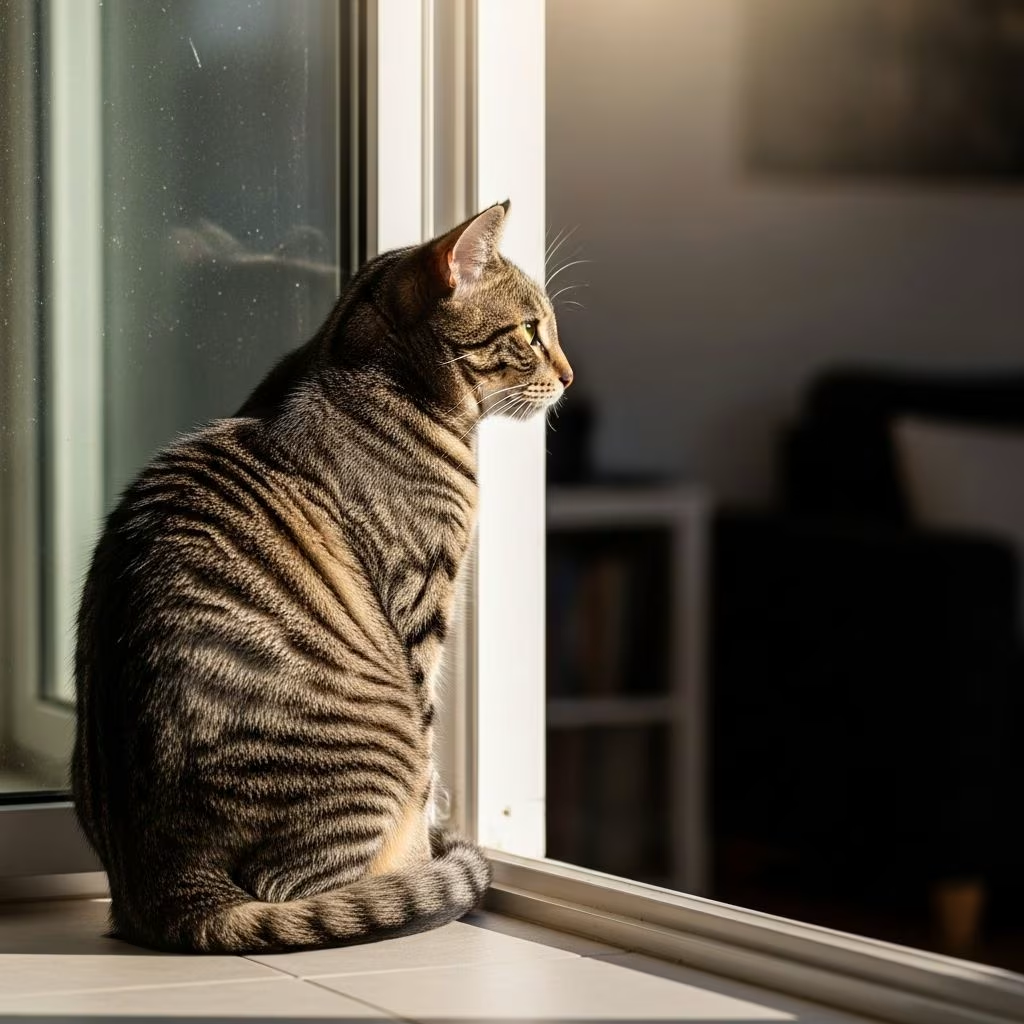
For decades, cats have maintained a reputation as solitary, independent creatures who view their human companions as convenient servants rather than genuine family members. However, contemporary behavioral science has fundamentally challenged this perception. Recent research demonstrates that cats experience genuine emotional connections to their caregivers and demonstrate measurable responses to separation. When owners consider rehoming a cat—whether due to life circumstances, allergies, or other reasons—understanding the emotional implications for the feline becomes increasingly important.
The Science Behind Feline Attachment
Cats form attachment bonds comparable to those observed in human infants and dogs. A landmark 2019 study published in Current Biology employed the same behavioral assessment criteria used to evaluate attachment patterns in human babies, revealing that cats exhibit similar attachment mechanisms to their human caregivers. This groundbreaking research fundamentally shifted scientific understanding of feline psychology, demonstrating that cats are not the aloof creatures popular culture has portrayed.
Attachment, as defined by developmental psychology, represents a “deep, abiding confidence” in how available and responsive a caregiver proves to be. For cats, this attachment system serves three critical functions:
- Providing safety and security in the home environment
- Enabling emotional regulation during stressful situations
- Establishing a foundation from which the cat can confidently explore and play
The presence of attachment behaviors in cats suggests they experience their human caregivers as essential components of their emotional and physical well-being, not merely as food providers or shelter managers.
Attachment Styles in Domestic Cats
Just as humans develop different attachment styles based on early caregiving experiences, cats demonstrate distinct patterns in how they relate to their owners. Researchers conducting controlled observations identified several predominant attachment styles among feline subjects.
Secure Attachment in Cats
Cats exhibiting secure attachment show confident, balanced behavior in their relationships with owners. When securely attached cats experience their owner’s departure, they do not display overt signs of distress. Instead, they remain occupied with normal activities like playing or grooming. Upon their owner’s return, these cats demonstrate greeting behaviors—such as rubbing against the person’s legs, vocalizing, or approaching for brief contact—before resuming independent play or exploration.
Remarkably, approximately 64% of cats in research studies demonstrated secure attachment patterns. These cats possess the psychological confidence to maintain equilibrium during their owner’s absence and can rapidly transition back to normal behavior upon reunion. This pattern mirrors secure attachment in human infants, suggesting evolutionary conservation of attachment systems across mammalian species.
Insecure-Ambivalent Attachment
Some cats develop insecure-ambivalent attachment styles, characterized by conflicting behavioral patterns. These cats may sit on their owner’s lap and seek constant attention while simultaneously showing signs of underlying anxiety. When separated from their caregiver, insecurely-ambivalent cats display visible distress and may continue showing anxiety when the owner returns. Their behavior appears disorganized—alternating between desperate seeking of contact and resistance to interaction.
Cats with ambivalent attachment styles likely experienced inconsistent caregiving during critical developmental periods, creating uncertainty about caregiver availability and responsiveness.
Insecure-Avoidant Attachment
Avoidantly attached cats present the most independent demeanor, often hiding or moving away from direct physical contact with their owners. These cats show minimal greeting behavior when owners return home and may actively avoid interaction. Avoidant attachment in cats frequently develops when caregivers failed to respond adequately to the kitten’s needs during early developmental stages, leading the cat to suppress attachment-seeking behaviors.
Notably, cat owners themselves frequently develop avoidant attachment patterns toward their pets compared to dog owners, creating a potential dynamic mismatch between human and feline attachment styles.
Do Cats Actually Miss Their Owners?
The evidence unambiguously demonstrates that cats do experience something comparable to missing their owners, though the intensity and expression vary based on individual attachment styles and relationship quality. Research examining stress responses and behavioral changes during owner absence indicates that cats—particularly those with secure attachment—notice and respond to their owner’s absence.
Cats with insecure attachment patterns show more pronounced reactions, including visible distress, vocalization changes, alterations in eating or elimination behavior, and increased anxiety. Even securely attached cats demonstrate awareness of routine disruption and may display subtle behavioral changes during extended periods without their primary caregiver.
The subjective experience of “missing” someone implies emotional recognition of absence and a desire for reunion. Behavioral evidence suggests cats meet these criteria—they demonstrate differential responses to their particular owner versus other humans, show preference for reunion with their specific caregiver, and display behavioral shifts linked to separation duration.
The Permanence of Feline Attachment Bonds
One crucial finding emerging from attachment research involves the stability of cat-human bonds over time. When researchers tested whether kittens could modify their attachment styles through environmental intervention—including socialization classes and exposure to unfamiliar adults—the results proved striking. Very few kittens shifted attachment styles despite intensive socialization programs.
This stability indicates that attachment bonds form early and remain relatively fixed, meaning the initial relationship a kitten develops with a caregiver likely persists throughout the cat’s life. For rehomed cats, this has profound implications: an adult cat separated from a long-term caregiver has established a deeply ingrained attachment pattern that cannot be quickly or easily transferred to a new owner.
Factors Influencing the Intensity of Feline Grief
Not all cats experience separation equally. Several variables determine how intensely a cat will react to rehoming or permanent separation from their owner:
| Factor | Impact on Separation Response |
|---|---|
| Attachment Style | Securely attached cats show moderate adjustment difficulty; insecurely attached cats experience more severe distress or complete indifference |
| Duration of Relationship | Longer relationships create stronger neural pathways associated with the caregiver; separation causes more pronounced disruption |
| Age at Separation | Kittens separated before forming strong bonds may adapt more readily; adult cats with established routines show greater difficulty |
| Prior Loss Experience | Cats with previous trauma or abandonment may show heightened anxiety during new separations |
| New Environment | A secure, predictable new home eases transition; chaotic or unstable environments increase stress responses |
| Caregiver Attachment Strength | Owners with stronger emotional bonds to their cats provide more consistent interaction, creating deeper feline attachment |
How Owner Beliefs Shape Feline Attachment Perception
An intriguing dimension of cat-human relationships involves how owners interpret their cats’ emotional capabilities. Research examining caregiver attributions found that individuals with stronger attachment bonds to their cats ascribe more complex emotions and cognitive abilities to their pets.
This phenomenon creates an interesting feedback loop: owners who form deeper attachments develop richer understandings of their cat’s inner emotional life, which may actually strengthen the relationship through more attentive caregiving. Conversely, owners with avoidant attachment styles perceive fewer emotions in their cats, potentially creating self-fulfilling prophecies where reduced emotional engagement leads to more distant feline behavior.
Behavioral Indicators of Feline Grief After Separation
When cats experience separation from primary caregivers, they may exhibit various behavioral changes indicating emotional distress:
- Vocalization increases: Cats may meow more frequently or intensely, particularly at times when the owner typically returned home
- Appetite fluctuations: Some cats refuse food initially, while others may overeat as a stress response
- Elimination behavior changes: House-trained cats may develop inappropriate elimination as a stress response
- Reduced play and activity: Depressed cats often show decreased interest in toys and play
- Sleep pattern disruption: Changes in sleeping duration or timing may indicate anxiety
- Avoidance or clinginess: Cats may either hide extensively or become unusually demanding of attention from new caregivers
- Grooming changes: Excessive grooming or neglected grooming can indicate emotional distress
The Role of Housing and Environmental Familiarity
Interestingly, research found that whether cats lived indoors or outdoors did not significantly predict attachment strength or emotional complexity attribution. However, the familiar environment itself appears crucial for cat adjustment.
The home environment represents more than mere shelter for attached cats—it functions as an extension of their sense of security. Familiar objects, scents, and spatial layouts create a predictable world where the cat’s attachment system can operate effectively. When rehomed, cats lose not only their primary caregiver but also the environmental context in which they formed their attachment.
Supporting Cats Through Separation
If rehoming becomes unavoidable, several strategies can facilitate better adjustment for the affected cat:
- Gradual transition: Allow extended overlap periods where the cat becomes familiar with the new caregiver before the original owner’s departure
- Environmental continuity: Transport familiar objects, bedding, and toys to the new home to maintain sensory familiarity
- Comprehensive information sharing: Provide the new caregiver with detailed information about the cat’s routine, preferences, fears, and behavioral patterns
- Professional support: Consider feline behavior consultation to develop individualized adjustment strategies
- Patient adaptation timeline: Recognize that cats require weeks or months to fully adjust, not days
Implications for Responsible Cat Ownership
The scientific evidence regarding feline attachment carries important implications for pet ownership decisions. Adopting a cat represents a commitment to an animal capable of forming meaningful emotional bonds. The research demonstrates that cats—like human children and dogs—depend on consistent, responsive caregiving for healthy emotional development.
Understanding that cats genuinely miss their owners when separated should encourage more thoughtful decision-making around rehoming situations. While rehoming may sometimes become necessary, it constitutes genuine loss for the cat and should be approached with the same gravity applied to separating human family members.
Frequently Asked Questions
Can an older cat form new attachments after being rehomed?
Yes, but with limitations. Adult cats can form new attachments, though the process requires patience and may never fully replicate the original relationship. The stability of early attachment patterns means a cat’s fundamental attachment style remains relatively unchanged.
Do all cats show sadness when separated from owners?
No. Cats with secure attachment show measurable behavioral adjustment but often appear less dramatically distressed than insecurely-attached cats. Avoidant cats may show minimal outward signs, though internal stress responses may still occur.
How long does it take a cat to adjust after rehoming?
Adjustment timelines vary considerably. Some cats show behavioral normalization within weeks, while others require several months. Complete emotional adjustment may take six months to a year for cats with strong prior attachments.
Will a cat remember a previous owner after rehoming?
Research suggests cats retain memories of important attachment figures. If reunited significantly later, they may show some recognition, though the intensity depends on separation duration and the cat’s current attachment situation.
References
- Attachment as the Catalyst for the Attribution of Complex Cognition in Cats — National Center for Biotechnology Information (NCBI). 2024. https://pmc.ncbi.nlm.nih.gov/articles/PMC11274030/
- Cats May Have ‘Attachment Styles’ That Mirror People’s — Science News. 2019. https://www.sciencenews.org/article/cats-attachment-styles-people
- Cats Experience Attachment Like Babies and Dogs — Current Biology Research. 2019. https://deziroo.com/blogs/pawsitive-connections/cats-experience-attachment-like-babies-and-dogs



