

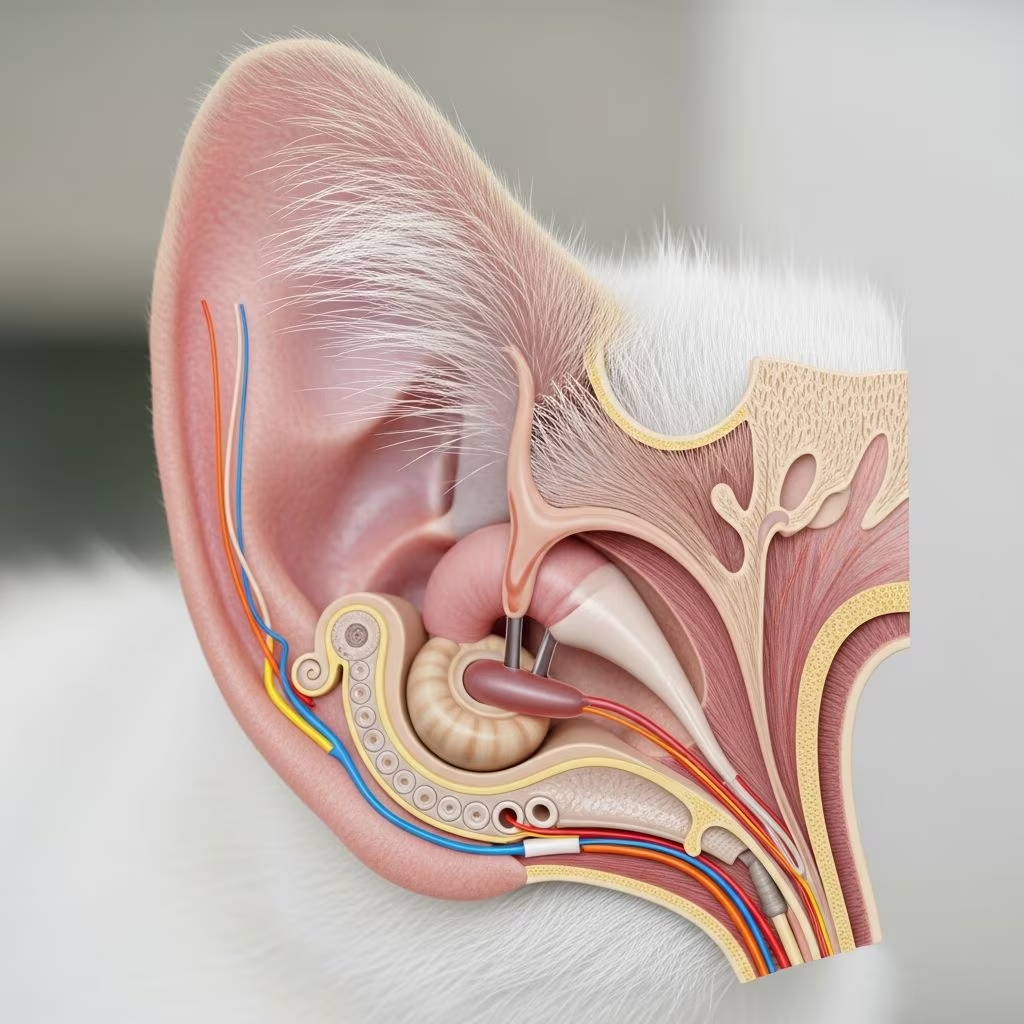
Cats possess some of the most sophisticated auditory systems in the animal kingdom, and their ears are marvels of biological engineering. Beyond simply detecting sound, a cat’s ears play a crucial role in maintaining balance and spatial awareness. The feline ear is composed of three distinct anatomical regions—the external, middle, and inner ear—each performing specialized functions that work in concert to create the exceptional sensory capabilities cats are known for.
The Three Primary Divisions of the Feline Ear
To understand how cats hear and maintain balance, it’s essential to recognize that the ear is divided into three interconnected yet functionally distinct regions. Each section has evolved specific structures and mechanisms tailored to process sound waves and equilibrium information with remarkable precision.
- External ear: The visible portion consisting of the pinna and ear canal
- Middle ear: A small air-filled chamber housing three tiny bones and connecting structures
- Inner ear: A complex system responsible for both hearing and balance
The External Ear: Sound Collection and Direction
The external ear is the most recognizable component of feline ear anatomy and serves as the primary interface between the environment and the inner hearing mechanisms. This region is specifically designed to capture, amplify, and direct sound waves toward the deeper structures of the auditory system.
The pinna, or auricle, is the prominent cartilage and skin structure that extends from the side of the head. Cats have particularly large and mobile pinnae relative to their head size, featuring a distinctive shape that functions like a biological satellite dish. The pinna’s funnel design naturally channels sound waves into the ear canal with remarkable efficiency. Unlike human ears, which remain fixed in position, feline pinnae can rotate and move independently of each other, allowing cats to pinpoint sound sources with precision unmatched by most other mammals.
Beneath the skin surface, the pinna is supported by multiple elastic cartilage structures, primarily the auricular cartilage, which provides both structural integrity and flexibility. This cartilage framework is controlled by numerous muscles that enable the sophisticated directional movement cats use when hunting or responding to environmental stimuli.
The external ear canal extends from the pinna downward and inward, following a distinctive L-shaped path toward the eardrum. This canal is notably deeper and more tapered in cats than in humans, creating an enhanced funnel effect that efficiently directs sound vibrations. The canal’s structure includes both cartilaginous and osseous (bony) sections, with the deeper portions being purely bony. The canal’s inner lining contains specialized glands that produce cerumen, or earwax, which serves dual protective functions: immobilizing foreign debris and maintaining the health of the tympanic membrane.
The Middle Ear: Sound Amplification and Transmission
Once sound waves reach the eardrum, the middle ear takes over the process of amplifying and transmitting these vibrations to the inner ear where they are ultimately processed as sound. This region, though small and hidden behind bone, contains remarkable anatomical features.
The tympanic membrane (eardrum) acts as a boundary between the external and middle ear, vibrating in response to incoming sound waves. These vibrations are then transferred to a chain of three tiny bones called the auditory ossicles. These bones—the malleus (hammer), incus (anvil), and stapes (stirrup)—are named for their resemblance to these common objects. Together, they form a biological amplification system that enhances sound vibrations by approximately thirty times before transmitting them to the inner ear.
The ossicles work sequentially: the malleus connects to the eardrum and receives initial vibrations, the incus serves as an intermediate connector, and the stapes transmits amplified vibrations to the oval window, an opening that leads to the inner ear. This three-bone system represents an evolutionary masterpiece of mechanical engineering, allowing cats to detect sounds across a remarkably broad frequency range.
The middle ear also contains the auditory (Eustachian) tube, a narrow passage that connects the middle ear to the back of the throat (pharynx). This tube performs the critical function of regulating air pressure within the middle ear cavity, preventing pressure imbalances that could interfere with normal hearing or cause discomfort. When cats swallow or yawn, this tube opens briefly, allowing air exchange that maintains pressure equilibrium.
The Inner Ear: Processing Sound and Balance
The inner ear represents the most complex and functionally sophisticated component of feline auditory anatomy. Located deep within the petrous temporal bone of the skull, this region houses structures responsible for both hearing and vestibular (balance) functions.
The cochlea is the spiral-shaped structure within the inner ear that transforms vibrations into electrical nerve signals. When vibrations from the stapes stimulate fluid within the cochlea, specialized sensory cells convert these mechanical movements into neural impulses that the brain interprets as sound. The cochlea’s spiral design allows it to analyze different frequencies, enabling cats to distinguish between sounds with extraordinary precision.
The vestibular system, which includes the vestibule and three semicircular canals, represents an equally important but often overlooked function of the inner ear. These fluid-filled structures are highly developed in cats, explaining their legendary agility and balance capabilities. The semicircular canals are oriented along three different planes, allowing them to detect movement and changes in head position in all directions. When a cat moves its head, fluid within these canals shifts, stimulating sensory cells that immediately transmit information to the brain about body position and movement. This constant feedback loop enables cats to maintain equilibrium during complex movements, land on their feet when falling, and navigate three-dimensional environments with remarkable confidence.
All sensory information from the inner ear is transmitted to the brain via the vestibulocochlear nerve (the eighth cranial nerve), which carries both auditory and balance-related signals.
The Remarkable Capabilities of Feline Hearing
The structural sophistication of the feline ear translates into exceptional hearing capabilities that far exceed those of humans. Cats can detect sounds ranging from very low frequencies (below 20 Hz) to extremely high frequencies (up to 64,000 Hz or higher), compared to the human range of approximately 20 to 20,000 Hz. This extended high-frequency sensitivity is particularly valuable for detecting the high-pitched vocalizations of prey animals and for communication with other cats.
The independent movement of each pinna allows cats to locate sound sources with remarkable accuracy without moving their head. This ability to isolate and triangulate sound sources is a significant hunting advantage, enabling cats to pinpoint prey in darkness or dense vegetation with precision.
Maintenance and Common Concerns
While feline ears are remarkably well-designed, they still require attention to maintain optimal health. The deeper ear canal structure, which enhances hearing efficiency, can also trap moisture and debris, potentially leading to infection or inflammation. Regular inspection and cleaning are important preventive measures for maintaining ear health.
Ear mites, wax accumulation, and bacterial or yeast infections represent common ear issues in cats. Any signs of scratching, head shaking, or unusual discharge warrant veterinary evaluation to prevent complications.
The Evolutionary Advantage
The sophistication of feline ear anatomy reflects millions of years of evolutionary refinement. Cats evolved as predators requiring exceptional sensory acuity for hunting, and their ears represent a significant competitive advantage in detecting, locating, and capturing prey. The combination of enhanced frequency detection, directional hearing, and vestibular balance capabilities creates a coordinated sensory system perfectly adapted to feline hunting and survival strategies.
Frequently Asked Questions
How many muscles control cat ear movement?
Cats possess numerous muscles controlling ear movement, organized into rostral, ventral, and caudal groups innervated by the facial nerve. This complex muscular arrangement enables the independent rotation and positioning that characterizes feline ear mobility.
Can cats hear ultrasonic sounds?
Yes, cats can detect ultrasonic frequencies far beyond human hearing capability, extending to frequencies above 64,000 Hz. This sensitivity allows them to hear communications and movements of small prey animals that produce high-frequency sounds.
Why do cats’ ears rotate independently?
The independent rotation of feline pinnae enables directional sound localization without head movement, allowing cats to monitor multiple sound sources simultaneously. This capability provides significant hunting and situational awareness advantages.
What causes cat ear infections?
The deeper and more tapered ear canal in cats, while enhancing hearing efficiency, can trap moisture, debris, and wax, creating environments conducive to bacterial, yeast, or parasitic infections. Regular ear inspection helps prevent such issues.
How do cats maintain balance so effectively?
The highly developed semicircular canals within the inner ear, filled with fluid that responds to movement and position changes, provide continuous vestibular feedback to the brain. This sophisticated system enables exceptional balance and coordination.
Conclusion
The feline ear represents a masterpiece of biological engineering, combining sophisticated anatomical structures with perfectly coordinated functions. From the large, mobile pinna that captures sound waves to the fluid-filled semicircular canals that maintain balance, every component serves a specific purpose in creating the exceptional sensory capabilities cats are known for. Understanding this remarkable system deepens our appreciation for feline anatomy and the remarkable abilities that have made cats such successful predators and companions throughout history.
References
- Structure and Function of the Ear in Cats — PetPlace.com. Accessed 2026. https://www.petplace.com/article/cats/pet-health/structure-and-function-of-the-ear-in-cats
- Ear Structure and Function in Cats — MSD Veterinary Manual. Accessed 2026. https://www.msdvetmanual.com/cat-owners/ear-disorders-of-cats/ear-structure-and-function-in-cats
- What’s with that slit on your cat’s ear, and more on feline anatomy — Ann Arbor Animal Hospital. Accessed 2026. https://annarboranimalhospital.com/blog/whats-slit-cats-ear-anatomy/
- How Do Cat Ears Work? — Cat Care Clinic. Accessed 2026. https://catcare.com/blog/how-do-cat-ears-work/
- Anatomy Of The Ear—Cats and Dogs — Oakleigh Central Vet. Accessed 2026. https://www.oakleighcentralvet.com.au/single-post/anatomy-of-the-ear-cats-and-dogs
- Anatomy of the Canine and Feline Ear — Veterian Key. Accessed 2026. https://veteriankey.com/anatomy-of-the-canine-and-feline-ear/



