

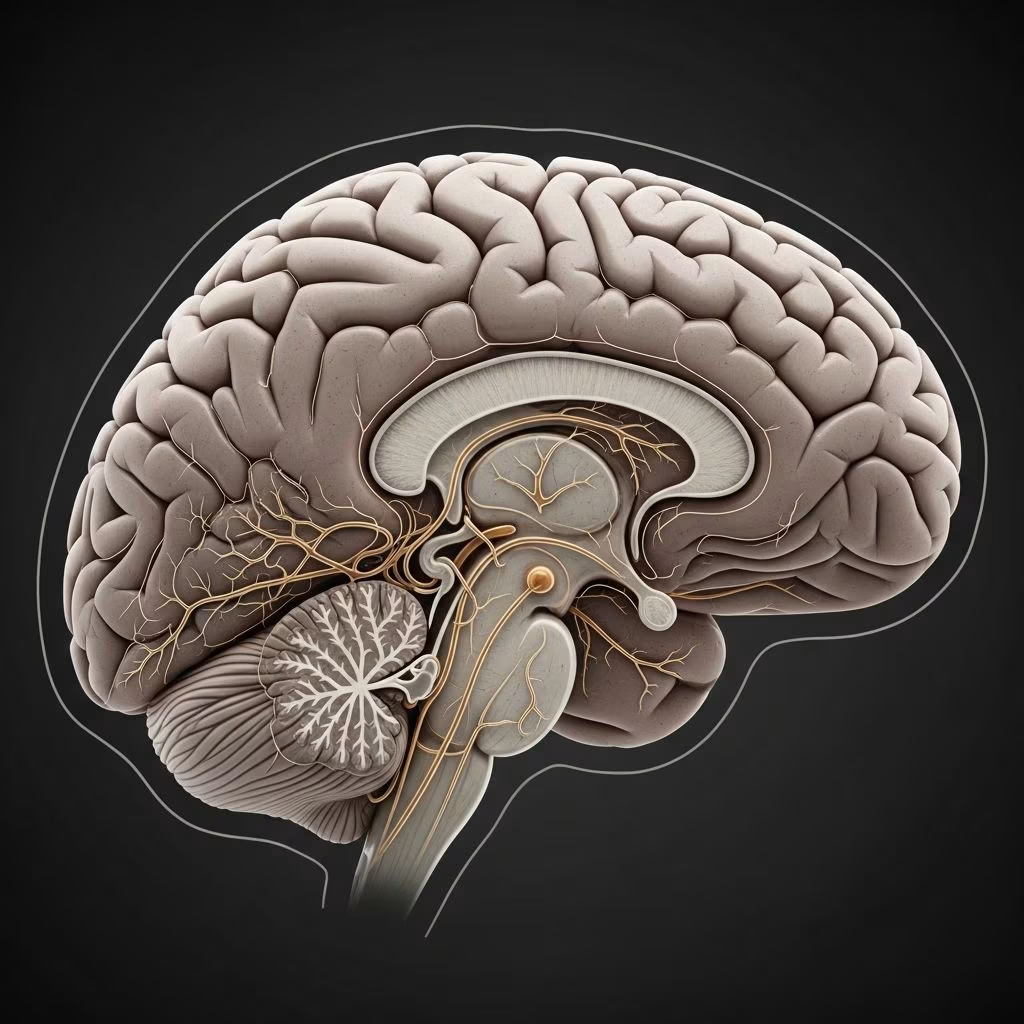
The brain of a domestic cat is a compact yet highly efficient organ weighing approximately one ounce, packed with hundreds of millions of neurons that orchestrate everything from graceful leaps to keen sensory perceptions. Structurally similar to the human brain in possessing folds on its surface—a trait known as gyrencephalic—this organ enables advanced coordination and problem-solving unique to felines.
Primary Divisions of the Cat Brain
A cat’s brain divides into three fundamental sections: the cerebrum, cerebellum, and brainstem. Each plays a distinct role in sustaining life, movement, and cognition, allowing cats to thrive as agile predators.
The Expansive Cerebrum
Dominating the brain’s volume, the cerebrum occupies the front and top portions, positioned between the olfactory bulbs and the cerebellum. This region governs higher functions such as awareness, voluntary actions, sensory processing, and rudimentary decision-making. With a surface area of about 83 square centimeters, it houses around 763 million cortical neurons, facilitating complex behaviors like hunting strategies and social interactions.
Coordination Hub: The Cerebellum
Tucked at the rear base, the cerebellum fine-tunes motor activities, ensuring precise balance and posture. Weighing roughly 0.17% of the cat’s body mass, it empowers the famous ‘righting reflex,’ enabling mid-air adjustments for four-pawed landings. Damage here could impair a cat’s acrobatic prowess, leading to stumbles or tremors.
Vital Control Center: The Brainstem
Anchoring the brain to the spinal cord, the brainstem regulates essential autonomic processes including respiration, heartbeat, blood pressure, and arousal states. It serves as the origin for most cranial nerves, bridging neural signals to peripheral systems for survival-critical responses.
Key Substructures and Connectivity
Beyond the main divisions, the cat brain features interconnected components that enhance functionality across sensory, motor, and emotional domains.
- Cerebral Hemispheres: Split into left and right sides, these are linked by the corpus callosum, a thick fiber tract enabling seamless information exchange for unified perception and action.
- Caudate Nucleus: Nestled near the thalamus, this structure influences motivation, reward processing, social bonding, and memory formation, contributing to a cat’s curious and affectionate nature.
- Medulla Oblongata: As the brainstem’s lowest segment, it integrates cardiovascular and respiratory controls, maintaining homeostasis during rest or stress.
Cranial Nerves: Sensory Gateways
Cats possess 12 pairs of cranial nerves emerging primarily from the brainstem, each specialized for sensory input or motor output. The trigeminal nerve, the largest, conveys facial sensations and mastication signals. Others manage vision (optic), smell (olfactory), hearing (vestibulocochlear), and eye movements, underscoring the brain’s reliance on these pathways for environmental mastery.
The Cerebral Cortex: Outer Command Layer
Enveloping the cerebrum, the cortex comprises four lobes tailored to specific tasks, reflecting evolutionary adaptations for a predatory lifestyle.
| Lobe | Primary Functions | Key Contributions to Cat Behavior |
|---|---|---|
| Frontal | Motor planning, olfaction analysis, learning | Temperament, limb coordination, scent discrimination |
| Temporal | Memory consolidation, emotion, audition | Fear responses, long-term recall, vocal processing |
| Parietal | Sensory integration, spatial awareness | Navigation, touch localization |
| Occipital | Visual processing | Object recognition, motion detection |
Frontal Lobe Specifics
Unlike humans, cats lack language centers, but their frontal lobe excels in scent evaluation—crucial for territory marking—and orchestrates voluntary movements alongside basic temperament traits like playfulness or wariness.
Temporal Lobe and Limbic Components
Central to the limbic system, this lobe hosts the amygdala for emotional reactivity (e.g., fight-or-flight) and autonomic regulation, plus the hippocampus for spatial memory and learning. These enable cats to remember safe paths or preferred hunting grounds over time.
Visual Dominance in the Occipital Lobe
Processing optic nerve inputs, the occipital lobe sharpens night vision and prey tracking, with dense neuron packing in the primary visual cortex (about 51,400 per cubic millimeter) supporting superior motion sensitivity.
Neural Foundations of Feline Intelligence
Boasting around 250-763 million cortical neurons, cats demonstrate intelligence through problem-solving, such as pawing open latches or navigating mazes. The thalamus relays sensory data, while the hypothalamus modulates hunger, thirst, and hormones. Advanced imaging reveals intricate pathways for vision, audition, and motor control, visible in high-resolution MRI studies delineating over 119 structures.
Common Neurological Challenges in Cats
Brain health issues can arise from trauma, infections, toxins, or aging. Symptoms vary by region: frontal lobe problems may dull cognition or alter personality; cerebellar damage causes ataxia; brainstem afflictions disrupt vitals.
- Epilepsy: Recurrent seizures from cortical hyperexcitability.
- Encephalitis: Inflammation impairing multiple functions.
- Traumatic Injury: Concussions leading to hemorrhage or swelling.
- Tumors: Meningiomas compressing tissue, often in seniors.
Early veterinary intervention via MRI, CT, or CSF analysis is crucial for prognosis.
Preserving Your Cat’s Brain Health
Support neural vitality through balanced nutrition rich in omega-3s, antioxidants, and taurine; regular exercise for cerebellar stimulation; environmental enrichment with puzzles and vertical spaces; and prompt check-ups for toxoplasmosis or hypertension risks. Vaccinations and parasite control mitigate infectious threats.
Advanced Insights from Imaging
Modern 3T MRI atlases highlight fine details like cerebellar nuclei, optic radiations, and cranial nerves, aiding precise diagnostics. These tools confirm the cat brain’s compact efficiency despite its small size.
FAQs
How does a cat’s brain compare to a human’s?
Both are gyrencephalic with cerebrum, cerebellum, and brainstem, but cats have fewer neurons (763 million vs. billions) and prioritize sensory-motor functions over abstract reasoning.
Why are cats so agile?
The cerebellum and vestibular systems integrate balance signals flawlessly, augmented by a flexible spine.
Can cats recover from brain injuries?
Prognosis depends on damage extent; neuroplasticity aids mild cases, but severe ones may cause lasting deficits.
What diet supports cat brain health?
Foods with DHA, vitamin E, and B vitamins promote neuron integrity and reduce oxidative stress.
Do cats dream?
Yes, REM sleep shows twitching, linked to hippocampus-processed memories.
References
- High resolution MRI anatomy of the cat brain at 3 Tesla — PMC (PubMed Central). 2014-05-14. https://pmc.ncbi.nlm.nih.gov/articles/PMC4060963/
- Cat Brain Anatomy: Vet-Verified Facts & Common Disorders — Catster. 2023 (approx., recent vet-verified). https://www.catster.com/cat-health-care/cat-brain-anatomy/
- 10 Facts About Your Cat’s Brain — FirstVet. 2023 (recent). https://firstvet.com/us/articles/10-facts-about-your-cats-brain
- Feline Nervous System — Willamette Veterinary Hospital. 2024 (ongoing). https://wilvet.com/interactive-animal/feline/nervous/
- Cat intelligence — Wikipedia (sourced data). 2024-01-29. https://en.wikipedia.org/wiki/Cat_intelligence



