

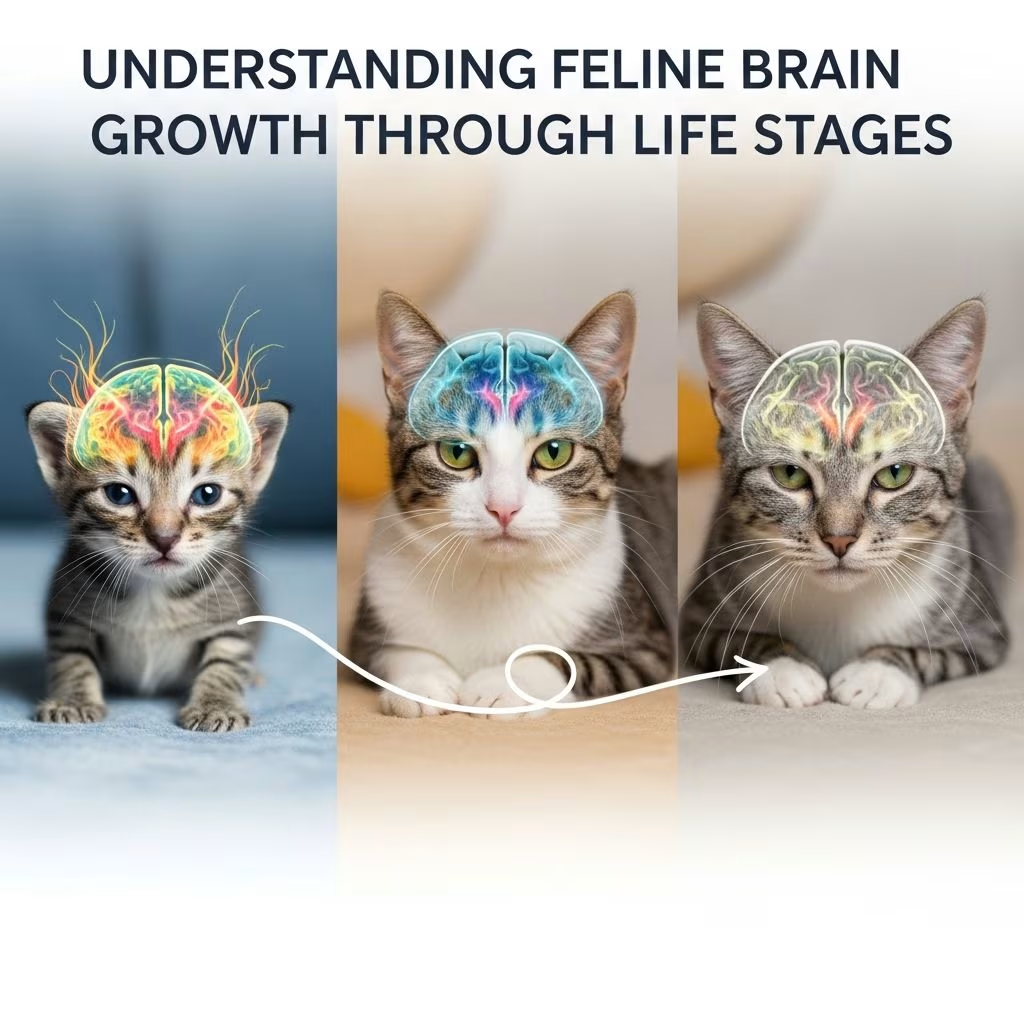
When you observe a kitten pouncing on a toy or an adult cat remembering exactly where you store its favorite treats, you’re witnessing the remarkable capabilities of the feline brain at work. The feline brain is a sophisticated organ that undergoes significant transformation from the moment a kitten is born through its transition into adulthood. Understanding these developmental phases provides valuable insights into why your cat behaves the way it does and how to best support its cognitive growth during critical periods.
The structural similarity between cat and human brains is striking. A cat’s brain contains approximately 250 million neurons in the cerebral cortex, the region responsible for complex thinking, decision-making, and memory formation. While cats have fewer total neurons than humans, their cerebral cortex exhibits a comparable level of folding and organization, allowing for sophisticated cognitive processing and behavioral flexibility. This neurological foundation enables cats to learn, adapt, and interact with their environment in complex ways throughout their lives.
The Architecture of Feline Intelligence
To understand how a cat’s brain develops, it’s essential to first recognize its fundamental structure. The cat brain, like the human brain, contains specialized regions that work in concert to produce intelligent behavior. The cerebral cortex governs higher-order functions including rational thought, problem-solving, and the consolidation of memories into both short-term and long-term storage. This means that when your cat learns the location of its food bowl or remembers a past experience, the cerebral cortex is actively encoding and retrieving this information.
Beyond the cerebral cortex, the feline brain includes additional structures such as the hippocampus, which plays a crucial role in memory formation, and the amygdala, which processes emotions and behavioral responses. The thalamus serves as a relay center for sensory information, while various other brain regions handle visual processing, motor control, and coordination. These brain areas are highly interconnected, forming what researchers describe as a hub-and-spoke network that allows rapid information sharing and environmental awareness.
One particularly notable feature of the feline brain is its neuroplasticity—the ability to reorganize and form new neural connections based on experiences. This remarkable capability means that a cat’s brain is not rigidly fixed at birth but rather remains adaptable and responsive to environmental stimuli throughout life. This property becomes especially important during critical developmental windows when experiences can have lasting impacts on brain organization and function.
The Neonatal Foundation: Birth to Two Weeks
The earliest stage of brain development occurs during the neonatal period, from birth through two weeks of age. During this phase, a kitten’s sensory systems are rapidly developing, though they begin in a remarkably underdeveloped state. Newborn kittens are largely dependent on their mothers, and their brains are still organizing basic sensory capabilities.
The developmental milestones during this period include:
- Learning to orient toward sound sources, establishing the foundation for auditory awareness
- Eyes beginning to open around the two-week mark, introducing visual input to the developing brain
- Initial competition for rank and territory beginning among littermates, which stimulates social brain development
The neonatal stage is particularly sensitive to maternal separation. If kittens are removed from their mother and littermates during this critical window, the consequences can be severe and long-lasting. Research indicates that premature separation during this period can lead to poor learning skills and increased aggression toward both people and other animals. The neurological reason is that the brain regions responsible for social bonding and behavioral regulation are still establishing their foundational patterns, and separation disrupts this crucial developmental process.
The Socialization Window: Two to Seven Weeks
The period from two to seven weeks represents one of the most critical phases in feline brain development. During this window, the kitten’s brain undergoes rapid maturation of sensory systems and begins developing the neural circuits that will support social behavior, coordination, and learning throughout life.
The progression of sensory development during the socialization period follows a predictable trajectory:
| Week of Development | Key Sensory Milestones | Behavioral Capabilities |
|---|---|---|
| Week 3 | Smell is well-developed; vision improves significantly | Kittens can locate their mother independently |
| Week 4 | Smell is fully mature; hearing is well-developed | Increased interaction with littermates; improved walking; tooth eruption begins |
| Week 5 | Sight reaches full maturity | Running, precise foot placement, obstacle avoidance, stalking, pouncing, and prey capture |
| Week 6-7 | Continued refinement of all senses | Adult sleeping patterns develop; grooming behaviors emerge; motor skills advance |
During this critical socialization window, kittens that receive regular human handling develop measurably larger brains than their non-handled counterparts. Research shows that kittens handled between 15 to 40 minutes daily during the first seven weeks develop enhanced exploratory behavior, increased playfulness, and improved learning capacity. This phenomenon reflects the brain’s plasticity during early development—environmental enrichment literally shapes brain structure and function.
The skills and social patterns a kitten acquires during these eight weeks have remarkable staying power. Research suggests that capabilities not developed during this early period may be permanently lost, making it a truly critical window for intervention and enrichment. A kitten that misses out on socialization with humans or other animals during this time may struggle with social behavior and learning throughout its entire life, despite the brain’s continued capacity for learning in adulthood.
The Ranking and Play Period: Three to Six Months
As kittens progress beyond the initial socialization window, their brains continue to mature through what researchers call the ranking period. During this phase, which extends from approximately three to six months of age, kittens’ brains become increasingly organized for learning through play and social interaction.
During this developmental stage, the kitten’s memory systems become more sophisticated. The brain begins consolidating both episodic memory—memories of specific experiences tied to particular places and times—and semantic memory, which relates to general knowledge and learned behaviors. A kitten observing older cats or human caregivers begins recording and processing these observations, with the information being stored in neural networks for future reference and imitation.
Play during this period serves a critical neurological function beyond mere entertainment. Through mock hunting, chasing, and wrestling with littermates, a kitten’s cerebellum—the brain region controlling motor coordination and balance—undergoes refinement. Simultaneously, the cerebral cortex processes the social and strategic elements of play, developing the neural circuits that will support predatory behavior, social hierarchy navigation, and problem-solving.
The Juvenile to Adult Transition: Six Months to Two Years
The transition from kittenhood to adulthood is not an abrupt change but rather a gradual maturation process that extends through approximately two years of age. During this extended adolescent phase, the cat’s brain continues developing and refining the neural circuits established during earlier developmental stages.
The cerebral cortex plays an increasingly sophisticated role during this period. A young adult cat’s brain becomes progressively more efficient at decision-making, problem-solving, and learning through observation and repetition. This is why a cat can learn the precise location of stored treats, the pattern of its owner’s daily routine, or the specific behaviors that trigger positive responses from humans. The different specialized regions of the brain—visual cortex, motor cortex, memory centers—communicate rapidly through dense interconnections, enabling quick environmental responses and adaptive behavior.
One particularly impressive capability that develops during this period is object permanence—the understanding that objects continue to exist even when they cannot be seen. Research demonstrates that cats achieve full object permanence, reaching what researchers call Stage 5 cognitive development. At this stage, a cat can observe an object being hidden behind a barrier and accurately search for and retrieve it. Some cats even demonstrate Stage 6 capabilities—understanding that objects can be hidden through displacement without directly observing the hiding process.
Memory Systems and Learning in Mature Cats
By adulthood, a cat’s brain has established sophisticated memory systems that allow for complex learning and retention of information. Cats demonstrate episodic memory capability, meaning they can recall specific events tied to particular contexts—remembering not just that treats exist, but where they are kept and the circumstances under which they become available.
The cat’s capacity for learning through observation and repetition remains highly developed in adulthood. When a kitten follows an older cat through the house, imitating behaviors and learning routines, the younger cat’s brain is recording patterns that will influence its behavior throughout life. Similarly, cats continue to learn new behaviors and adapt to changes in their environment well into their senior years, though the rate of learning may slow compared to the rapid acquisition during kittenhood.
Long-term memory storage in cats can retain information for remarkably long periods—research indicates cats can remember and retrieve information over a span of approximately ten years. This extraordinary memory capacity allows cats to maintain detailed maps of their territory, remember the locations of resources, recall human family members’ patterns and preferences, and even retain memories of other cats they’ve known.
Environmental Enrichment and Brain Development
Understanding brain development stages has practical implications for how we care for cats at different life phases. During the critical socialization period, providing regular human interaction, exposure to various stimuli, and opportunities for play with appropriate toys and littermates directly supports brain development and long-term behavioral outcomes.
Environmental enrichment continues to be important throughout adulthood. Interactive toys, puzzle feeders, opportunities for climbing and perching, and engaging social interactions support continued neuroplasticity and help maintain cognitive function as cats age. A stimulating environment encourages the brain to form new neural connections and maintain existing ones, potentially delaying cognitive decline in senior cats.
The quality of early experiences has documented effects on brain structure. Kittens handled regularly during sensitive developmental windows show measurable differences in brain size and organization compared to less-handled kittens. These structural differences translate into behavioral and cognitive advantages that persist throughout the cat’s life.
Frequently Asked Questions About Feline Brain Development
Q: Can adult cats learn new behaviors, or is learning limited to kittens?
A: While kittens may acquire skills more rapidly, adult cats retain significant learning capacity throughout their lives. The feline brain remains receptive to new experiences and lessons well beyond kittenhood. However, the foundational skills and social patterns established during the first eight weeks tend to have the most lasting impact on lifelong behavior.
Q: How does early handling affect a cat’s brain development?
A: Kittens that receive 15 to 40 minutes of daily human handling during the first seven weeks develop measurably larger brains and demonstrate enhanced exploratory behavior, playfulness, and learning ability compared to non-handled kittens. This hands-on interaction literally shapes brain structure during the critical developmental window.
Q: What brain structures are responsible for memory in cats?
A: The cerebral cortex serves as the storage center for both short-term and long-term memories. Additional structures like the hippocampus are crucial for memory formation and consolidation. These structures work together to allow cats to retain information for extended periods—up to approximately ten years.
Q: How does a cat’s brain compare to a human brain?
A: While a cat’s brain is substantially smaller and contains fewer total neurons than a human brain, the structural organization is remarkably similar. Both possess cerebral cortices with specialized regions for different functions, and both demonstrate the capacity for complex cognition, memory formation, and behavioral adaptation.
Supporting Optimal Brain Development
Understanding the stages of feline brain development empowers pet owners to make informed decisions that support cognitive growth and behavioral health. During the critical socialization period, prioritizing regular handling, appropriate play opportunities, and varied environmental exposure creates the neural foundation for a well-adjusted, intelligent, and behaviorally flexible adult cat.
As cats transition into adulthood, continued mental stimulation through interactive play, environmental enrichment, and social engagement supports the maintenance of cognitive function. Recognizing that cats remain capable learners throughout their lives encourages ongoing interaction and environmental modification to prevent boredom and cognitive decline.
The feline brain’s remarkable capacity for neuroplasticity means that your cat’s behavior and capabilities are not entirely determined at birth but rather shaped by experiences throughout life. By understanding the developmental stages and supporting optimal brain development at each phase, you contribute to your cat’s lifelong health, happiness, and behavioral well-being.
References
- Feline Intelligence: How Your Cat’s Brain Works — Fear Free Happy Homes. Accessed January 2026. https://www.fearfreehappyhomes.com/feline-intelligence-how-your-cats-brain-works/
- Developmental Stages of Kitten Behavior — Seattle Humane Society. https://www.seattlehumane.org/resource-library/developmental-stages-of-kitten-behavior/
- Cat Brain Development: From Kitten to Adult (An Overview) — Catster. https://www.catster.com/lifestyle/cat-brain-development-from-kitten-to-adult/
- Cat Intelligence — Wikimedia Foundation. https://en.wikipedia.org/wiki/Cat_intelligence
- Understanding Your Kitten’s Behavior and Development — Almost Home Humane Society. https://www.almosthomehumane.org/cat-handbook/understanding-your-kittens-behavior-and-development



