

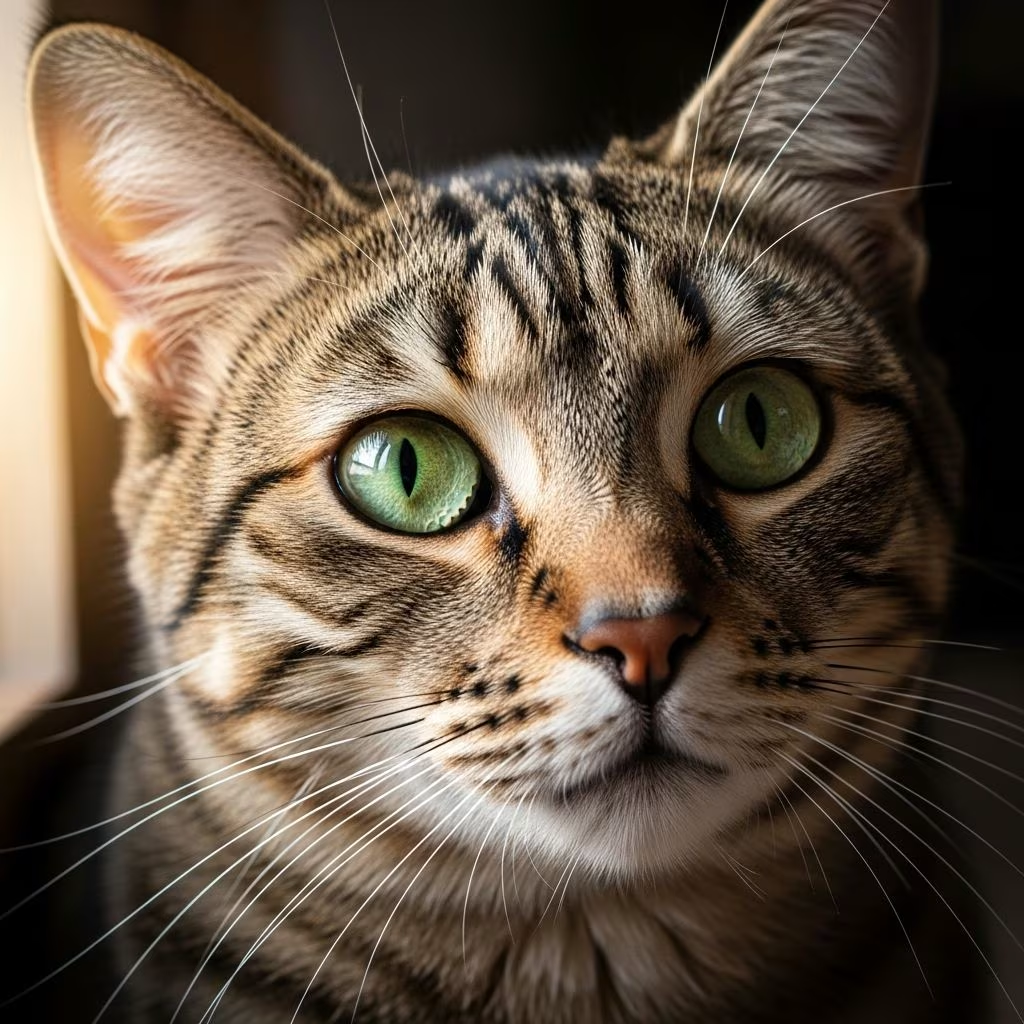
Cats have captivated human imagination for thousands of years, and for good reason. These enigmatic creatures possess a complex array of behaviors, remarkable sensory abilities, and subtle communication methods that continue to intrigue scientists and pet owners alike. Understanding the intricacies of feline behavior can deepen the bond between cats and their human companions while providing insight into their evolutionary heritage as skilled predators and adaptable survivors.
How Cats Communicate with Their World
Feline communication extends far beyond the simple meow that most people associate with cats. Cats employ a sophisticated repertoire of vocalizations, body language, and scent-marking behaviors to express their needs, emotions, and territorial claims. Each vocalization carries distinct meaning, and when combined with body posture and facial expressions, creates a nuanced language that reflects the cat’s emotional state and intentions.
Vocalizations and What They Mean
Meowing serves as a primary communication tool between cats and humans, functioning as a greeting, request, protest, or attention-seeking behavior. Interestingly, cats often vocalize to themselves while moving through their environment, suggesting that meowing may serve purposes beyond direct communication with other beings.
Purring is commonly associated with contentment and relaxation, occurring during pleasurable activities such as eating and resting. However, the reality is more complex—cats also purr when experiencing stress, pain, or illness, indicating that this behavior may serve a broader function than simple pleasure expression.
Hissing and spitting represent defensive or aggressive responses, serving as warnings to potential threats. These sounds mimic predatory animals and are typically accompanied by aggressive body postures designed to make the cat appear larger and more threatening.
Yowling and howling manifest as prolonged, loud vocalizations that indicate distress. Cats may produce these sounds when trapped, experiencing pain, or seeking their owners, and they represent a distinct departure from normal communication patterns that warrants investigation.
Chattering occurs when cats hunt or track potential prey, consisting of rapid chirps produced while the mouth vibrates. The cat maintains a fixed, intense gaze during this behavior, which may reflect a surge of adrenaline or anticipation of an impending hunt.
Silent Communication: The Power of the Slow Blink
One of the most remarkable discoveries in feline communication research involves the slow blink, a behavior that conveys positive emotional responses. In controlled studies examining cat behavior, researchers observed that cats respond to slow blinks from humans with increased approach behaviors and reciprocal slow blinking.
When a familiar human slow-blinks toward a cat—achieved by narrowing the eyes as in a relaxed smile followed by closing them for a couple of seconds—the cat tends to approach more frequently than when the human maintains a neutral expression with averted eye contact. This behavior shares features with genuine human smiling, where the corners of the eyes narrow, suggesting a deeply rooted form of cross-species emotional communication.
This discovery has practical implications for cat owners seeking to strengthen their bonds with their feline companions. By initiating slow-blink exchanges, humans can create a form of conversation that communicates safety, trust, and affection—a bridge between two species that speaks a different language.
The Spectrum of Feline Social Preferences
Contrary to popular belief, cats are not fundamentally anti-social creatures. Rather, they are asocial, meaning they are flexible and variable in their preferences for social interactions. This distinction is crucial for understanding feline behavior in diverse contexts, from multi-cat households to feral colonies.
Individual Personalities and Coping Styles
Research has identified distinct personality clusters among cats that influence how they respond to stressors and environmental changes. In one study of 55 owned cats, researchers identified two primary coping styles:
- Shy, calm, mellow, and timid cats responded to stress by eating more, hiding more frequently, and showing longer latencies when approaching both familiar and unfamiliar people.
- Active, playful, curious, and easygoing cats displayed more affiliative behaviors toward people, vocalized more frequently, and engaged more readily with environmental enrichment.
These personality variations have significant implications for how individual cats experience their environment and respond to changes in their living situations. Understanding a cat’s inherent personality type can help owners adjust their expectations and provide appropriate care.
Social Bonds and Preferred Associates
When cats live in groups, they demonstrate clear preferences for certain individuals, showing behaviors such as allorubbing, mutual grooming, touching while sleeping, nose touching, and tail-up greetings with their preferred associates. These affiliative behaviors occur more frequently between related cats, particularly those sharing family lineage.
Naturally occurring cat colonies often structure themselves around related females, who display more friendly interactions with one another than with unrelated individuals. Even in temporary sheltering situations, related cat pairs show significantly more affiliative behaviors compared to unrelated pairs, suggesting that genetic bonds influence social preferences even in artificial environments.
The Hunter Within: Prey Capture and Feeding Behaviors
Despite domestic cats’ comfortable lives as household pets, their predatory instincts remain largely intact, shaped by millions of years of evolutionary pressure. The hunting behaviors displayed by contemporary cats reflect sophisticated strategies refined across generations.
Hunting Strategies and Prey Preferences
Contrary to popular misconceptions about cats decimating bird populations, research demonstrates that cats preferentially hunt mammals, particularly rodents and insects, far more frequently than birds. Studies analyzing the diets of outdoor cats confirm that mammals appear three times more often than birds in their prey consumption, with birds consumed only incidentally rather than as part of regular feeding patterns.
Cats employ distinct hunting strategies depending on prey type and availability. They prove far more efficient hunters when sitting and waiting for prey outside a rodent burrow than when stalking and pouncing—the approach typically used when pursuing birds. As opportunistic feeders, cats are more likely to access garbage, consume insects, or sit and wait for rodents than invest energy chasing birds that can easily escape by flying away.
The Mechanics of Predatory Behavior
When cats have successfully identified and are preparing to strike prey, they remain extremely tense before launching forward to strike with their paws. When prey proves difficult to access—such as in small pools or burrows—cats use their paws to effectively fish out food and reach into confined spaces.
Once cats have control of their prey, they often cuff or push it about in what appears to be playful behavior. Cats engage in a behavior known as “prey shaking,” where they hold prey in their mouths and shake their heads to kill or disorient their target. If the prey survives this initial attack, one or two bites typically complete the process.
Observational learning plays a crucial role in developing hunting competence. Young cats learn predatory behavior from their mothers through a process involving the drive to hunt (initiated by hunger), the cue (presence of prey), the response (catching the prey), and the reward (relieving hunger).
Sensory Superpowers: Whiskers and Beyond
The sensory capabilities of cats far exceed those of humans, providing them with remarkable abilities to navigate their environment and execute precise movements. Whiskers represent just one aspect of a complex sensory system that has evolved to support their predatory lifestyle.
The Role of Facial Whiskers
Facial whiskers align precisely to body width, aiding cats in judging distances while moving through space. These sensitive structures are far more than simple tactile sensors—whiskers contain proprioceptors, special sensory organs on their tips that monitor the distance, direction, and even texture of objects and prey.
Beyond their tactile function, whiskers also monitor airflow to coordinate locomotion. This multi-functional sensory system enables the graceful, precise movements that characterize feline movement, allowing cats to navigate confined spaces, execute hunting strikes with minimal wasted motion, and maintain equilibrium in three-dimensional environments.
Body Language: Reading Your Cat’s Intentions
Cats express their emotional states and intentions through subtle shifts in body posture, tail position, and facial expression. Understanding these visual cues provides insight into a cat’s comfort level, emotional state, and potential actions.
Stress and Anxiety Postures
When cats experience anxiety or stress, they adopt distinctive postural changes. An anxious cat typically lies on its belly with the back of the body visibly lower than the front when standing or moving. Their breathing becomes rapid, and their legs tuck underneath their body. The tail positions itself close to the body, often curling forward or remaining tucked, with the tip moving up and down or side to side in agitated movements.
Recognition of these postural signals allows owners and caregivers to identify when cats are uncomfortable and need space or intervention to prevent escalation of anxiety-related behaviors.
Behavioral Challenges and Problem Behaviors
Cats sometimes exhibit behaviors that challenge their human companions, including aggression, destructive actions, and inappropriate elimination. These behaviors often stem from underlying causes including anxiety, medical issues, environmental stressors, or unmet behavioral needs.
Separation-Related Behaviors
Research analyzing behavioral problems in cats identified that approximately 13.5 percent of sampled cats displayed at least one trait associated with separation-related problems. The most frequently reported issue was destructive behavior, observed in 20 of 30 affected cats.
Other behavioral manifestations of separation anxiety include excessive vocalization (19 cats), inappropriate urination (18 cats), aggression (11 cats), agitation-anxiety (11 cats), and inappropriate defecation (7 cats). Understanding that these behaviors often reflect emotional distress rather than spite or deliberate misbehavior helps owners approach problem behaviors with appropriate interventions.
Aggression in Cats
Aggression, defined as hostile or violent behavior intended to dominate or intimidate another individual, represents a fairly common behavioral problem in domestic cats. This behavior may be directed toward humans, other cats, or other animals, and understanding the underlying causes is essential for addressing it effectively.
The Bond Between Cats and Humans
Recent scientific research has challenged the longstanding perception that cats form weaker bonds with humans compared to dogs. Studies reveal that domestication has unlocked suite of kitten-like behaviors in cats, including grooming, play-fighting, and gift-bringing behaviors that extend beyond simple food procurement.
In September 2019, scientists announced that cats appear to display traits of “secure attachment” similar to that seen in dogs, where the presence of a human caregiver prompts behaviors signaling security and calmness. Additionally, cats receiving strokes experience a sudden dose of brain hormones similar to what humans experience when around their loved ones. These findings suggest that cats possess the capacity for genuine emotional bonds with their human companions, potentially rivaling dogs in their pursuit of the title of humankind’s best friend.
Environmental Awareness and Storm Prediction
Cats demonstrate an ability to perceive changes in atmospheric conditions that precede severe weather events such as thunderstorms, suggesting sensory capabilities beyond those commonly recognized in casual observation. This awareness may relate to changes in barometric pressure, electromagnetic fields, or other environmental factors that cats’ sensitive systems detect before humans notice changing conditions.
The Ecological Impact of Domestic Cats
While much debate surrounds the impact of outdoor cats on wildlife populations, research provides important context. Studies indicate that pet cats kill two to 10 times more wildlife than equivalent wild predators. However, because pet cats consume prepared cat food, they kill fewer individual prey items per day than wild predators; their concentrated impact on local prey results from their small home ranges rather than increased hunting efficiency.
Key Takeaways About Feline Behavior
- Cats communicate through diverse vocalizations, body language, and sensory signals that convey complex emotional states
- The slow blink represents a form of cross-species communication that strengthens human-cat bonds
- Cats demonstrate variable social preferences rather than inherent anti-social tendencies
- Hunting behaviors and prey preferences reflect evolutionary adaptations honed over millions of years
- Whiskers and other sensory systems provide cats with remarkable environmental awareness
- Behavioral problems often reflect anxiety or unmet needs rather than deliberate misbehavior
- Scientific research reveals genuine emotional attachments between cats and human caregivers
Frequently Asked Questions About Cat Behavior
Why does my cat slow blink at me?
A slow blink indicates positive emotional response and trust. When your cat slow-blinks, it’s communicating contentment and affection. Reciprocating with your own slow blink strengthens this bonding behavior.
What does it mean when my cat chatters at birds?
Chattering represents a predatory response triggered by visual detection of potential prey. The rapid chirping sounds combined with mouth vibration reflect heightened arousal and anticipatory excitement about the prospect of hunting.
Are cats really solitary animals?
Cats are asocial rather than anti-social, meaning their social preferences are variable and individual. Some cats enjoy social interaction while others prefer solitude, and preferences can change based on context and available resources.
Do cats really kill more wildlife than wild predators?
While pet cats may kill more wildlife relative to their size due to concentrated home ranges and supplemental food, their primary prey consists of rodents and insects rather than birds, contrary to popular belief.
What causes separation anxiety in cats?
Separation anxiety stems from genuine emotional attachment and distress at owner absence. Behavioral signs include destructive behavior, inappropriate elimination, excessive vocalization, and agitation-anxiety.
References
- Cat behavior — Wikipedia. https://en.wikipedia.org/wiki/Cat_behavior
- 8 (very very cute) facts about cats, according to science — Science Focus. https://www.sciencefocus.com/nature/cat-facts-science
- Biology & Behavior of Cats – What they Eat & More — Alley Cat Allies. https://www.alleycat.org/resources/biology-and-behavior-of-the-cat/
- Common misconceptions about the social behavior of domestic cats — PubMed Central (PMC), National Center for Biotechnology Information. https://pmc.ncbi.nlm.nih.gov/articles/PMC10841747/
- Feline Behavior Problems: Aggression — Cornell University College of Veterinary Medicine. https://www.vet.cornell.edu/departments-centers-and-institutes/cornell-feline-health-center/health-information/feline-health-topics/feline-behavior-problems-aggression



