

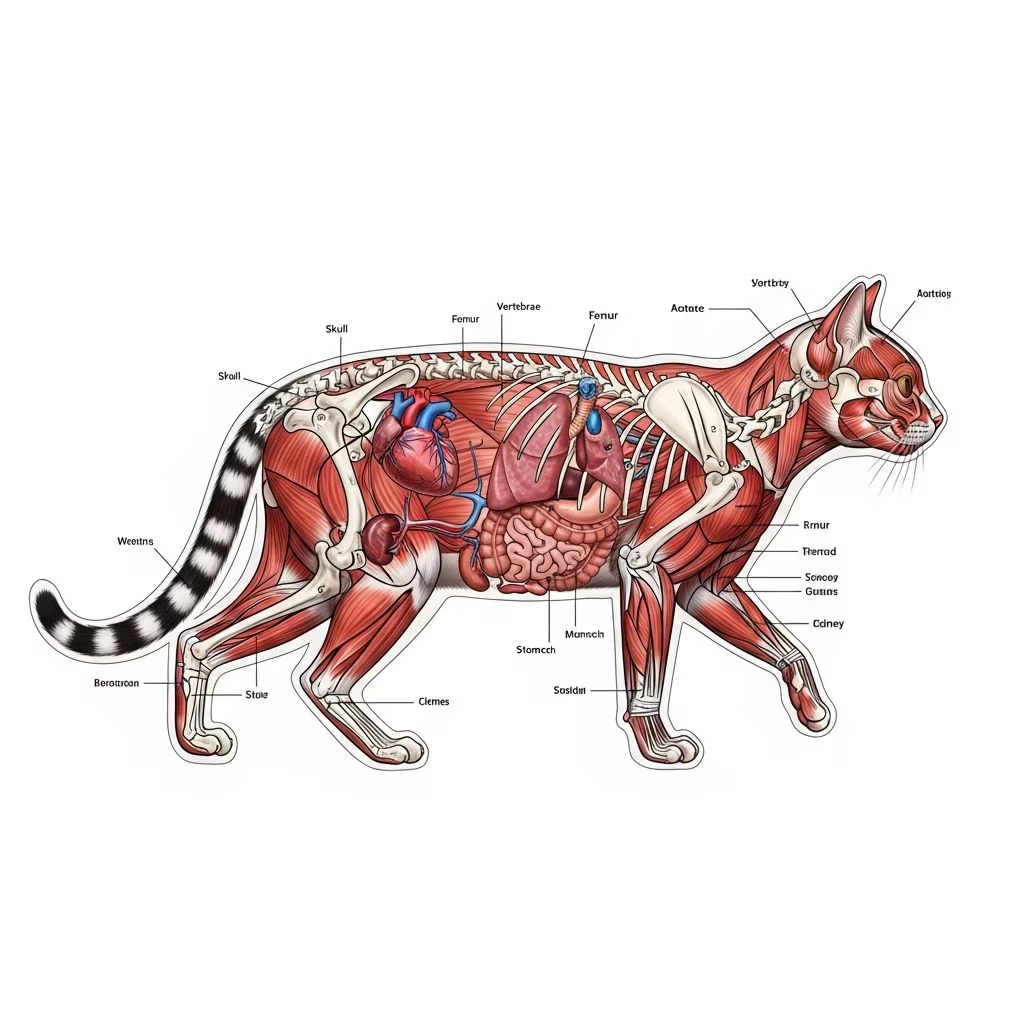
Cats possess a remarkable body structure optimized for agility, hunting, and survival. Their anatomy features flexible skeletons, powerful muscles, and specialized senses that distinguish them from other pets. Understanding these elements helps owners monitor health and appreciate their pet’s natural abilities.
The Skeletal Framework: Backbone of Agility
The cat’s skeleton forms the foundation for its acrobatic prowess, comprising approximately 250 bones—far more than the human 206. This excess arises from additional vertebrae and tail bones, varying by breed and tail length.
Key to their flexibility is the axial skeleton, including the skull, spine, ribs, and sternum. Cats have around 30 vertebrae, enabling extreme twisting and bending. Thick, spongy discs between vertebrae cushion impacts and allow independent movement of front and back halves. Unlike dogs, cats lack a prominent nuchal ligament and supraspinous ligament, enhancing spinal mobility.
The appendicular skeleton handles limbs. Front limbs connect via a vestigial clavicle (collarbone), nearly absent in many breeds, permitting shoulder hyper-flexion for tight squeezes. Hind limbs feature a rectangular pelvis where the femur articulates, supporting powerful leaps.
| Region | Bone Count (Approx.) | Unique Feature |
|---|---|---|
| Vertebral Column | 30 | Extra vertebrae for flexibility |
| Forelimbs | ~60 | Small/absent clavicle |
| Hindlimbs | ~60 | Pear-shaped patella |
| Tail | 19-28 | Variable length affects total bones |
This design suits climbing, pouncing, and landing softly from heights, with shock-absorbing joints like the stifle (knee) and patella (kneecap) in hind legs.
Muscular System: Power and Precision
Cats boast over 500 muscles, densely packed for explosive strength. Superficial muscles cover the body, with notable divisions in the shoulder and neck.
- Trapezius muscles: Divided into clavotrapezius, acromiotrapezius, and spinotrapezius for precise head and limb control.
- Deltoids: Three separate muscles (clavobrachialis, acromiodeltoid, spinodeltoid) versus one in humans, aiding powerful forelimb swings.
- Leg muscles: Gastrocnemius connects via the calcaneal (Achilles) tendon for jumping; tibialis anterior and flexors enable gripping.
Neck muscles like the brachiocephalicus insert via shared tendons on the ulna, supporting rapid head turns during hunts. Trunk muscles, such as serratus dorsalis, extend further in cats for enhanced torso flexion. This muscular setup allows cats to achieve speeds up to 30 mph in bursts and leap distances five times their body length.
Digestive and Internal Organs: Efficient Processing
The feline digestive tract is short and carnivore-optimized, processing meat quickly to extract proteins and fats.
Food enters the mouth with 30 adult teeth: 12 incisors, 4 canines, 10 premolars, and 4 molars for tearing and grinding. Deciduous teeth shed around 5-7 months. Salivary glands moisten food before it travels down the esophagus to the stomach, where powerful acids break it down. The small intestine absorbs nutrients, aided by the liver and pancreas secreting enzymes.
The large intestine compacts waste, expelled via the rectum and anus. Cats have a simple stomach without a multi-chambered rumen, reflecting their obligate carnivore status.
Other systems include:
- Cardiovascular: Strong heart pumps oxygenated blood efficiently for high-energy pursuits.
- Respiratory: Lungs expand within the thoracic cavity, separated by the diaphragm from abdominal organs.
- Lymphatic: Nodes filter pathogens, prominent around the head and limbs.
Sensory Organs: Hunters’ Tools
Eyes and Vision
Cat eyes feature a tapetum lucidum layer reflecting light for superior night vision—six times better than humans. Vertical pupils adjust rapidly for depth perception in low light. The nearly complete bony orbit protects these organs, connected by a short orbital ligament.
Ears: Sound Collectors
Triangular pinnae (ear flaps) funnel sounds into the canal. Middle ear ossicles amplify vibrations to the cochlea, while the vestibular system maintains balance. Cats detect frequencies up to 65 kHz, hearing ultrasonic prey calls.
Nose and Whiskers
A robust olfactory system with 200 million scent receptors dwarfs human capabilities. Whiskers (vibrissae) act as tactile sensors, detecting air currents for navigation in darkness.
Paws and Claws: Gripping Adaptations
Front paws have five toes with claws; hind paws four. Retractable claws sheath into sheaths, staying sharp for traction. They curve backward, ideal for climbing up but requiring backward descent. Paws include digital pads for silent stalking and scent glands for territory marking.
The carpus (wrist) and tarsus (ankle) provide shock absorption, with elastic ligaments enhancing jumps.
Reproductive and Urinary Systems
Males feature a scrotum and penis with barbs for mating. Females have two ovaries, uterus, and vulva. Urinary systems include bean-shaped kidneys filtering waste into the bladder, crucial for hydration in dry-food diets.
Positioning: Ventral surface up reveals these in dissections, with anterior toward head and posterior toward tail.
Common Anatomical Variations and Health Insights
Breeds vary: Manx cats lack tails, reducing vertebrae; Persians have flatter faces affecting sinuses. Monitor for issues like dental disease (common in seniors) or joint problems from flexible skeletons.
| System | Common Issue | Sign |
|---|---|---|
| Skeletal | Arthritis | Limping, reluctance to jump |
| Dental | Periodontal disease | Bad breath, drooling |
| Digestive | Hairballs | Vomiting, reduced appetite |
FAQs
Why do cats have more bones than humans?
Their extra vertebrae and tail bones provide flexibility and balance.
How many claws does a cat have?
18 total: 10 front, 8 back.
Can cats twist their bodies mid-air?
Yes, due to loose vertebrae and clavicle absence, allowing rotation for right-side-up landings.
What makes cat digestion unique?
Short gut for high-protein meat diets, with rapid transit.
Do all cats have the same number of teeth?
Adults have 30; kittens have 26 deciduous teeth.
References
- 2024 Ultimate Guide to Cat Anatomy — VetCheck. 2024. https://vetcheck.it/cat_anatomy/
- Cat Anatomy & Physiology 101 — Purina. N/A. https://www.purina.com/articles/cat/behavior/understanding-cats/cat-anatomy
- CAT DISSECTION A LABORATORY GUIDE — Bennington College. N/A. https://www.bennington.edu/sites/default/files/sources/docs/Cat_Dissection_Guide.pdf
- Dissection Lab Guide for Dog and Cat Anatomy — University of Minnesota Pressbooks. N/A. https://pressbooks.umn.edu/dogcatanatomylabguide/back-matter/appendix/
- Cat Anatomy Guide — Cats.com. N/A. https://cats.com/cat-anatomy-guide



