
Face Flies in Cattle: Biology and Control
Understand the biology, health risks, and effective strategies to manage face flies impacting cattle productivity and welfare.
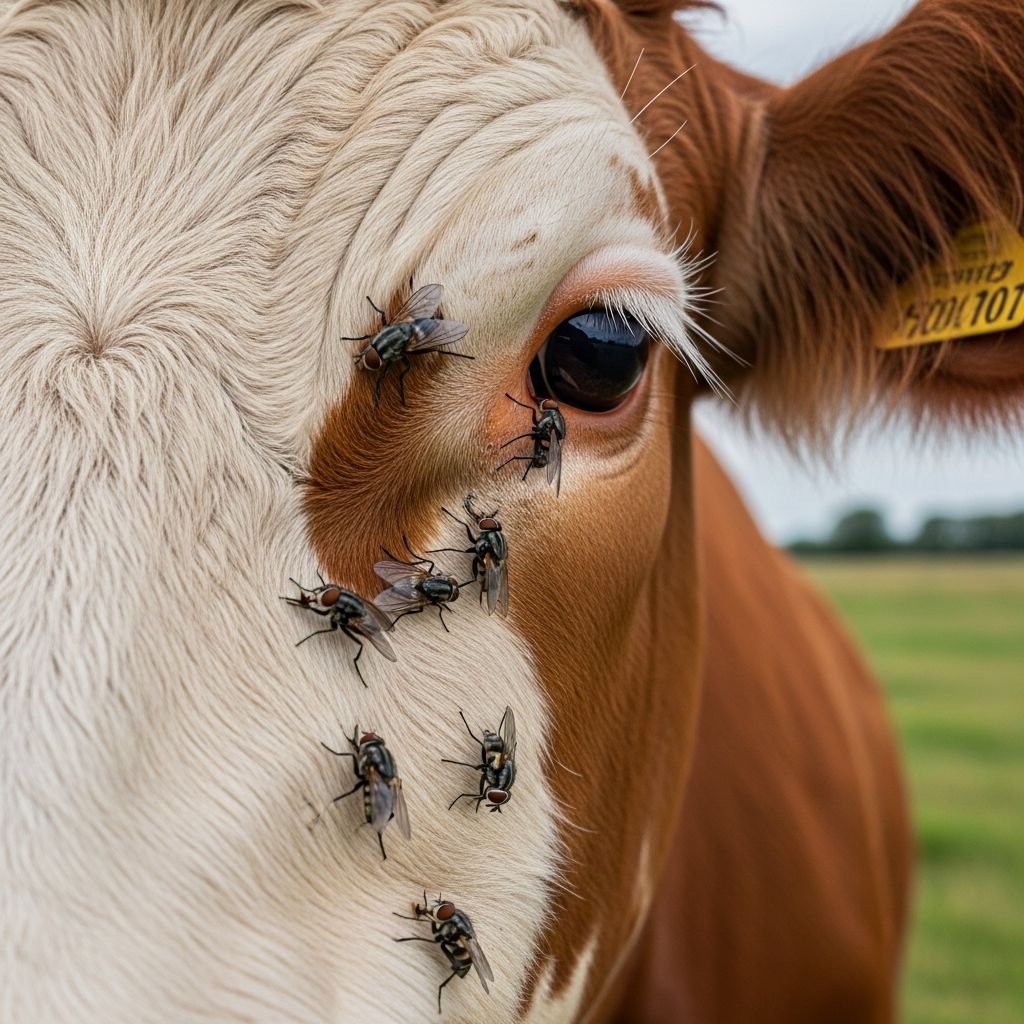
Face flies represent a significant challenge for cattle producers, particularly those managing pastured herds. These pests cluster around animals’ faces, feeding on secretions and transmitting diseases that compromise livestock health and farm economics.
Recognizing Face Flies: Key Identification Features
Face flies, scientifically named Musca autumnalis, closely resemble common house flies but exhibit distinct traits tailored to their livestock-hosting habits. Adults measure about 6-7 mm in length with a robust build. Females, responsible for most animal interactions, display mottled gray-black abdomens marked by a small yellow patch on the lower edge of the first abdominal segment. Their eyes are separated by a noticeable gap at the head’s top. Males stand out with bright yellow-orange sides on their abdomen starting from the second segment, a central black stripe, and holoptic eyes that meet at the head’s apex. Both sexes possess sponging mouthparts equipped with prestomal teeth for rasping secretions, and their wings feature a characteristic curved M1 vein visible under magnification. Four dark stripes adorn the thorax, aiding quick field identification.
- Size and shape: Slightly larger and sturdier than house flies.
- Color patterns: Males’ golden abdomen sides vs. females’ subdued gray tones.
- Behavior clue: Persistent clustering on cattle faces, unlike house flies’ broader habits.
Life Cycle and Seasonal Patterns
The face fly’s development hinges on warm weather and fresh cattle manure. Females deposit eggs exclusively in undisturbed bovine dung pats within hours of deposition. Larvae hatch quickly, burrowing into the moist interior to filter-feed on bacteria, yeast, and organic particles. After several days, mature larvae exit the pat, pupate in surrounding soil, and emerge as adults in 18-20 days under optimal temperatures around 25-30°C. Northern regions see 3-4 generations annually, while southern areas support up to 12. Peak activity spans late spring to early fall, intensifying in July through September near waterways, irrigated pastures, or vegetated canyons. As days shorten below 12.5 hours and temperatures drop, adults overwinter by aggregating on sun-warmed southern exposures of buildings, entering diapause until spring thaw.
| Life Stage | Duration | Habitat | Key Activity |
|---|---|---|---|
| Egg | Hours to 1 day | Fresh dung surface | Laid in clusters |
| Larva | 5-7 days | Inside dung pat | Filter feeding |
| Pupa | 5-10 days | Soil near dung | Metamorphosis |
| Adult | Weeks | Cattle faces, overwinter sites | Feeding, breeding |
Feeding Habits and Animal Annoyance
Only female face flies target livestock, drawn to eyes, nostrils, mouths, and wounds for nutrient-rich secretions like tears, mucus, and blood. Their rasping mouthparts cause mechanical irritation, prompting defensive responses that disrupt grazing. Cattle bunch together head-to-tail, toss heads, flick tails, flap ears, or seek shade and water, reducing productive time by up to 20-30%. Horses exhibit similar evasion, amplifying stress across mixed pastures. Males feed mainly on nectar and dung liquids, avoiding direct contact.
Health Risks: Disease Vectors and Transmission
Face flies serve as primary vectors for devastating cattle ailments. They mechanically transmit Moraxella bovis, M. bovoculi, and M. ovis—bacteria fueling infectious bovine keratoconjunctivitis (IBK), or pinkeye. Flies acquire pathogens from infected ocular discharges and deposit them on healthy eyes during feeding. IBK symptoms progress from tearing and conjunctival swelling to corneal ulcers, opacity, vision loss, and potential blindness, slashing weight gains by 10-20% and necessitating culls. Even 1-5 flies per eye daily induces lesions mimicking early pinkeye via abrasion alone.
Additionally, face flies propagate eyeworms (Thelazia spp., notably T. rhodesi) exclusive to them in North America. Larvae ingested by flies mature inside, then deposit into host eyes, causing chronic lacrimation, keratitis, and tissue damage resembling mild IBK. These nematodes infect cattle and horses across continents, compounding fly-related woes.
Economic Consequences for Producers
Beyond immediate discomfort, face flies inflict substantial losses. Pinkeye outbreaks cost U.S. beef producers millions annually through treatment, reduced gains (0.5-1 lb/day), condemned carcasses, and long-term blindness in 2-5% of cases. Defensive behaviors cut grazing efficiency, while eyeworm burdens add hidden productivity drags. Pastured operations near fly hotspots face amplified risks, underscoring integrated management’s value.
Prevention and Cultural Strategies
Disrupting breeding sites forms the foundation. Remove or harrow manure pats weekly to expose larvae to desiccation and predators. Rotate pastures, avoiding overgrazing that concentrates dung. Plant fly-repelling forages or maintain buffer strips. Mineral supplements with garlic or diatomaceous earth show anecdotal benefits, though evidence varies.
Chemical Control Options
Insecticide ear tags (pyrethroid or organophosphate) reduce face fly counts by 70-90% when applied early summer to high-risk herds. Dust bags or back rubbers at gateways encourage self-application, targeting facial clusters. Pour-ons and sprays offer knockdown but require frequent reapplication (every 2-4 weeks). Rotate active ingredients to curb resistance. Always follow label rates to minimize residues and environmental impact.
- Ear tags: Long-lasting, animal-applied.
- Dusts/oils: Forced-use stations for consistent coverage.
- Systemic feed additives: Emerging for larval control in manure.
Biological and Integrated Approaches
Dung beetles naturally suppress larvae by burying pats, enhanced via commercial releases. Parasitic wasps target pupae in soil. Integrated pest management (IPM) combines cultural sanitation, monitoring (scout for 10+ flies/face), and targeted chemicals, cutting populations 80-95% sustainably. Thresholds: Treat at 10-20 flies per face or early pinkeye signs.
Monitoring and Early Detection
Regular herd walks assess fly loads: Count averages per face/side. Eye scores track IBK stages (0: normal; 3: ulcerated). Log weather data—humidity and warmth boost flies. Digital apps or sticky traps near pastures aid population tracking.
Regional Considerations and Origins
Native to Europe and Central Asia, face flies invaded North America via Nova Scotia in 1952, spreading north of 35°N latitude. Prevalence surges in humid, pastured Midwest and Northeast U.S., Canada. Climate shifts may expand ranges southward.
FAQs
What do face flies look like on cattle?
They cluster densely around eyes and muzzles, distinguishable by size and male abdomen sheen.
Can face flies affect humans?
Rarely; they prefer livestock but may enter homes to overwinter.
How quickly do face fly populations build?
One generation every 2-3 weeks in summer heat.
Are there natural predators?
Yes—dung beetles, birds, wasps target eggs/larvae/pupae.
Does fly control prevent pinkeye entirely?
No, but reduces incidence 50-70% alongside vaccination.
References
- Face Flies on Pastured Cattle — University of Nebraska-Lincoln Beef. 2023. https://beef.unl.edu/beefwatch/2023/face-flies-pastured-cattle/
- Face Fly Identification Resource — California Department of Food and Agriculture. N/A. https://www.cdfa.ca.gov/AHFSS/AUS/docs/FlyID-Resource.pdf
- Face Fly Biology, Pest Status, Current Management Prospects and Research Needs — University of Tennessee Beef. 2022-02. https://utbeef.tennessee.edu/wp-content/uploads/sites/127/2022/02/Face-Fly-Biology-Pest-Status-Current-Management-Prospects-and-Research-Needs.pdf
- Face Flies – Identification & Control — Better Termite & Pest Control. N/A. https://bettertermite.com/pests/flies/face-flies/
- Meet the Face Fly and Learn How to Get Rid of Them — Central Fly Control. N/A. https://www.centralflycontrol.com/blog/face-fly
Similar Articles








Read full bio of Sneha Tete


