

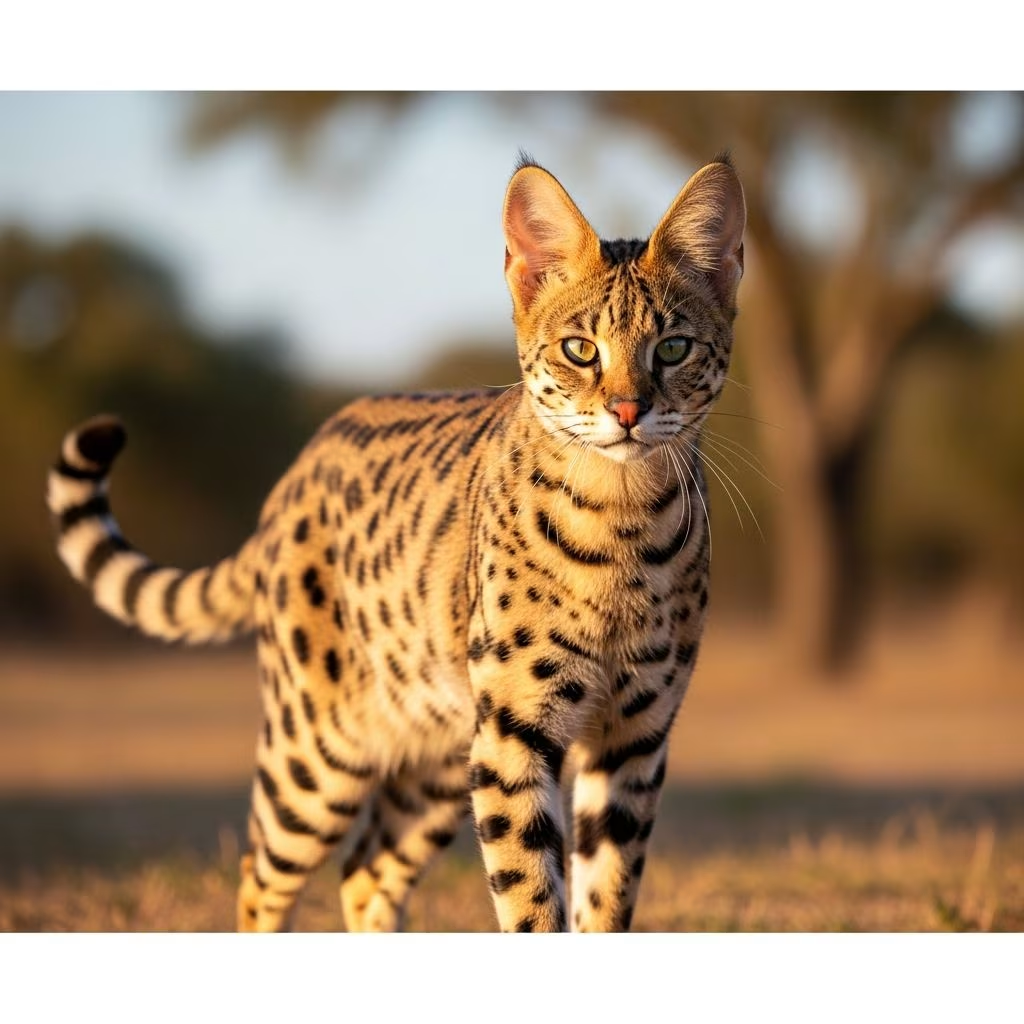
The F5 Savannah cat represents the fifth generation in a remarkable hybrid lineage blending the African Serval with domestic cats, offering a striking balance of wild aesthetics and domesticated behavior. These cats, about 12.5% Serval, captivate with their elegant proportions and spotted coats while adapting well to family life.
Origins and Development of the Savannah Breed
The Savannah breed traces its beginnings to 1986, when a domestic Siamese cat mated with a male African Serval named Ernie, producing the first known kitten dubbed “Miracle’s.” This serendipitous event, facilitated by breeder Judee Frank, marked the dawn of a new hybrid experiment inspired by the earlier Bengal breed’s success.
Early pioneers like Suzi Wood Mustacio and Patrick Kelley drove the breed forward. Kelley acquired an F2 female and bred her to domestics, yielding the first F3 kittens, while Joyce Sroufe contributed extensively by producing numerous early generations using Servals, Bengals, Egyptian Maus, and Oriental Shorthairs. Challenges abounded: initial males were often infertile, necessitating backcrossing to domestic cats, which diluted Serval traits over generations.
By 1996, Kelley, Sroufe, and Karen Sausman drafted the initial breed standard, submitting it to The International Cat Association (TICA). Recognition progressed, with full championship status in 2012, solidifying the breed’s legitimacy. European efforts by breeders like Margitta Graeves of Kiwanga Savannahs further refined type through selective outcrossing.
Understanding F5 Generation Specifics
Generations in Savannah cats are denoted by ‘F’ followed by a number, where F1 signifies the closest to Serval (typically 50% Serval ancestry from a Serval-domestic cross). Each subsequent generation halves the wild percentage: F2 (25-28%), F3 (12.5-18%), F4 (6.25-12.5%), and F5 (3.13-6.25%).
Thus, F5 cats carry minimal Serval genetics, roughly 12.5% from an F4-Serval cross or less in standard lineages, resulting in more predictable temperaments and smaller sizes compared to earlier generations. They retain hallmark Serval-like features but exhibit enhanced domestic compatibility, making them suitable for varied households.
- Filial Calculation: F1 = Serval x Domestic; F2 = F1 x Serval/Domestic; progressive dilution stabilizes traits by F5.
- Breed Standard Impact: TICA penalizes excessive domestic traits in show cats, favoring bold spots and long legs even in later generations.
Physical Appearance and Size Variations
F5 Savannahs boast a lithe, athletic build reminiscent of their wild forebears, with long legs, a slender neck, and a deep chest. Adults typically weigh 10-20 pounds, stand 14-17 inches at the shoulder, and measure up to 30 inches in body length (excluding tail), though males often larger.
Their coat is short, luxurious, and covered in bold, teardrop-shaped rosettes on a tawny, silver, or brown background, with solid black noses and thumb-printed ears featuring ocelli (white inverted Vs). Tails are short and thick, hooded eyes dark-rimmed for an alert expression.
| Generation | Avg. Weight (lbs) | Serv % | Key Traits |
|---|---|---|---|
| F1-F2 | 20-40 | 25-50% | Largest, most wild-like |
| F3-F4 | 15-25 | 12-25% | Balanced size/energy |
| F5+ | 10-20 | 3-12% | Domestic-friendly |
Temperament and Behavioral Traits
F5 Savannahs are renowned for their dog-like devotion, intelligence, and playfulness. Highly social, they bond deeply with owners, often following them room-to-room and greeting newcomers boldly. Their curiosity drives endless exploration, mimicking a Serval’s hunting prowess through pouncing and leaping.
Unlike skittish purebreds, these cats crave interaction, excelling in fetch, leash walks, and even water play. Vocalizations include chirps, trills, and meows, communicating moods effectively. Early socialization curbs potential aloofness from wild genes, fostering affectionate pets.
- High energy: Needs 30-60 minutes daily play.
- Loyal: Greets at door, sleeps nearby.
- Intelligent: Learns tricks, puzzle toys.
Health Considerations and Lifespan
F5 Savannahs enjoy robust health, with lifespans of 12-20 years, benefiting from hybrid vigor. Common concerns mirror domestics: dental issues, obesity if under-exercised, and rare genetic hiccups like hypertrophic cardiomyopathy (HCM) or patellar luxation from outcross breeds.
Servals introduce no major breed-specific diseases, but screen for allergies and monitor for irritability signaling pain. Annual vet checks, vaccinations, and parasite control are essential. Spay/neuter prevents behavioral issues in non-breeding homes.
Grooming and Daily Maintenance
Low-maintenance coats require weekly brushing to distribute oils and reduce shedding. Bathing is infrequent; claw trims biweekly, ear cleaning monthly. Dental hygiene via brushing or treats prevents tartar.
Provide vertical spaces: cat trees, shelves. Interactive toys combat boredom-induced mischief like counter-surfing.
Ideal Living Environment and Training Tips
F5s thrive in spacious homes with access to outdoors via enclosures or leashed walks—never free-roam due to escapism and predation risks. Multi-cat homes work if introductions gradual; supervise with dogs initially.
Training leverages food motivation: clicker for commands, litter consistency from youth. Harness training enables safe adventures.
Nutrition and Feeding Guidelines
High-protein (40%+) diets mimic ancestral carnivory: quality kibble/wet food, raw if supervised. Portion 1-1.5 cups daily split meals; fresh water always. Avoid grains; supplements for omega-3s support coat/skin.
Cost Factors and Acquisition Advice
F5 kittens range $1,500-$4,000 from reputable breeders, varying by lineage/show quality. Research TICA-registered catteries; visit, query health tests. Adoptions rarer but possible via rescues.
Frequently Asked Questions
Are F5 Savannah cats legal everywhere?
Most regions allow F5+ as domestics; earlier generations face bans/restrictions in places like Hawaii, Georgia (pre-F4). Verify local exotic pet laws.
Do F5 Savannahs get along with children?
Yes, with supervision; their size/energy suits older kids tolerant of enthusiastic play.
How big do F5 Savannah cats grow?
Typically 10-20 lbs, 14-17 inches tall, lean and leggy.
Can F5 Savannahs be indoor-only?
Yes, with ample enrichment; enclosures enhance welfare.
What’s the difference between F4 and F5 Savannahs?
F5 has less Serval (3-6%), milder temperament, smaller stature versus F4’s bolder traits.
References
- A Timeline of the Savannah Cat Breed’s Development from 1986 to Present Day — Savannahgans.com. 2023. https://www.savannahgans.com/blog-1/savannahcathistory
- Savannah Cat F1: Unique Feline Characteristics — Baileyscbd.com. 2024. https://baileyscbd.com/blogs/cat-breeds/savannah-cat-f1-unique-feline-characteristics
- Savannah Cat History — Savannahcatassociation.org. 2023. https://savannahcatassociation.org/savannah-cat-history/
- Savannah Facts — Wisdompanel.com. 2025. https://www.wisdompanel.com/en-us/cat-breeds/savannah
- Savannah Cat History — Savannahbreedsection.com. 2024. https://www.savannahbreedsection.com/savannah-cat-history/
- Savannah Cat Breed Overview — Petsafe.com. 2024. https://www.petsafe.com/blog/savannah-cat-breed/
- Savannah cat — Wikipedia.org. 2026-01-28. https://en.wikipedia.org/wiki/Savannah_cat



