

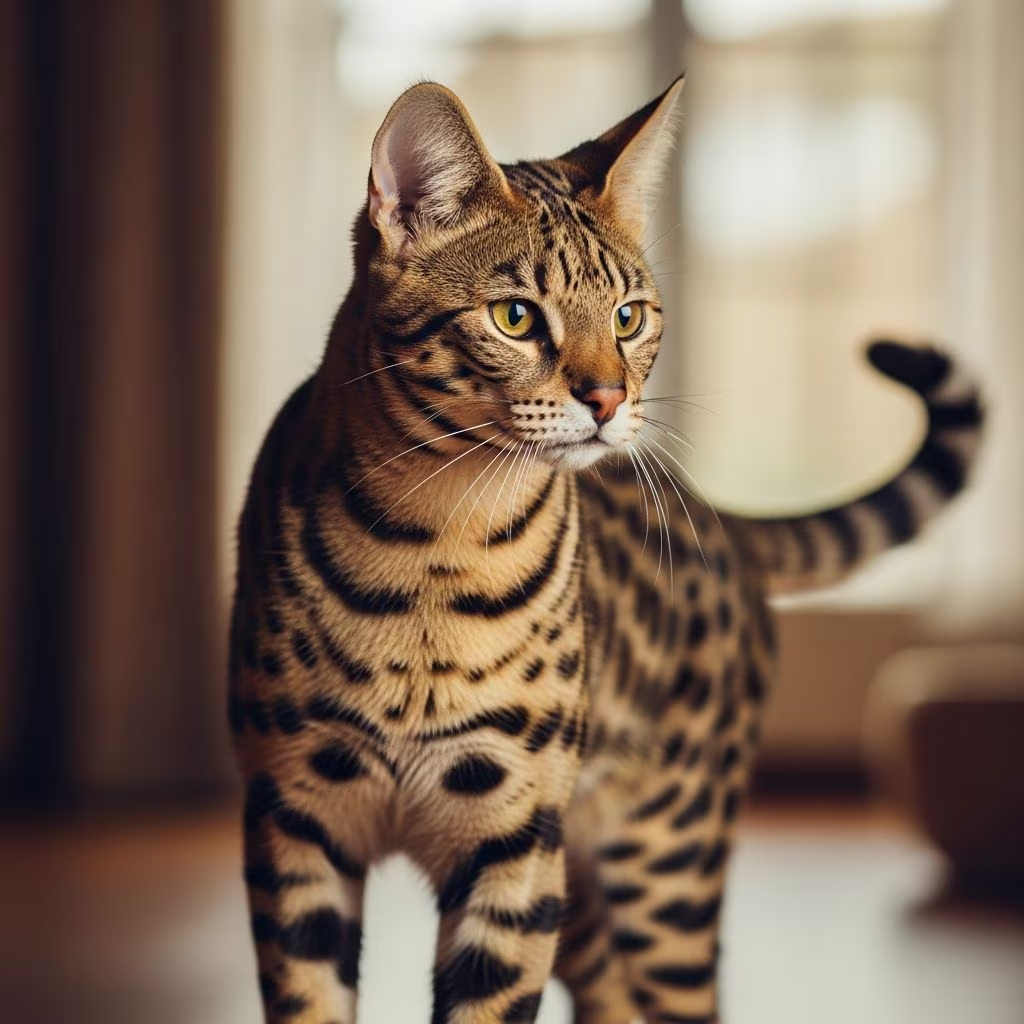
Understanding the F3 Generation and Its Place in the Savannah Lineage
The Savannah cat represents one of the most fascinating hybrid breeding programs in the feline world. These cats are the result of deliberate crossbreeding between domestic cats and the African Serval, a wild spotted feline known for its exceptional hunting prowess and striking appearance. The designation system used for Savannah cats—F1, F2, F3, and beyond—indicates how many generations removed a cat is from its wild Serval ancestor.
An F3 Savannah cat occupies a particularly interesting position within this generational spectrum. The “F” stands for “filial,” and the number indicates the generation. An F3 Savannah has a great-great-grandparent that is a Serval, meaning the wild genetics are present but significantly diluted compared to earlier generations. This specific placement makes the F3 generation particularly appealing to families and individuals seeking a balance between the exotic appearance of a wild cat and the temperament of a domestic companion.
Physical Characteristics and Distinctive Features
Size and Weight Variations
One of the most significant questions potential F3 Savannah owners ask concerns the size of these cats. Unlike earlier generations, F3 Savannahs exhibit considerable size variation, particularly between males and females. Male F3 Savannahs typically weigh between 15 and 20 pounds, making them substantially larger than average domestic cats but noticeably smaller than their F1 and F2 counterparts. Female F3 Savannahs often maintain a size closer to that of standard domestic cats, though they retain the characteristic tall, slender body proportions of the breed.
An important distinction exists between height and overall bulk. While F3 females may not weigh significantly more than average cats, they typically stand a couple of inches taller and longer than standard domestic felines, maintaining that distinctive lankier silhouette that makes Savannahs immediately recognizable. This height-to-weight ratio creates an elegant, elongated appearance that differs markedly from the stockier build of most domestic cat breeds.
Distinctive Anatomical Features
F3 Savannahs inherit several striking physical characteristics from their Serval ancestry that persist through the generations. These cats possess unusually large ears that are taller than they are wide and set far apart on their heads, contributing to their alert and exotic appearance. The ears serve both aesthetic and functional purposes, reflecting the Serval’s adaptation for hunting in African grasslands.
The body structure of F3 Savannahs follows a consistent pattern throughout the breed. Their legs are notably long and disproportionate to body size, a feature inherited directly from the Serval. These elongated limbs contribute significantly to the cat’s exceptional jumping ability and graceful, athletic movement. The tail is similarly extended, balanced, and expressive, while the neck appears relatively short in comparison to the overall body length.
Coat Patterns and Coloration
The F3 generation represents a milestone where color variation becomes notably pronounced. Unlike earlier generations, which display relatively consistent coloration patterns within litters, F3 Savannahs can exhibit remarkable diversity in coat color and pattern. These cats may display colors ranging from cool neutral tones to vibrant fiery oranges, silvery hues, snow patterns, and even melanistic (near-black) variations. Some F3s display marbled patterns in addition to or instead of the characteristic spotted coat.
The spotted or marbled pattern typically becomes more pronounced as an F3 Savannah matures, with the distinctive brown spots becoming increasingly defined and visible. This progression means that kittens may display subtle markings that develop into striking patterns as they mature. The variation in quality and presentation between cats bred by different breeders becomes particularly apparent at the F3 level, allowing prospective owners to make more informed aesthetic choices.
Temperament: The Ideal Balance Point
Personality Profile and Social Behavior
The F3 Savannah has earned a reputation as the “sweet spot” within the Savannah breed, primarily due to its personality characteristics. These cats possess exceptional confidence and adaptability that allows them to thrive in diverse home environments. Unlike the more reserved and potentially challenging F1 and F2 generations, F3 Savannahs bond readily with entire families rather than showing preference for a single person.
F3 Savannahs are notably hands-on and social, even with young children. Many F3 owners report that their cats function as partial lap cats—not quite achieving the complete comfort level of traditional lap cats, but willing to settle on owners during relaxation time. This balance makes them suitable for families with moderate activity levels who desire affection without the constant physical contact demands of some breeds.
Adaptability and Visitor Tolerance
A distinctive behavioral trait of F3 Savannahs involves their remarkable composure around strangers and changes in routine. Most F3 Savannahs will approach and interact with visitors within five to ten minutes of introduction, often permitting petting and attention from newcomers. This welcoming nature makes them excellent choices for households with frequent guests or active social schedules.
The psychological resilience of F3 Savannahs also applies to environmental changes. Introduction of new pets, rearrangement of furniture, or other modifications to the home environment cause less stress and behavioral disturbance in F3 Savannahs compared to earlier generations. This adaptability extends to their acceptance of leash training and outdoor adventures with their owners, making them versatile companions for various lifestyle circumstances.
Energy Levels and Activity Demands
It is crucial to understand that despite their improved temperament and domestication compared to earlier generations, F3 Savannahs remain significantly more active and energetic than standard domestic cat breeds. These cats are not suitable for owners seeking quiet, sedentary companions. They possess remarkable athleticism and a strong drive to climb, explore, and investigate their environment.
F3 Savannahs are exceptional jumpers, capable of achieving heights up to 8 feet, which necessitates secure housing and thoughtful furniture arrangement. Without adequate environmental enrichment and interactive playtime, F3 Savannahs can develop destructive behaviors, including inappropriate scratching, climbing on areas where they are unwelcome, and knocking items from shelves.
Intelligence and Trainability
One of the most remarkable attributes of F3 Savannahs relates to their superior intelligence compared to standard domestic cats. This cognitive ability stems directly from their Serval ancestry and remains pronounced even in the third generation. F3 Savannahs demonstrate curiosity levels that exceed those of most cat breeds, manifesting as persistent investigation of new objects, doors, and situations.
The intelligence of F3 Savannahs translates into practical trainability. These cats can be taught to obey simple commands, a skill relatively uncommon in the feline world. Some F3 owners have successfully trained their cats to walk on leashes with appropriate harnesses, to fetch toys, and to respond to their names and specific commands. This trainability makes them candidates for enrichment activities and interactive games that stimulate their considerable mental capacity.
However, this same intelligence can present challenges. F3 Savannahs are quick to identify patterns and exploit opportunities in their environment. They may learn how to open doors, access forbidden areas, or manipulate their owners into providing desired outcomes. Responsible ownership requires understanding that their cleverness demands equally creative owners who can provide appropriate outlets for their mental energy.
Reproduction and Genetic Considerations
An important reproductive fact distinguishes male Savannah cats from females in the first several generations. Male F3 Savannahs are sterile, incapable of reproducing. This sterility extends through the F1, F2, F3, F4, and F5 generations, with males only becoming fertile at the F6 generation and beyond. This characteristic has significant implications for breeding programs and explains the price differential between male and female F3 Savannahs, with females commanding premium prices due to breeding potential.
For prospective owners, this sterility eliminates certain concerns about accidental breeding and overpopulation while also making males potentially more suitable for households where reproductive behavior (marking and aggression related to mating drives) might otherwise present challenges.
Suitability as Family Pets
Ideal Household Characteristics
F3 Savannahs make excellent pets for families with specific characteristics and environmental conditions. These cats thrive in homes where activity levels are moderate to high, where family members are present regularly, and where the household environment permits climbing, jumping, and active play. They are particularly well-suited to families with older children who can appreciate their energetic nature and interactive play style.
Households with a lot of activity and frequent visitors often provide ideal environments for F3 Savannahs. Rather than finding such activity stressful, these cats often enjoy the stimulation and interaction. Families that engage in activities like hiking or outdoor adventures with their pets find F3 Savannahs excellent companions, as these cats often enjoy walking on leashes and exploring new environments.
Incompatibilities and Considerations
F3 Savannahs are not appropriate for certain household situations. Owners seeking quiet, independent cats that require minimal attention will find themselves frustrated with the demands of F3 Savannahs. These cats require regular interactive engagement and do not thrive when isolated for extended periods.
Importantly, F3 Savannahs are not suitable companions for households containing small prey animals. These cats maintain strong hunting instincts inherited from their Serval ancestry, viewing small animals such as hamsters, guinea pigs, rabbits, fish, and birds as prey. Introduction of F3 Savannahs into homes with small pets creates situations where the natural predatory behavior of the cat poses genuine danger to the smaller animals.
Space Requirements and Housing
While F3 Savannahs are smaller than F1 and F2 generations, they still require more space than average domestic cats to maintain optimal physical and mental health. Vertical space is particularly important, as these cats utilize their exceptional jumping ability and climbing skills throughout the day. Homes with high ceilings, multiple levels, or access to enclosed outdoor spaces facilitate the activity patterns natural to F3 Savannahs.
Outdoor access presents a particular consideration. Many owners utilize secure outdoor enclosures or “catios” to allow their F3 Savannahs supervised outdoor exploration while preventing escape, as their jumping ability exceeds the barrier heights that contain standard domestic cats.
Health and Care Requirements
F3 Savannahs generally enjoy good health, though they require veterinary care from practitioners experienced with the breed. Their larger size compared to many domestic cats means they may require higher caloric intake and appropriately-sized carriers and equipment for veterinary visits. Regular health screening for conditions that may affect larger cat breeds helps ensure longevity and quality of life.
Dental care, obesity prevention through appropriate nutrition and exercise, and regular veterinary examinations form the foundation of responsible F3 Savannah ownership. These cats’ active nature generally prevents the weight-related health issues that plague sedentary breeds, though appropriate diet and portion control remain essential.
Frequently Asked Questions About F3 Savannahs
- What is the typical lifespan of an F3 Savannah cat?
- While specific lifespan data for F3 Savannahs varies, these cats typically live 12-20 years with appropriate care, comparable to standard domestic cats, though their larger size may influence longevity.
- Are F3 Savannahs legal to own?
- Legality varies by jurisdiction. Some areas restrict ownership of hybrid cats or require specific permits. Prospective owners must verify local and regional regulations before acquiring an F3 Savannah.
- How do F3 Savannahs compare to F2 and F4 generations?
- F2 Savannahs are larger and more unpredictable in temperament but more exotic in appearance. F4 and later generations are smaller and more domesticated but retain the distinctive Savannah look and enhanced intelligence.
- What is the approximate cost of an F3 Savannah kitten?
- F3 Savannah kittens typically cost between $1,500 and $4,000, with female kittens commanding higher prices due to reproductive potential. Prices vary based on breeder reputation, coat quality, and lineage.
- Can F3 Savannahs be left alone during work hours?
- F3 Savannahs should not regularly spend full work days alone. They do better with mid-day attention or access to interactive toys and enrichment. Boredom leads to destructive behaviors.
Making the Decision: Is an F3 Savannah Right for You?
F3 Savannahs represent an excellent choice for a specific type of owner and household. If you appreciate exotic-looking cats, possess the energy to match your pet’s activity level, have time for interactive engagement, and can provide appropriate physical space and environmental enrichment, an F3 Savannah may be an ideal companion.
However, if you prefer independent, quiet cats; have limited time for active play and training; or maintain a home with small animals, the F3 Savannah is not the appropriate breed choice. Responsible pet ownership requires honest self-assessment of your lifestyle, resources, and genuine ability to meet a breed’s specific needs.
The F3 Savannah generation successfully bridges the gap between exotic appeal and practical domesticity, offering families and individuals a remarkable companion that combines striking beauty, impressive intelligence, and engaging personality in a package that remains manageable for committed owners.
References
- F3 Savannah Cat — Select Exotics. Accessed January 2026. https://savannahcatbreed.com/f3-savannah-cat/
- Savannah: Personality, Diet, Grooming, Training — Petplan. Accessed January 2026. https://www.petplan.co.uk/cat-insurance/cat-breeds/savannah.html
- F3 Savannah Cat: Info, Pictures, Facts & History — Catster. Accessed January 2026. https://www.catster.com/cat-breeds/f3-savannah-cat/
- F1 F2 F3 Explained for Savannah Cats — Savannah Cat Association. Accessed January 2026. https://savannahcatassociation.org/f1-f2-f3-explained/
- Savannah Cat 101 – Personality, Traits, Price & Size — Outdoor Bengal. Accessed January 2026. https://www.outdoorbengal.com/blogs/cat-breeds/savannah-cat-101



