

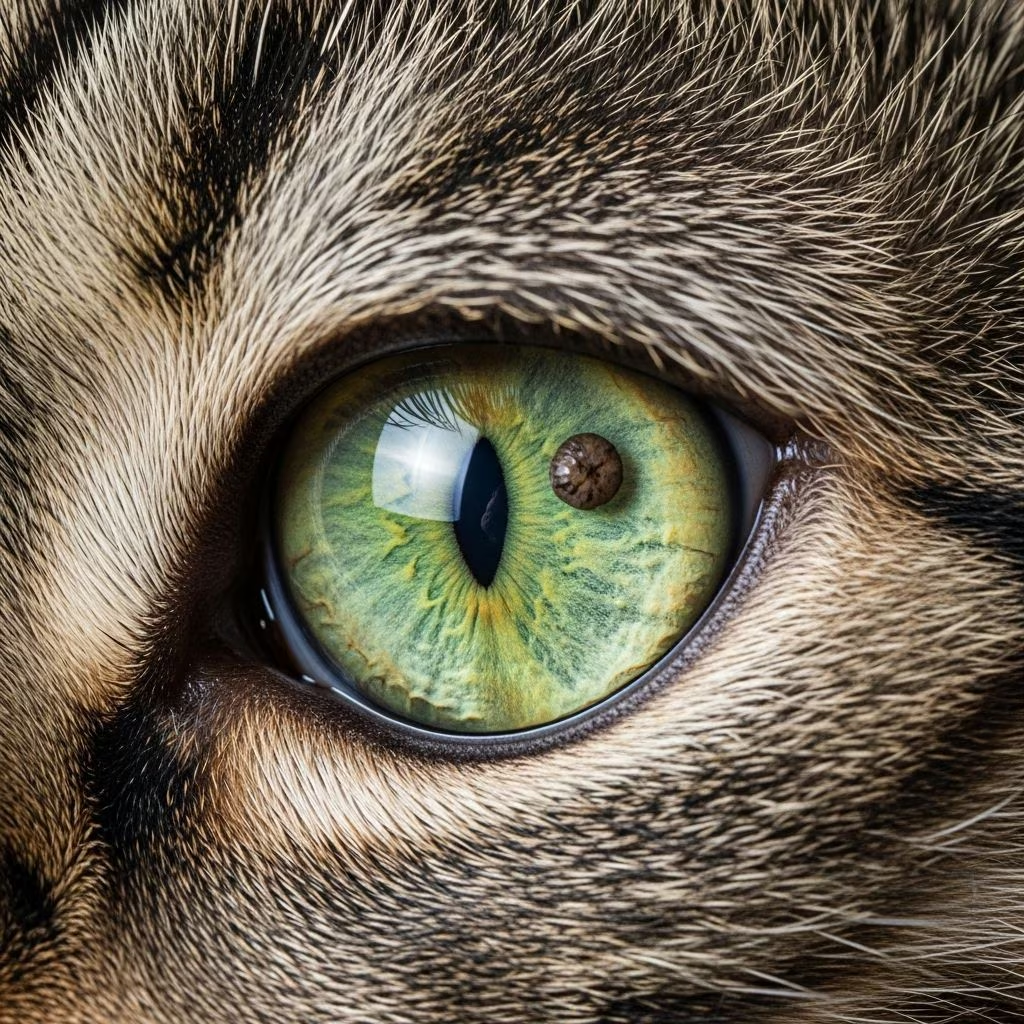
Eye tumors represent a significant concern in feline veterinary medicine, often linked to prior injuries, chronic inflammation, or viral associations. These neoplasms can rapidly impair vision, cause pain, and spread, necessitating prompt veterinary attention. Understanding their development, manifestations, and management is crucial for cat owners and practitioners alike.
Understanding Feline Ocular Neoplasia
Ocular neoplasia in cats encompasses a range of malignant growths affecting the eye and surrounding structures. Primary tumors originate within the eye, while secondary ones spread from elsewhere in the body. Factors like chronic uveitis, trauma-induced lens rupture, and feline leukemia virus (FeLV) contribute to their onset. These conditions frequently lead to secondary complications such as glaucoma or phthisis bulbi, where the eye shrinks due to prolonged inflammation.
Unlike dogs, cats exhibit unique tumor profiles, with melanomas and sarcomas predominating intraocular sites. Post-traumatic sarcomas, in particular, arise months to years after ocular injury, highlighting the importance of monitoring damaged eyes closely.
Primary Intraocular Tumors: Key Types and Features
Primary tumors develop directly in ocular tissues, often presenting insidiously until advanced.
Diffuse Iris Melanoma
The most prevalent primary intraocular tumor, diffuse iris melanoma begins as subtle hyperpigmentation on the iris surface. Over time, it expands irregularly, distorting the pupil and obstructing aqueous humor outflow, which triggers glaucoma and buphthalmos (eye enlargement). Cats typically present in middle to older age, around 10 years.
- Early indicators: Iris color darkening, irregular surface texture.
- Late complications: Pupillary irregularities, hyphema (blood in anterior chamber), corneal edema.
Enucleation is advised for rapidly progressing cases or those with angle involvement to mitigate metastasis risks.
Feline Ocular Post-Traumatic Sarcomas (FOPTS)
These aggressive sarcomas follow ocular trauma or severe uveitis, with lens capsule rupture as a common precursor. Latency periods vary from months to over a decade. Tumors infiltrate the globe, causing opacity, chamber filling masses (white, tan, or pink), and globe distortion.
Behavioral cues of discomfort include blepharospasm (squinting), lethargy, appetite loss, and hiding. Advanced infiltration along the optic nerve leads to blindness, seizures, or altered mentation.
| Tumor Subtype | Characteristics | Common Sites |
|---|---|---|
| Spindle Cell | Most frequent; produces cartilage/osteoid | Intraocular, optic nerve |
| Round Cell | Lymphocytic markers; inflammation-linked | Anterior chamber, cornea |
| Fibrosarcoma | Rare; collagen-producing | Globe wall, orbit |
Prophylactic enucleation of blind, phthisical, or chronically inflamed eyes is often recommended due to high invasiveness.
Secondary and Periocular Neoplasms
Feline Lymphosarcoma-Leukemia Complex (FeLLC)
The leading secondary tumor, FeLLC associates with FeLV. Manifestations span isolated ocular changes to systemic disease. Anterior uveitis predominates, with keratic precipitates, hypopyon, and synechiae. Retinal hemorrhages, vascular tortuosity, and detachments signal posterior involvement.
- Corneal signs: Edema, neovascularization, infiltrates, ulcers.
- Pupillary anomalies: Mydriasis, anisocoria, spastic pupils—often pre-systemic illness harbingers.
Prognosis worsens with FeLV positivity; survival is shorter.
Squamous Cell Carcinoma (SCC)
Predilects white cats with unpigmented lids. Affects eyelids, conjunctiva, nictitans as pink, ulcerated, irregular masses with ill-defined borders. Early excision or cryotherapy improves outcomes.
Other Periocular Tumors
Limbal melanomas appear as raised, dark scleral edge masses, prone to uveitis and ulceration. Orbital masses cause exophthalmos, while conjunctival lymphomas present as salmon-pink patches.
Recognizing Clinical Signs: What to Watch For
Owners often first note eye color shifts, cloudiness, or shape changes. Pain manifests subtly: pawing, rubbing, tearing, redness, discharge, or closed lids. Systemic signs like weight loss or anorexia accompany advanced disease.
| Sign | Associated Tumors | Urgency |
|---|---|---|
| Iris hyperpigmentation | Melanoma | Moderate |
| Globe opacity/mass | FOPTS, lymphoma | High |
| Squinting, lethargy | Glaucoma, uveitis | Immediate |
| Neurologic changes | Optic nerve invasion | Critical |
Blindness may precede other symptoms, underscoring routine exams.
Diagnostic Approaches
Diagnosis integrates history, ophthalmoscopy, tonometry (IOP measurement), ultrasonography, and fine-needle aspirates. B-scan ultrasound reveals intraocular masses, retinal detachment. Histopathology post-enucleation confirms type, guiding prognosis.
- Schirmer tear test: Assesses lacrimation deficits.
- Fluorescein staining: Detects ulcers.
- FeLV/FIV testing: Essential for lymphoma suspicion.
Treatment Strategies and Prognosis
Treatment prioritizes enucleation for painful, blind eyes harboring sarcomas or advanced melanomas, offering pain relief and local control. Radiation or chemotherapy adjuncts are investigational; FeLLC may respond to systemic chemo, though FeLV+ cases fare poorly.
Prognosis varies: Early melanoma enucleation yields good local control, but metastasis risks persist. FOPTS extension beyond sclera signals doom; survival post-op averages months if optic nerve involved.
Prevention and Monitoring High-Risk Cats
Minimize trauma risks indoors. Vaccinate against FeLV. Monitor cats with uveitis history, phthisis, or trauma via annual ophthalmic checks. Prophylactic removal of non-visual, dysmorphic eyes curbs sarcoma development.
Frequently Asked Questions (FAQs)
What causes eye tumors in cats?
Trauma, chronic inflammation, FeLV, and genetic predispositions like light pigmentation trigger most cases.
Can cat eye tumors be treated without surgery?
Limited options exist; enucleation is standard for aggressive types. Medical management suits early, non-invasive lesions.
Is blindness inevitable with feline ocular cancer?
Not always; unilateral cases preserve contralateral vision. Early intervention prevents bilateral spread.
How do I know if my cat’s eye problem is cancer?
Persistent color changes, masses, or pain unresponsive to anti-inflammatories warrant imaging and biopsy.
What’s the survival rate for cats with iris melanoma?
Enucleation offers 70-80% metastasis-free survival if confined to globe; extrascleral extension halves it.
Early vigilance transforms outcomes in feline ocular neoplasia. Consult veterinary ophthalmologists for tailored plans.
References
- Feline ocular post-traumatic sarcomas – PMC – NIH — National Institutes of Health. 2024. https://pmc.ncbi.nlm.nih.gov/articles/PMC10814148/
- Ocular Neoplasia in Cats – Eye Diseases and Disorders — Merck Veterinary Manual. 2023. https://www.merckvetmanual.com/eye-diseases-and-disorders/neoplasia-of-the-eye-and-associated-structures/ocular-neoplasia-in-cats
- Eye Tumors – Melanoma in Cats — VCA Animal Hospitals. 2023. https://vcahospitals.com/know-your-pet/eye-tumors-melanoma-in-cats
- Feline Ocular Sarcoma — Purdue University Animal Disease Diagnostic Laboratory. 2006. https://www.addl.purdue.edu/newsletters/2006/summer/FOS.htm (Authoritative historical reference on sarcoma pathology).



