

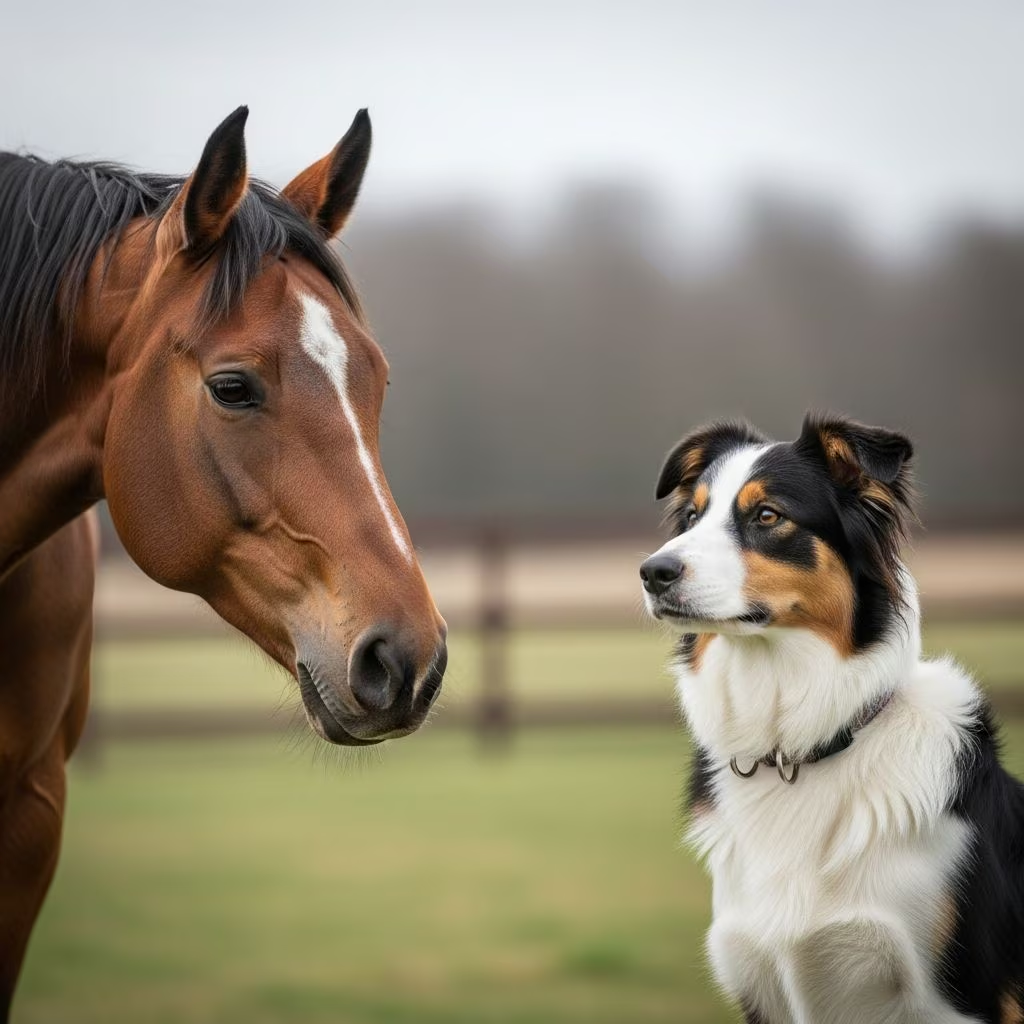
When considering which animal is smarter—a horse or a dog—the answer proves far more complex than simple comparison allows. Both species possess remarkable cognitive abilities, yet they manifest differently based on fundamental biological differences and evolutionary pressures. Rather than declaring a winner in an intelligence contest, understanding how each animal thinks reveals why they excel in different domains and why direct measurement remains impossible.
The Challenge of Cross-Species Intelligence Comparison
The fundamental problem with comparing horse intelligence to dog intelligence lies in the absence of a universal measuring system. Humans have developed sophisticated IQ tests for our own species, but no equivalent exists for animals. Each creature evolved to solve specific environmental problems, developing specialized cognitive strengths rather than general intelligence.
Dogs descended from predatory wolves, shaping their cognitive architecture toward hunting, tracking, and outsmarting prey. Horses, conversely, evolved as prey animals, developing entirely different survival mechanisms. This biological divergence means their intelligence cannot be placed on a simple linear scale. What represents intelligence for a predator differs markedly from what constitutes intelligence for a herd herbivore.
Researchers and equine behavior experts consistently emphasize this point. Dr. Marla Foreman, an equine behavior consultant, notes that comparing these two species requires acknowledging their fundamentally different nature. Intelligence must be evaluated within the context of each animal’s ecological niche and evolutionary history.
Understanding Prey versus Predator Cognition
The distinction between predator and prey animals fundamentally shapes intelligence expression. Predators like dogs developed cognitive abilities optimized for:
- Tracking and interpreting sensory data
- Strategic pursuit and capture behaviors
- Problem-solving within competitive contexts
- Understanding and manipulating prey behavior
Prey animals including horses evolved different capabilities aligned with survival through:
- Heightened environmental awareness and threat detection
- Complex social coordination within herd structures
- Rapid decision-making under pressure
- Emotional intelligence regarding group dynamics
These divergent selective pressures created animals with specialized intelligence rather than generalized smarts. A horse’s field of vision, spanning nearly 360 degrees, provides survival advantages a dog cannot match. Similarly, a dog’s ability to track scent over vast distances exceeds equine capabilities. Neither represents superior intelligence—they represent adaptation.
Memory Capabilities and Retention
When examining memory, both species demonstrate impressive abilities, though through different mechanisms. Research indicates notable differences in how each processes and retains information.
| Memory Type | Horses | Dogs |
|---|---|---|
| Object Recall | Up to 20 objects in space | Around 15 objects in space |
| Long-term Memory | Excellent retention of humans and commands for years | Powerful associative memory influenced by scent |
| Memory Type | Specialized for environmental navigation | Optimized for olfactory association |
Horses possess exceptional long-term memory, often remembering human handlers, learned commands, and established routines across many years. This capability reflects their evolutionary need to remember herd members, safe locations, and seasonal patterns crucial for survival.
Dogs rely heavily on associative memory, connecting sensory experiences—particularly smells—with outcomes and emotions. A dog remembers the rustle of a food bag or the owner’s car pulling into the driveway not through visual recall alone, but through a cascade of sensory associations anchored in olfaction.
The data regarding object recall shows horses slightly outperforming dogs, remembering approximately 20 objects compared to dogs’ 15. However, this difference likely reflects different testing conditions and learning mechanisms rather than superior cognitive capacity.
Problem-Solving and Adaptive Behavior
Both species demonstrate strong problem-solving abilities, though context dramatically influences performance. Horses show particular aptitude when navigating complex environments and overcoming physical obstacles. They excel at puzzles that require environmental manipulation, though individual horses show varying enthusiasm for such mental exercises.
Dogs have long been recognized for problem-solving linked to hunting behaviors and service work. Their ability to interpret human gestures and respond to novel situations enables rapid adaptation to new tasks. Dogs trained as service animals demonstrate sophisticated problem-solving, determining when to disobey commands if doing so protects their handler from danger.
An often-overlooked factor in problem-solving capability involves experience and training quality. Dr. Foreman emphasizes that horses perform better as problem-solvers when exposed to varied experiences throughout their lives. The same principle applies to dogs—richer environmental experience correlates with enhanced adaptive thinking. Trainer skill significantly influences both species’ apparent problem-solving abilities, sometimes creating illusions of species-level differences when differences actually reflect individual or training variation.
Social Intelligence and Emotional Awareness
Social intelligence represents a dimension where both animals demonstrate remarkable sophistication. Dogs inherited pack-living instincts from their wolf ancestors, developing complex communication systems, hierarchical understanding, and group coordination. Their ability to interpret human body language and emotional states remains legendary among pet owners.
Horses, derived from herd-living ancestors, display equally sophisticated social intelligence expressed through different mechanisms. They navigate intricate social hierarchies, maintain coalitions, and demonstrate awareness of group dynamics that rivals dog pack behavior. Research shows horses can read human expressions and interpret human intentions, often with greater accuracy than the humans themselves possess regarding their own states.
| Social Intelligence Aspect | Horses | Dogs |
|---|---|---|
| Emotional Recognition | Slightly less accurate but highly skilled | Can read human emotions with 85% accuracy |
| Human Command Understanding | Recognize approximately 30 cues from humans | Understand 165-250 words in human commands |
| Social Hierarchy Navigation | Complex herd-based social structures | Pack-based hierarchical awareness |
| Group Coordination | Herd-level problem solving and defense | Pack hunting and cooperative strategies |
Dogs recognize significantly more human words than horses acknowledge distinct cues. This difference reflects dogs’ domestication alongside humans for thousands of years, creating intense selective pressure for understanding human communication. Horses developed alongside humans more recently and in different contexts, resulting in smaller vocabularies but no less sophisticated social understanding.
Learning Capacity and Training Speed
Common misconceptions suggest dogs learn faster than horses, based on their eagerness to perform tricks and follow commands. This generalization oversimplifies a more nuanced reality. Learning speed depends on multiple factors including motivation, training methodology, individual temperament, and task type.
Both species demonstrate equal capability for rapid learning when properly motivated and trained. Horses can learn complex sequences, perform precise movements, and respond to subtle cues when training employs methods aligned with their learning preferences. Dogs similarly show varied learning speeds depending on breed, individual personality, and trainer approach.
Breed differences further complicate generalizations. Certain dog breeds—Border Collies, Poodles, German Shepherds—show exceptional trainability, while others demonstrate less eagerness for obedience work. Similarly, horse breeds reveal intelligence variations. Welsh Cobs exhibit strong problem-solving orientation, Thoroughbreds demonstrate quick adaptation despite high energy, and Morgan horses display remarkable long-term learning retention.
The key factor determining learning speed remains trainer skill. An exceptional trainer can achieve remarkable results with either species, while poor training methods limit performance regardless of the animal’s inherent capability.
Loyalty and Emotional Bonding
Horses and dogs each form profound attachments to humans, though expressing loyalty through different behavioral patterns. Dogs demonstrate affection openly—greeting owners enthusiastically, seeking physical contact, and showing obvious distress during separation.
Horses express loyalty more selectively, often taking considerable time before bonding deeply with a particular person. Once formed, however, these attachments run remarkably deep. Horses recognize individual humans even after years of separation, preferentially interact with familiar handlers, and demonstrate behavioral changes indicating emotional investment. This selectivity perhaps reflects different evolutionary pressures—dogs benefited reproductively by bonding quickly to humans, while horses maintained more cautious social structures.
The perceived difference in loyalty often stems from expression style rather than depth of feeling. A horse choosing to trust a human demonstrates emotional intelligence and discernment. Dogs, by contrast, often extend trust more readily to unfamiliar people, which humans interpret as greater loyalty when it may simply reflect different temperamental styles.
Specialized Abilities and Domain Expertise
Rather than ranking overall intelligence, recognizing domain-specific expertise provides clearer insight. Dogs excel in scent tracking, reading human intent, rapid obedience learning, and detecting medical conditions. These capabilities stem from their predatory heritage and thousands of years of domestication alongside humans.
Horses demonstrate excellence in environmental navigation, sustained physical performance, herd-level problem solving, and reading subtle social cues. Their prey animal background and millennia of partnership with humans created different expert domains.
Neither species achieves superiority across all dimensions. Each represents an optimized solution to different survival and performance challenges. Attempting to crown one species as universally smarter ignores this fundamental specialization.
The Verdict on Comparative Intelligence
After examining memory, problem-solving, social intelligence, learning capacity, and loyalty, the evidence points clearly toward one conclusion: both horses and dogs are intelligent in complementary ways. The question itself—which is smarter—is fundamentally flawed, analogous to asking whether carrots or kibble taste better.
Intelligence, when evaluated scientifically, reflects adaptation to ecological and social contexts. Horses and dogs developed their cognitive capacities solving different survival problems, resulting in different intelligent profiles rather than different points on a linear scale.
Frequently Asked Questions
Can horses solve problems as well as dogs?
Yes. Horses demonstrate strong problem-solving abilities, particularly in environmental navigation and physical puzzle-solving. Dogs excel at social problem-solving and hunting-related challenges. Performance depends more on individual experience, training quality, and task type than species-level differences.
Do horses have better memory than dogs?
Horses show stronger long-term memory for people, places, and learned behaviors across years. Dogs possess more powerful associative memory, particularly for scent-related information. Different memory types serve different evolutionary functions rather than indicating memory superiority.
Which species learns faster?
Learning speed varies individually within both species and depends significantly on training methods and motivation. Neither species consistently outpaces the other across all learning contexts. Trainer skill often determines apparent learning speed differences.
Are horses more emotionally intelligent than dogs?
Both demonstrate emotional intelligence expressed differently. Dogs openly display attachment and emotional response. Horses read emotions and intentions in humans with remarkable accuracy while expressing feelings more subtly. Emotional intelligence manifests differently, not unequally.
Which species is more loyal?
Both form deep bonds with humans. Dogs express loyalty openly and readily, while horses bond selectively but intensely. Loyalty depth may be equal; expression styles differ.
References
- Are Horses Smarter Than Dogs? — The Plaid Horse Magazine. 2025-01-31. https://www.theplaidhorse.com/2025/01/31/are-horses-smarter-than-dogs/
- Are Horses Smarter Than Dogs? Unraveling Animal Intelligence — Just Horse Riders. https://www.justhorseriders.co.uk/blogs/news/are-horses-smarter-than-dogs-unraveling-animal-intelligence
- Are Horses Smarter Than Dogs? Animal Intelligence Explained — Dogster. https://www.dogster.com/lifestyle/are-horses-smarter-than-dogs
- Are Horses Smart? — PetMD. https://www.petmd.com/horse/are-horses-smart



