

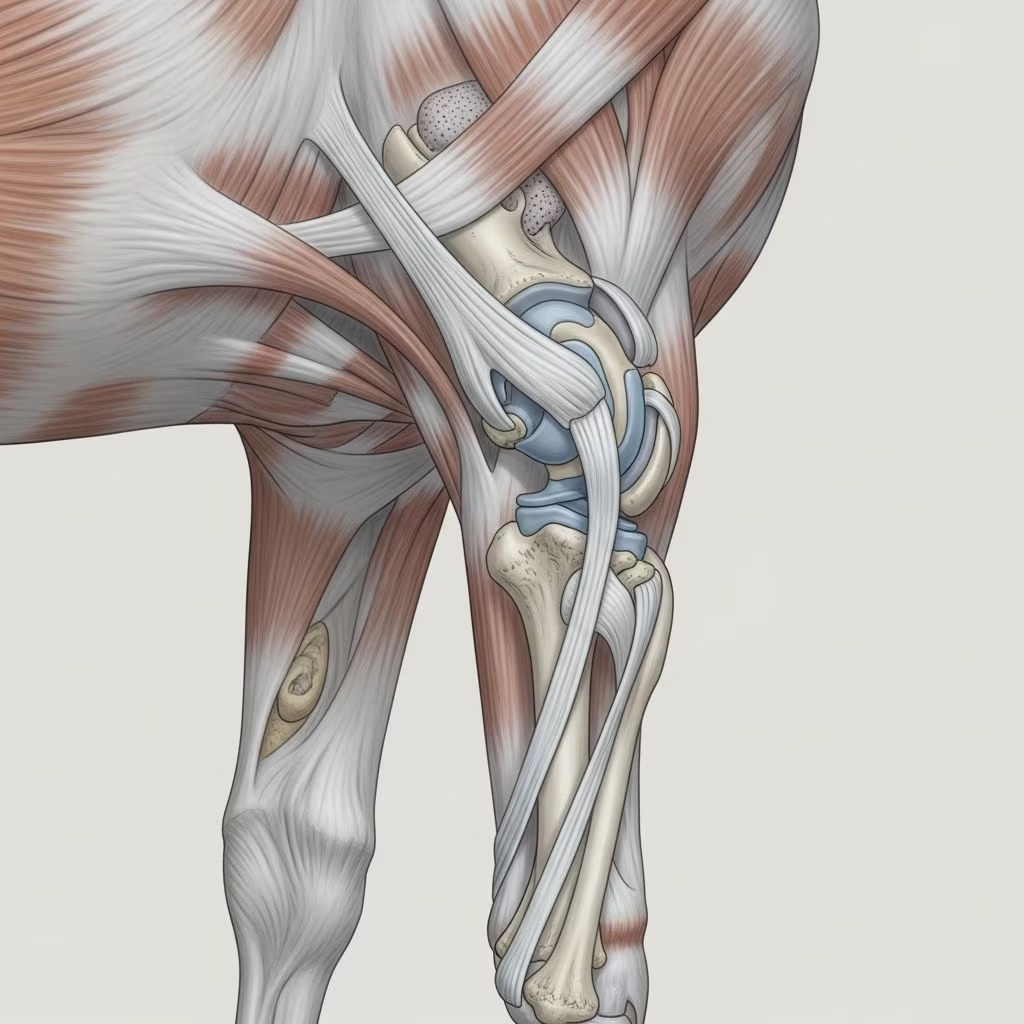
The stifle joint stands as a cornerstone of equine hind limb function, enabling powerful propulsion, stability, and rest. Disorders affecting this complex structure can significantly impair a horse’s movement, performance, and comfort, making early recognition and intervention crucial for owners and veterinarians alike.
Understanding the Stifle’s Anatomical Framework
Positioned midway up the hind leg, the equine stifle mirrors the human knee in its role but surpasses it in complexity. It unites the femur, tibia, and patella, forming a tripartite system that facilitates flexion, extension, and weight-bearing under immense loads during locomotion.
- Femoropatellar component: Features the patella sliding within the femoral trochlea, supported by three patellar ligaments for smooth extension.
- Femorotibial components: Comprise medial and lateral compartments with menisci that cushion impacts and distribute forces evenly.
Ligaments such as the medial and lateral collateral ligaments provide lateral stability, while cranial and caudal cruciates prevent excessive tibial displacement. This intricate setup integrates with the reciprocal apparatus, linking stifle motion to hock and fetlock flexion for coordinated gait.
Critical Mechanisms: Stay and Reciprocal Apparatus
Horses possess unique adaptations like the stay apparatus, allowing them to “lock” the stifle for standing rest without muscular fatigue. The medial patellar ligament engages a femoral ridge, securing extension—a vital energy-conserving feature evolved for predator evasion.
Complementing this is the reciprocal apparatus, involving tendons like the superficial digital flexor and peroneus tertius, ensuring synchronized hind limb movement. When the stifle flexes, the hock and fetlock follow suit, optimizing stride efficiency in disciplines from dressage to racing.
Prevalent Stifle Pathologies in Horses
Stifle disorders manifest diversely, often stemming from trauma, repetitive strain, conformational flaws, or degenerative processes. Performance horses in jumping, barrel racing, and cutting face heightened risks due to abrupt directional changes and deceleration.
| Disorder | Primary Causes | Key Features |
|---|---|---|
| Upward Fixation of Patella | Weak quadriceps, conformational issues, trauma | Sudden locking in extension, stumbling, reluctance to trot |
| Patellar Luxation | Shallow trochlea, ligament laxity | Intermittent downward slipping, chronic lameness |
| Meniscal Tears | Twisting injuries, overextension | Effusion, pain on flexion, positive cranial drawer sign |
| Cruciate Damage | Severe trauma | Rare; instability, cranial tibial thrust |
| Osteochondrosis (OCD) | Developmental cartilage defects | Common in young horses; fragments cause inflammation |
Upward Fixation: A Mechanical Hitch
This condition occurs when the patella fails to disengage from the femoral trochlea, halting forward motion. Acute cases demand immediate veterinary attention to avert muscle spasms and prolonged lameness. Chronic forms link to quadriceps atrophy or straight hock conformation.
Meniscal and Ligamentous Injuries
Menisci, C-shaped fibrocartilages, tear from rotational forces, yielding joint effusion and lameness exacerbated by circling. Collateral ligament strains grade from mild sprains to complete ruptures, with the lateral variety more prevalent due to biomechanical stresses.
Recognizing Clinical Signs of Stifle Dysfunction
Horses with stifle issues often exhibit subtle hind limb lameness, detectable via flexion tests or lunging. Indicators include:
- Shortened anterior phase of stride
- Hip hike or drop on the affected side
- Reluctance to engage hindquarters
- Joint swelling or heat post-exercise
- Abnormal canter transitions
Owners may note intermittent “catching up” strides or resistance to vertical flexion, underscoring the need for systematic evaluation.
Diagnostic Approaches for Accurate Assessment
Veterinarians employ a multi-modal strategy:
- Clinical exam: Palpation for effusion, flexion tests, and dynamic assessments.
- Diagnostic analgesia: Intra-articular blocks to localize pain.
- Imaging: Radiography detects OCD or fractures; ultrasound reveals soft tissue damage; MRI offers superior meniscal detail.
- Advanced tools: Arthroscopy for direct visualization and biopsy.
Flexion tests provoke lameness by compressing menisci, while long-term monitoring tracks progression in subtle cases.
Treatment Modalities: From Conservative to Surgical
Management tailors to severity and chronicity.
Conservative Therapies
- Rest and NSAIDs: Reduce inflammation; phenylbutazone controls pain.
- Physical therapy: Controlled exercise strengthens quadriceps, preventing fixation recurrence.
- Intra-articular therapies: Corticosteroids or hyaluronic acid for synovitis; IRAP or PRP for regenerative healing.
Surgical Interventions
Arthroscopic debridement removes OCD flaps or meniscal shreds. Medial patellar desmotomy severs the medial ligament to cure chronic fixation, though complications like luxation necessitate follow-up tenodesis. Cruciate repairs remain experimental due to poor prognosis.
Preventive Strategies for Stifle Longevity
Proactive care mitigates risks:
- Balanced nutrition with adequate minerals to support cartilage health.
- Proper warm-up routines and gradual conditioning.
- Regular farriery to correct hoof angles influencing biomechanics.
- Conformation assessments in young horses to address straight hocks early.
- Cross-training to avoid repetitive strain in specialized disciplines.
Monitoring growth in juveniles prevents developmental orthopedic diseases like OCD.
Prognosis and Rehabilitation Outlook
Outcomes vary: Acute meniscal tears respond well to arthroscopy (80-90% return to work), while cruciate ruptures often end careers. Post-treatment rehab emphasizes hill work for muscle building and swimming for low-impact cardio, ensuring full recovery.
Frequently Asked Questions (FAQs)
What causes a horse to stumble from stifle problems?
Stumbling often ties to upward patellar fixation, where the kneecap locks, interrupting stride smoothness. Strengthening exercises resolve most cases.
Can stifle lameness be mistaken for hock issues?
Yes, due to the reciprocal apparatus; diagnostic blocks differentiate them precisely.
Is surgery always needed for stifle injuries?
No, many respond to rest, therapy, and injections; surgery reserves for structural damage.
How can I strengthen my horse’s stifles at home?
Incorporate cavaletti, ground poles, and uphill trotting under professional guidance.
Are certain breeds prone to stifle disorders?
Large warmbloods and stock horses in agility sports show higher incidence due to conformation and use.
References
- The Equine Stifle: Anatomy and Function — Horse Education Online. Accessed 2026. https://www.horseeducationonline.com/post/the-equine-stifle-anatomy-and-function
- Equine Stifle Model — Butler Professional Farrier Schools. 2015-02-24. https://butlerprofessionalfarrierschool.com/archives/1847
- Stifle Lameness in Horses: Causes, Treatment & Prevention — Mad Barn. Accessed 2026. https://madbarn.com/stifle-lameness/
- Inside the equine stifle — dvm360. Accessed 2026. https://www.dvm360.com/view/inside-equine-stifle
- Horse’s Stifle Anatomy Integral for Rest and Snoozing While Standing — American Farriers Journal. Accessed 2026. https://www.americanfarriers.com/articles/13016-horses-stifle-anatomy-integral-for-rest-and-snoozing-while-standing
- Functional Anatomy and Biomechanics of the Equine Stifle — IVIS (BEVA Congress). 2022. https://www.ivis.org/library/beva/beva-annual-congress-liverpool-2022/functional-anatomy-and-biomechanics-of-equine-stifle
- Horse Stifle: Anatomy, Problems, and Treatments Explained — Integricare. Accessed 2026. https://us.integricare.ca/blogs/articles/horse-stifle



