
Equine Nervous System: Essential Guide For Horse Owners
Explore the intricate equine nervous system: from brain functions to nerve pathways, vital for horse health and performance.
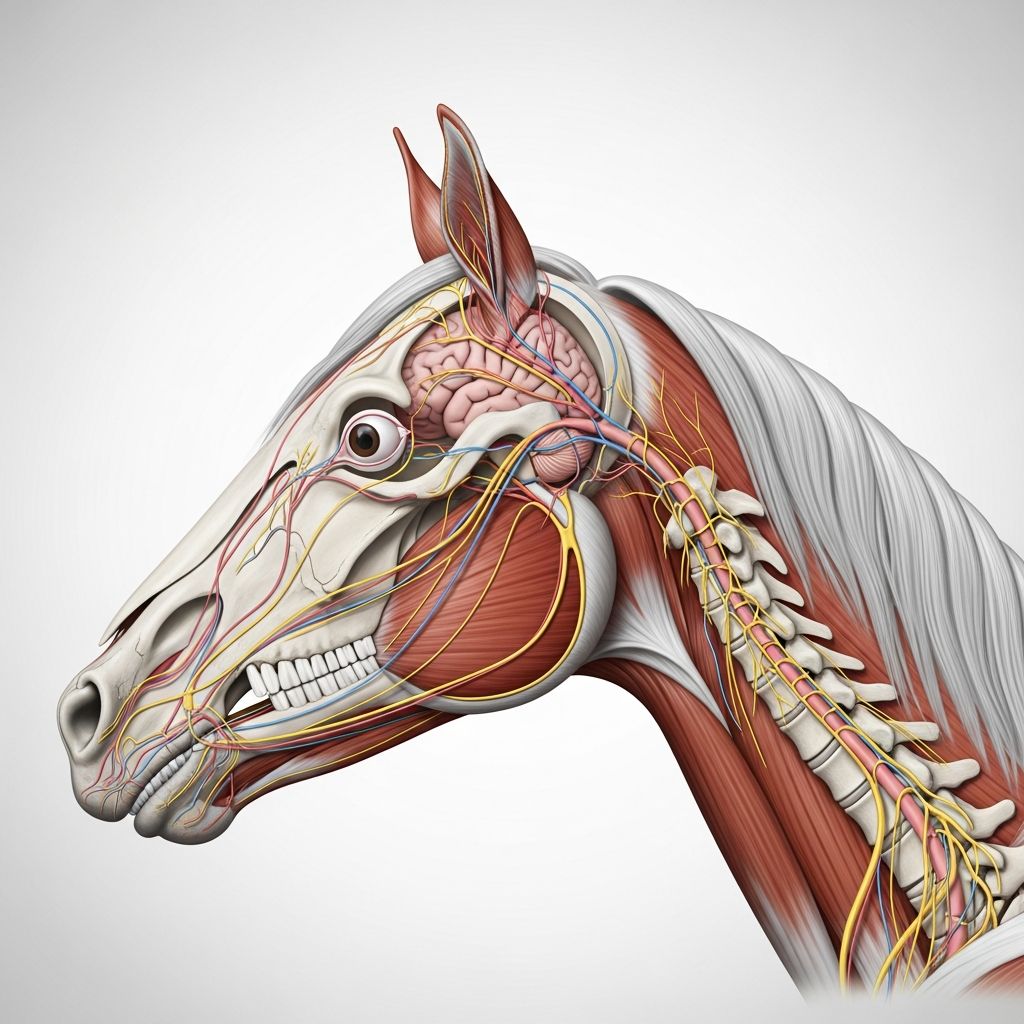
The nervous system in horses serves as the primary control center, orchestrating every movement, sensation, and automatic process essential for survival and performance. This complex network enables equines to navigate environments, respond to stimuli, and maintain physiological balance.
Overview of the Nervous System Framework
Horses possess a highly specialized nervous system divided into two main divisions: the central nervous system (CNS) and the peripheral nervous system (PNS). The CNS, comprising the brain and spinal cord, acts as the processing hub, while the PNS extends throughout the body to relay signals.
This division ensures efficient communication, allowing rapid responses critical for a prey animal like the horse. Understanding this framework helps owners recognize signs of neurological issues early.
Central Nervous System: The Core Command Center
The CNS forms the foundational backbone of equine neurology. It integrates sensory input and generates coordinated outputs for behavior and homeostasis.
The Equine Brain: Regions and Roles
The horse brain consists of three primary regions: the cerebrum, cerebellum, and brainstem, each with distinct functions.
- Cerebrum: Handles higher processing, including learning patterns, memory, and sensory integration. It enables horses to recognize familiar environments and handlers.
- Cerebellum: Manages balance, coordination, and precise movements, crucial for gait stability during trots or jumps.
- Brainstem: Regulates vital reflexes like breathing, heart rate, and swallowing, ensuring continuous life support.
Advanced imaging reveals unique equine brain features, such as a well-developed pineal body and spiral Ammon’s horn, supporting spatial awareness and instinctual behaviors.
Spinal Cord: The Signal Superhighway
Extending from the brainstem through the vertebral canal, the spinal cord segments correspond to body regions: cervical (neck/forelimbs), thoracic/lumbar (trunk/hindlimbs), and sacral (tail/pelvis). Damage here leads to localized deficits, like forelimb dragging from cervical trauma.
The cord facilitates both long-distance signaling to the brain and local reflexes, such as the withdrawal response to pain, bypassing higher centers for speed.
| Spinal Region | Body Area Controlled | Common Issues |
|---|---|---|
| Cervical | Neck, Forelimbs | Ataxia, Toe Dragging |
| Thoracic/Lumbar | Trunk, Hindlimbs | Weakness, Paralysis |
| Sacral | Tail, Pelvis | Incontinence, Tail Paralysis |
Peripheral Nervous System: Extending the Reach
The PNS connects the CNS to muscles, organs, and sensory receptors, subdivided into somatic (voluntary) and autonomic (involuntary) components.
Somatic Nerves: Voluntary Control
Somatic nerves include sensory (afferent) pathways carrying input like touch or pain to the CNS, and motor (efferent) pathways directing muscle contractions for locomotion.
This system underpins equine athleticism, from precise dressage maneuvers to evading predators swiftly.
Cranial Nerves: Head and Sensory Specialists
Twelve pairs of cranial nerves originate from the brain, governing head-specific functions:
- I: Olfaction for detecting feed or danger.
- II: Vision for environmental scanning.
- VII: Facial expressions and taste.
- X: Vagus nerve for heart rate, digestion, respiration.
Issues like head tilt or dysphagia signal cranial nerve involvement.
Autonomic Nervous System: Involuntary Regulation
The autonomic nervous system (ANS) maintains homeostasis without conscious effort, split into sympathetic (fight-or-flight) and parasympathetic (rest-and-digest) branches.
- Sympathetic: Accelerates heart rate, dilates pupils during stress.
- Parasympathetic: Slows heart rate, promotes digestion post-exercise.
Balance prevents chronic stress-related conditions like colic or ulcers in performance horses.
Integrated Functions in Daily Equine Life
The nervous system’s synergy allows complex behaviors: reflexes protect via instant responses, while learned patterns from the cerebrum refine training.
Horses excel in reactive instincts over abstract reasoning, prioritizing survival traits like hyper-vigilance.
Recognizing Neurological Dysfunction
Owners should watch for asymmetry, ataxia, head pressing, or altered mentation, prompting veterinary evaluation. Early intervention preserves function.
FAQs
What causes spinal cord issues in horses?
Trauma, infections, or compressions from vertebrae misalignments.
How many cranial nerves do horses have?
Twelve pairs, each vital for sensory and motor head functions.
Can stress affect a horse’s nervous system long-term?
Yes, via ANS imbalance leading to gastric issues or behavioral changes.
What role does the cerebellum play in riding?
It ensures gait smoothness and balance under saddle.
How is equine brain anatomy studied?
Via MRI revealing structures like the thalamus and hippocampus.
Maintenance Tips for Neurological Health
- Provide consistent footing to prevent falls.
- Monitor for vitamin E deficiency linked to neuromuscular diseases.
- Regular deworming to avoid parasite-induced damage.
- Balanced nutrition supporting myelin sheath integrity.
Proactive care enhances resilience against age-related decline or injury.
References
- The Equine Nervous System — Horse Education Online. 2023. https://www.horseeducationonline.com/post/the-equine-nervous-system
- The Nervous System: Why Your Horse is Nervous or Spooky — My Equine Solutions. 2022. https://www.myequinesolutions.com/blog/the-nervous-system-understanding-why-your-horse-is-nervous-or-spooky
- Neuroanatomy of the equine brain as revealed by high-field MRI — PMC (NCBI). 2019-03-20. https://pmc.ncbi.nlm.nih.gov/articles/PMC6443180/
- Parts of the Nervous System — LibreTexts Veterinary Medicine. 2023. https://med.libretexts.org/Bookshelves/Veterinary_Medicine/Anatomy_and_Physiology_of_Animals_(Lawson)/14:_Nervous_System/14.05:_Parts_of_the_Nervous_System
- Horse Anatomy: Nervous System — PetMD. 2024. https://www.petmd.com/horse/horse-anatomy
Similar Articles








Read full bio of Sneha Tete


