

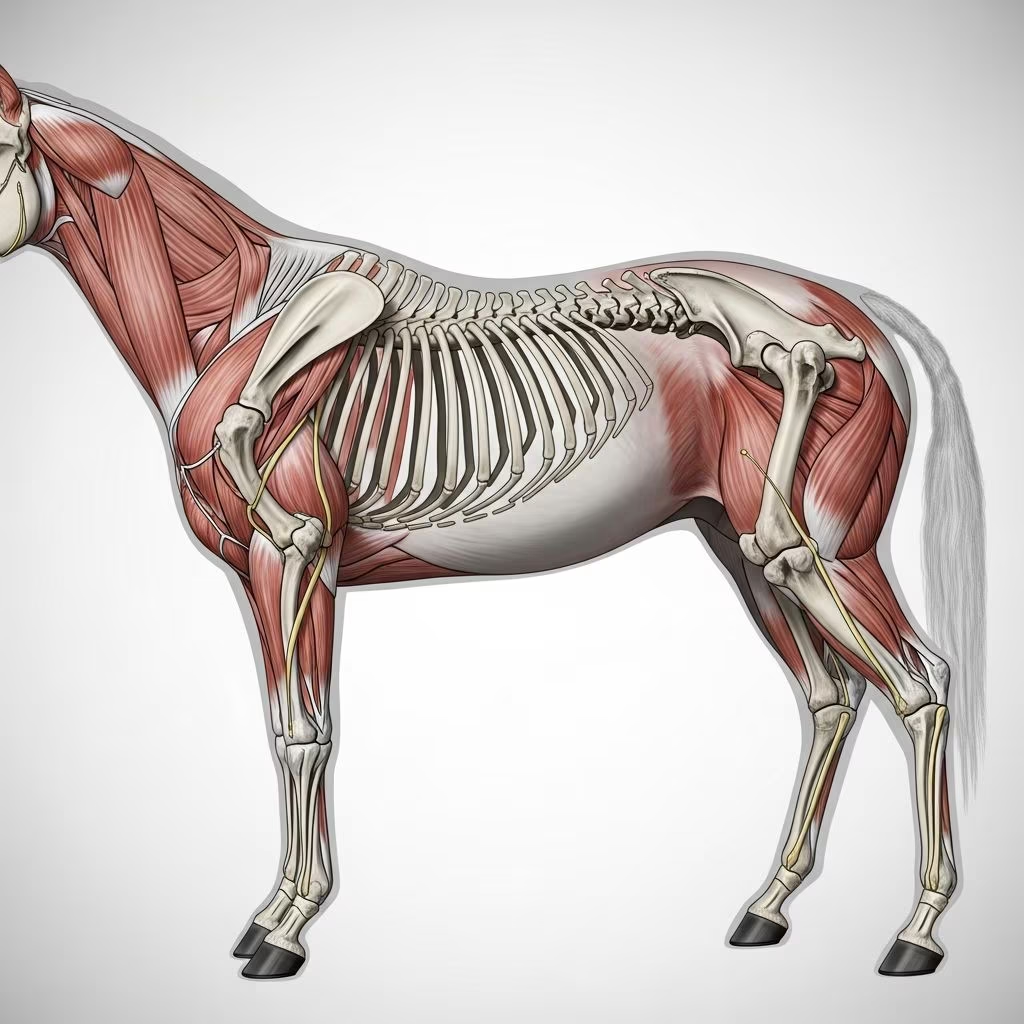
The musculoskeletal system in horses forms the backbone of their athletic prowess, enabling everything from graceful trots to powerful jumps. Comprising bones, joints, muscles, tendons, and ligaments, this system supports the horse’s body weight, facilitates locomotion, and protects vital organs. Understanding its components is essential for horse owners, trainers, and veterinarians to promote soundness and prevent injuries.
The Skeletal Framework: Building Blocks of Equine Structure
Horses possess approximately 205 bones, creating a robust yet flexible framework optimized for speed and endurance as a prey animal. This skeleton divides into axial and appendicular parts. The axial skeleton includes the skull, vertebral column, ribs, and sternum, providing central support. The appendicular skeleton encompasses the limbs and girdles, crucial for propulsion and stability.
The vertebral column stands out with its regional variations: seven cervical vertebrae for neck flexibility, 18 thoracic vertebrae (sometimes 17-19) for rib attachment, six lumbar vertebrae for back support, five fused sacral vertebrae linking to the pelvis, and 15-21 caudal vertebrae in the tail. This configuration allows the neck to move freely while maintaining thoracic and lumbar stability under load.
- Cervical region: Highly mobile for grazing and evasion.
- Thoracic region: Anchors ribs, forming a protective cage.
- Lumbar region: Short and rigid to bear weight efficiently.
A distinctive equine trait is the absence of a collarbone, unlike humans. The forelimbs hang suspended from the rib cage via muscles and ligaments, known as the thoracic sling, granting exceptional shoulder mobility for jumping and striding.
Limbs: Pillars of Power and Propulsion
The limbs bear the brunt of a horse’s weight and generate movement. Each forelimb and hindlimb contains about 20 bones, totaling 80 for all four. Forelimbs support roughly 60% of body weight at rest, while hindlimbs drive forward thrust despite bearing only 40%.
| Limb Component | Forelimb Bones | Hindlimb Bones | Function |
|---|---|---|---|
| Upper | Scapula, humerus | Pelvis, femur | Absorb shock, initiate swing |
| Middle | Radius, ulna | Tibia, fibula (fused distally) | Stabilize stride |
| Lower | Carpus, cannon, splint, sesamoids, phalanges | Tarsus, cannon, splint, sesamoids, phalanges | Flexion, extension, ground contact |
The stay apparatus—a series of tendons and ligaments—allows horses to “lock” limbs passively, conserving energy during stance. In hindlimbs, the patella, reciprocal apparatus, and check ligaments enable standing without muscle effort.
Muscular System: Engines of Motion
Skeletal muscles, attached to bones via tendons, drive posture and locomotion. Key groups include the thoracic sling, back extensors, and hindquarter powerhouses.
- Thoracic sling: Abdominals, pectorals, serratus ventralis lift the rib cage, essential for carrying riders without back strain.
- Back muscles: Longissimus dorsi acts elastically during gait, not as a primary weight-bearer.
- Hindquarters: Gluteals, hamstrings provide thrust for collection and elevation.
Weak thoracic sling muscles lead to a dropped back, risking spinal issues. Training strengthens these for rounded toplines and healthy weight carriage.
Joints: Hinges of Flexibility and Stability
Joints connect bones, allowing controlled motion. Synovial joints predominate, with cartilage, synovial fluid, and capsules reducing friction. Shoulder and hip are ball-and-socket for wide range; hock and stifle are hinge-like for sagittal plane movement.
Collateral ligaments prevent lateral sway in most joints, except shoulder/hip for mobility. Stifle collaterals permit slight rotation.
Tendons and Ligaments: Connectors and Stabilizers
Tendons link muscles to bones, transmitting force efficiently but prone to strain. Ligaments bind bones, maintaining alignment.
Critical ligaments include:
- Nuchal and supraspinous: Elastic bands from poll to sacrum support head carriage and back rounding.
- Suspensory: Modified muscle from hock/pastern to fetlock, preventing hyperextension; common lameness site.
- Distal check and annular: Guide flexor tendons, forming pulleys.
- Impar and collateral: Stabilize navicular and phalangeal joints.
Overuse injures flexor tendons and suspensories, emphasizing balanced training.
Unique Adaptations for Equine Performance
Horses evolved for flight: long limbs for stride length, spring-like tendons for energy return, and no collarbone for limb freedom. The thoracic sling’s muscular suspension allows rib cage elevation, vital under saddle.
Intercapital ligaments between ribs avert disc herniation, enhancing thoracic resilience.
Common Issues and Preventive Strategies
Musculoskeletal soundness hinges on balanced development. Weak slings cause back pain; overloaded tendons lead to bowed tendons.
- Strengthen thoracic sling via ground poles and hill work.
- Promote even muscle via lateral exercises.
- Monitor for suspensory strain in performance horses.
FAQs
Why don’t horses have collarbones?
This absence allows forelimb suspension by muscles, boosting mobility for speed and jumping.
What is the thoracic sling?
Muscles suspending the rib cage between scapulae, crucial for rider weight support.
How many bones in a horse?
About 205, with 80 in limbs.
What causes suspensory injuries?
Overextension or fatigue in high-performance activities.
How does the stay apparatus work?
Tendons/ligaments lock limbs passively for rest.
Training Tips for Musculoskeletal Health
Incorporate variety: transitions build back muscles; cavalletti strengthen tendons. Regular vet checks catch issues early. Nutrition supports bone density and tendon repair.
References
- Fundamentals of Equine Anatomy: The Musculoskeletal System — Sano Animal. 2026-01-13. https://sanoanimal.com/en/2026/01/13/fundamentals-of-equine-anatomy-the-musculoskeletal-system/
- Musculoskeletal Anatomy Of Your Horse — Classic Equine Equipment. 2018-01-18. https://blog.classic-equine.com/2018/01/18/musculoskeletal-anatomy-of-your-horse
- Skeletal system of the horse — Wikipedia (informed by primary anatomy sources). N/A. https://en.wikipedia.org/wiki/Skeletal_system_of_the_horse
- Anatomy: Equine — University of Calgary Faculty of Veterinary Medicine. N/A. https://vet.ucalgary.ca/summercamps/anatomy/tuesday/equine
- Components of the Musculoskeletal System of Horses — MSD Veterinary Manual. N/A. https://www.msdvetmanual.com/horse-owners/bone-joint-and-muscle-disorders-in-horses/components-of-the-musculoskeletal-system-of-horses



