

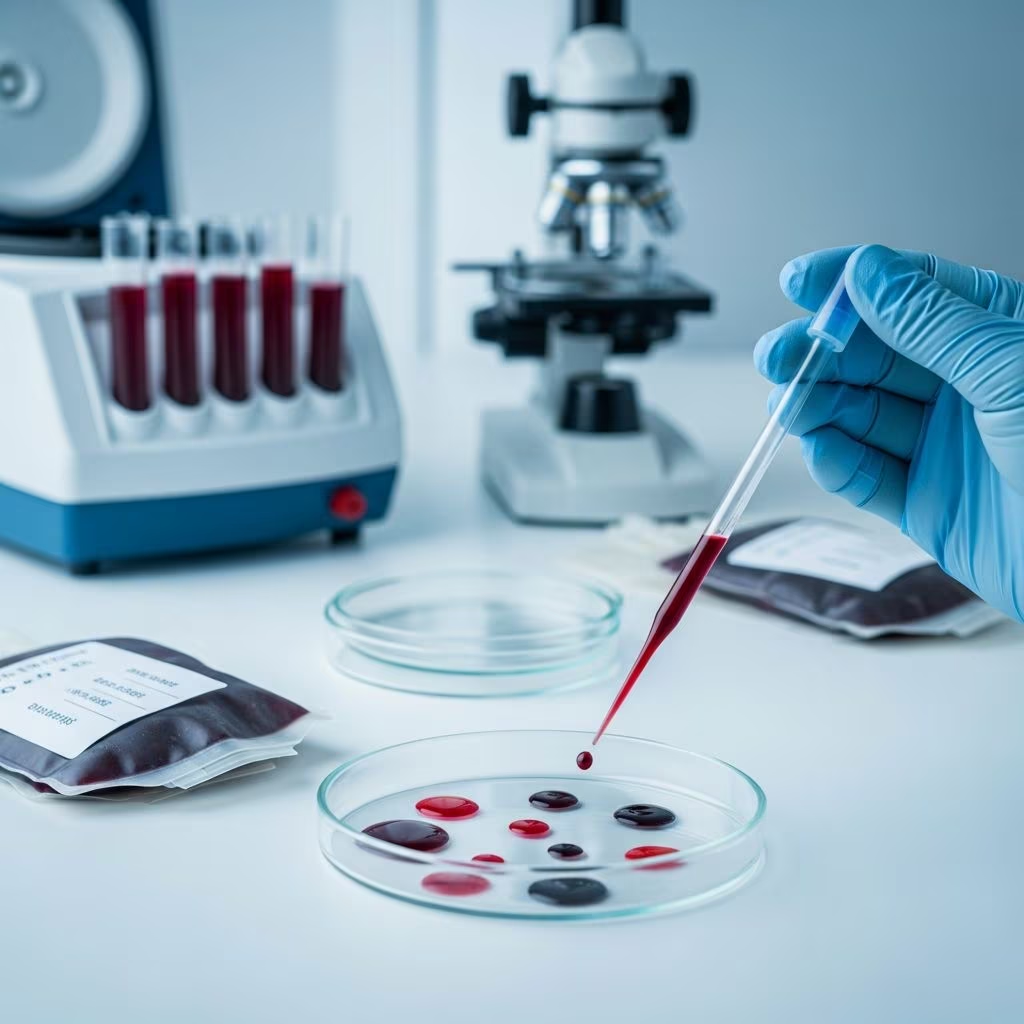
Horses possess a complex system of blood groups that play a critical role in veterinary care, particularly during transfusions and breeding decisions. Understanding these groups ensures safer medical interventions and healthier foals.
The Science Behind Horse Blood Groups
Equine red blood cells feature specific proteins and sugars on their surfaces, acting as antigens that define blood types. Horses have eight primary blood group systems: A, C, D, K, P, Q, U, and T. These antigens determine compatibility for transfusions and influence immune responses.
Each system includes multiple factors, denoted by lowercase letters, creating over 30 major combinations. For instance, Group A includes factors a, b, and c; Group Q has a, b, and c. This diversity—far exceeding human blood types—complicates matching but allows precise typing.
| Blood Group | Key Factors | Immunogenicity Risk |
|---|---|---|
| A | a, b, c | High |
| C | a (Ca) | High |
| D | Multiple | Low |
| K | a (Ka) | Moderate |
| P | a, b | Low |
| Q | a, b, c | High |
| U | a (Ua) | Moderate |
| T | Under study | Unknown |
Groups A, C, and Q pose the highest risk for antibody production if mismatched, potentially causing severe reactions.
Genetic Basis and Breed Variations
Blood group expression is genetically controlled, with each system linked to specific genes producing allelic variants. This inheritance pattern aids pedigree verification, though DNA testing has largely supplanted traditional typing.
Breed-specific frequencies influence donor selection. In Thoroughbreds, Qa+ prevails at 82%, while Standardbreds are nearly all Qa-. Ka+ is rare across breeds (under 5%), making universal donors feasible.
- Thoroughbreds: High Qa+ (82%), Aa- (95%), Ca+ (93%).
- Quarter Horses: Variable, often Qa+ dominant.
- Standardbreds: 100% Qa- in some studies.
- Warmbloods: Diverse, requiring individual typing.
These patterns guide blood banks in maintaining breed-matched inventories.
Why Blood Typing Matters for Horse Owners
Routine typing identifies safe donors and screens for antibodies from prior exposures like transfusions or pregnancies. Negative horses for high-risk factors (e.g., Aa-, Ca-, Qa-) serve as universal donors, minimizing reactions.
Stall-side tests, resembling pregnancy strips, detect factors like Ca rapidly with 100% accuracy in trials, revolutionizing emergency care. Traditional lab typing takes days, but these kits provide instant results using minimal blood.
Transfusion Procedures in Equine Medicine
Blood transfusions treat anemia from hemorrhage, toxicity, or immune disorders. Whole blood restores oxygen-carrying capacity; plasma supplies clotting factors.
Preparation Steps:
- Confirm recipient’s clinical need via hematocrit and history.
- Type both donor and recipient.
- Perform major (donor-to-recipient) and minor (recipient-to-donor) crossmatches.
- Administer slowly (5-10 mL/kg/hour), monitoring vitals.
Gel column crossmatching, adapted from human medicine, offers faster (1.5-2 hours) and more readable results than tube methods, using drops of blood.
Crossmatching: Ensuring Compatibility
Crossmatching simulates transfusion by mixing serum and cells. Agglutination or hemolysis signals incompatibility. Gel tests excel in speed and sensitivity, matching tube accuracy.
First transfusions often succeed without typing due to naive immunity, but subsequent ones risk reactions from memory antibodies.
Risks of Transfusion Reactions
Mismatched antigens trigger acute reactions: fever, tachycardia, hemoglobinuria, or shock. Delayed reactions cause hemolysis days later. Preventive typing and crossmatching reduce incidence to under 1% in typed cases.
- Acute Hemolytic: Immediate cell destruction.
- Febrile Non-hemolytic: Leukocyte antibodies.
- Allergic: Hives, mild edema.
Neonatal Isoerythrolysis: A Breeding Hazard
NI occurs when mares produce antibodies against paternal antigens in foals, crossing the colostrum to destroy newborn red cells. High-risk factors: Aa, Ab, Ac, Ka, Pa, Qa, Ua.
Sensitization happens via prior pregnancies or transfusions. At-risk mares test positive for antibodies; foals may need plasma transfusions or supportive care.
Prevention Strategies:
- Pre-breeding typing of mare and stallion.
- Avoid pairings where stallion positives complement mare negatives.
- Monitor at-risk mares; delay nursing 24-48 hours if needed.
Selecting and Maintaining Blood Donors
Ideal donors are healthy, negative for A, C, Q antigens, and Aa-. Regular health checks, deworming, and vaccinations ensure quality. Blood volume allows 8-10% safe collection (4-8 liters).
Blood banking stores whole blood (35 days refrigerated) or frozen components, enabling 24/7 availability.
Advances in Equine Blood Banking
Veterinary hospitals now offer donor programs. Rapid tests and gel methods streamline processes. Research explores T group’s role and synthetic alternatives.
Frequently Asked Questions (FAQs)
How many blood types do horses have?
Horses feature 7-8 major groups (A, C, D, K, P, Q, U, T) with over 30 factor combinations, vastly more complex than human ABO/Rh.
Can I transfuse without typing?
First-time yes, but risky thereafter. Always crossmatch.
What is a universal donor horse?
Negative for A, C, Q factors; e.g., Aa-, Ca-, Q-. Rare but valuable.
How to prevent NI in foals?
Type parents pre-breeding; use plasma for affected neonates.
How long does crossmatching take?
Gel method: 1.5-2 hours; tube: 2-3 hours.
Practical Tips for Horse Owners
Partner with labs like UC Davis for typing. Enroll in donor programs. Breed wisely using genetic profiles. Emergencies demand pre-typed universal donors on speed dial.
References
- Blood Groups and Blood Transfusions in Horses — MSD Veterinary Manual. 2023. https://www.msdvetmanual.com/horse-owners/blood-disorders-of-horses/blood-groups-and-blood-transfusions-in-horses
- Blood Transfusion in Equids—A Practical Approach and Review — PMC (NCBI). 2022-09-01. https://pmc.ncbi.nlm.nih.gov/articles/PMC9454663/
- Do You Know Your Horse’s Blood Type? — Equine Chronicle / Penn Vet. 2023. http://www.equinechronicle.com/do-you-know-your-horses-blood-type-a-c-d-k-p-q-or-u/
- How Many Blood Types Do Horses Have? — A-Z Animals. 2023. https://a-z-animals.com/articles/how-many-blood-types-do-horses-have/
- Equine Blood Type and Antibody Screen — UC Davis VMTH. 2023-09. https://www.vetmed.ucdavis.edu/hospital/support-services/lab-services/clinical-laboratory-services/equine-blood-type-and-antibody-screen
- Equine Blood Types Guide — Mad Barn. 2023. https://madbarn.com/equine-blood-types-guide/



