

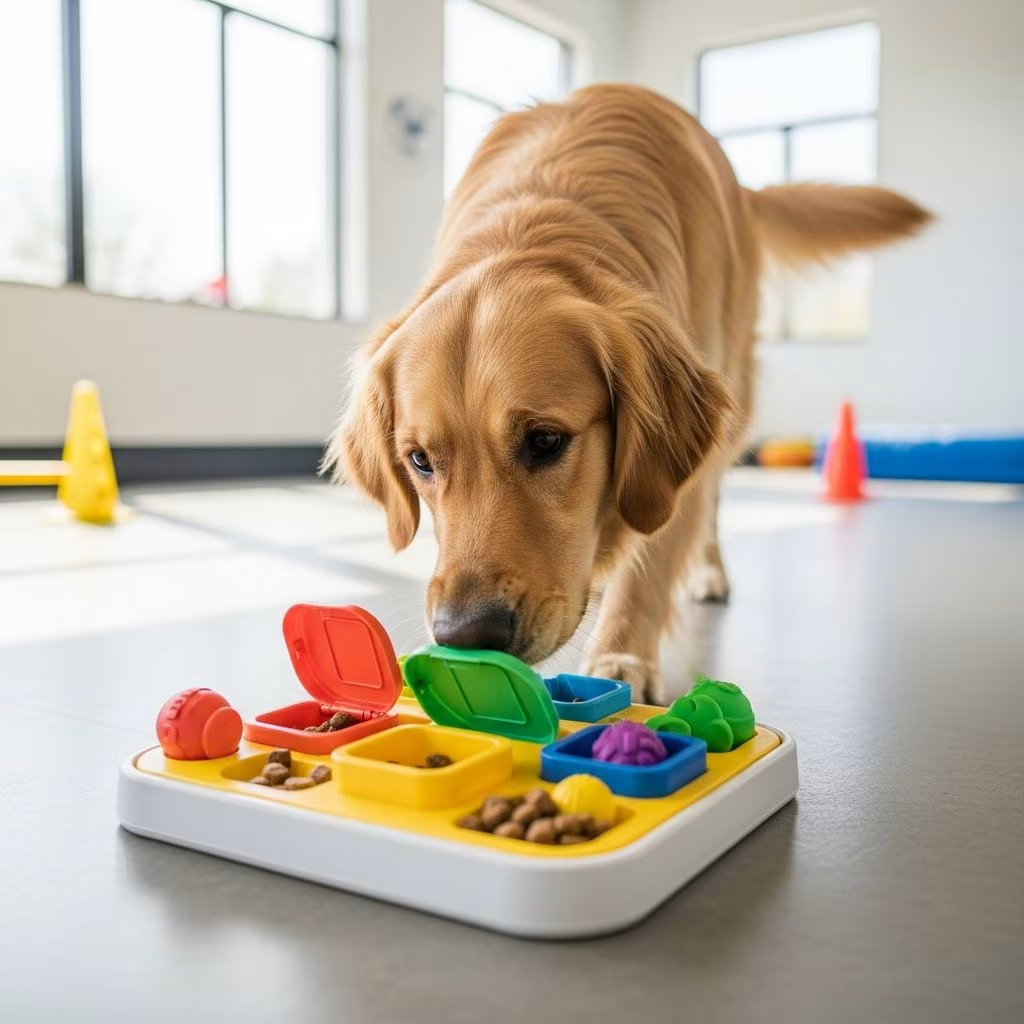
Teaching dogs to make choices transforms traditional training into a dynamic process that fosters independence, sharpens mental acuity, and deepens the human-canine relationship. This approach leverages a dog’s natural curiosity and intelligence, encouraging them to weigh options and select rewarding paths under guidance.
The Science Behind Canine Decision-Making
Canine cognition encompasses perception, memory, attention, and reasoning, enabling dogs to process information and form understanding. Research reveals that even young puppies exhibit foundational cognitive traits like short-term memory, social responsiveness to human cues, and basic problem-solving, as measured by standardized assessment batteries.
Adult dogs build on these abilities through targeted exercises that promote neural growth and adaptability. Unlike rote obedience drills, choice-based methods stimulate deeper brain functions, enhancing emotional regulation and resilience. Studies from canine cognition centers emphasize that dogs thrive when given opportunities to explore, interpret their environment, and solve structured challenges.
Foundational Principles of Choice Training
Effective choice training rests on positive reinforcement, where dogs associate decisions with rewarding outcomes. This motivates sustained engagement without fear or coercion. Core principles include gradual complexity increases, brief sessions to maintain focus, reward variation for unpredictability, and customization to each dog’s pace and interests.
- Incremental Progression: Start with binary options, like left versus right paths, advancing to multi-step dilemmas.
- Clear Feedback: Use enthusiastic tones or treats to signal correct selections immediately.
- Mental State Awareness: Train in low-distraction settings to build cognitive control before real-world application.
These elements ensure dogs develop confidence in their judgment, reducing frustration and boosting retention.
Getting Started: Simple Choice Exercises
Begin with everyday scenarios to introduce decision-making. For instance, offer two toys and reward selection of a specific one by name, gradually expanding vocabulary. This mirrors concept training, where dogs learn abstract ideas like “retrieve any pointed item” rather than isolated commands.
Another entry-level game involves hiding treats in clear containers, letting the dog choose which to approach. Use verbal cues like excited “hotter” tones for proximity and neutral “colder” for distance, refining listening and spatial awareness.
| Exercise | Objective | Difficulty Level | Required Tools |
|---|---|---|---|
| Toy Selection | Object discrimination | Beginner | Two distinct toys, treats |
| Hot/Cold Hide-and-Seek | Auditory cue response | Beginner-Intermediate | Treats, hiding spots |
| Path Choices | Directional decision | Beginner | Open space, markers |
Building Complexity: Intermediate Challenges
Once basics are mastered, introduce puzzles requiring sequential choices. Nesting bowls with layered treats challenge dogs to remove barriers methodically, supervised to prevent mishaps. Progress to scent-based searches where dogs select from multiple trails, tapping olfactory strengths.
Curiosity-driven tasks, such as novel obstacle navigation or item retrieval by description (e.g., “blue ball”), prevent boredom in quick learners. Vary environments—from home to parks—to generalize skills. Differential rewards, like play for complex solves versus treats for simple ones, maintain motivation.
Advanced Techniques for Cognitive Mastery
High-IQ dogs benefit from concept-based and collaborative problem-solving. Teach “platform” as staying on varied surfaces or “same/different” by offering matching object pairs. These generalize across contexts, fostering flexible thinking.
Incorporate emotional cognition by training recovery from distractions, akin to “cognitive zone calibration,” working at thresholds where dogs retain processing ability near triggers. Purposeful reinforcement integrates rewards into tasks, such as earning a tug game post-puzzle.
- Shaping Behaviors: Reward approximations toward goals, like paw lifts leading to door-opening.
- Vocabulary Expansion: Name 50+ items, cueing retrieval to build associative networks.
- Cooperative Games: Partner in “shell games” guessing treat cups, enhancing joint attention.
Games That Sharpen Decision Skills
Interactive toys like snuffle mats encourage foraging choices among scents and textures. DIY versions use muffin tins covered by tennis balls, with treats underneath select cups.
“Guess Which Cup” evolves by shuffling under dog view, testing memory and prediction. Switch walking routines, offering path forks for dog-led decisions with handler approval, promoting leadership under guidance.
Benefits of Choice-Based Training
This method yields adaptable, resilient dogs with superior problem-solving and stress management. Cognitively enriched pets show fewer behavioral issues, better obedience in novel situations, and stronger bonds via mutual respect.
Owners report reduced separation anxiety and hyperactivity as mental fulfillment curbs boredom. Long-term, it supports aging brains, potentially delaying decline through sustained neural stimulation.
Common Pitfalls and Solutions
Avoid overwhelming with too many options early; stick to two initially. Inconsistent feedback erodes trust—always mark correct choices promptly. Quick learners may rush; instill patience via timed pauses before rewards.
For stubborn dogs, harness curiosity with high-value incentives. Monitor frustration signals like yawning, shortening sessions accordingly.
Adapting for Different Dogs
Puppies start with perceptual games, building inhibitory control. Seniors focus on memory refreshers like familiar object choices. Breeds vary—herders excel in task chains, scent hounds in olfactory dilemmas.
| Dog Type | Ideal Focus | Example Activity |
|---|---|---|
| Puppy | Attention & memory | Pointing to hidden treats |
| Working Breed | Complex tasks | Item retrieval by name |
| Senior | Gentle recall | Two-cup treat choice |
Integrating into Daily Routines
Weave choices into mealtimes (two bowl spots) or walks (route selections). Brief 5-minute sessions multiple times daily maximize gains without fatigue. Track progress in a journal to adjust challenges.
FAQs
How long until my dog masters choices?
Basics emerge in weeks with daily practice; advanced skills take months, varying by age and breed.
Is this suitable for fearful dogs?
Yes, start small in safe spaces; successes build confidence gradually.
What if my dog always picks wrong?
Gently block incorrect options initially, fading as learning progresses.
Can puppies under 8 weeks participate?
Focus on gentle exposure; full cognition tasks suit 8+ weeks per research.
Does it replace obedience training?
No, it enhances it by adding mental depth to commands.
References
- Understanding Dog Cognitive Training — iPuppee. 2023. https://ipuppee.com/blogs/news/understanding-dog-cognitive-training
- Train High-IQ Dogs: 8 Techniques for Cognitive Engagement — The Cosmic Pet. 2023. https://www.thecosmicpet.com/iq/guide/dog-iq-training-tips
- Fun, Cognitive Training Games to Make Your Dog Smarter — American Kennel Club (AKC). 2023-10-15. https://www.akc.org/expert-advice/training/fun-cognitive-training-games-for-dogs/
- Cognitive Dog Training — Courteous Canine. 2024. https://www.courteouscanine.com/cognitive-dog-training/
- Mind Over Manner: From Behavioral Conditioning to Cognitive Mind — Canine Evolutions. 2023. https://www.canineevolutions.com/news/mind-over-manner
- Puppy Cognition – the Making of a Brilliant Canine Mind — AKC Canine Health Foundation. 2022. https://www.akcchf.org/breakthrough/puppy-cognition-the-making/



