

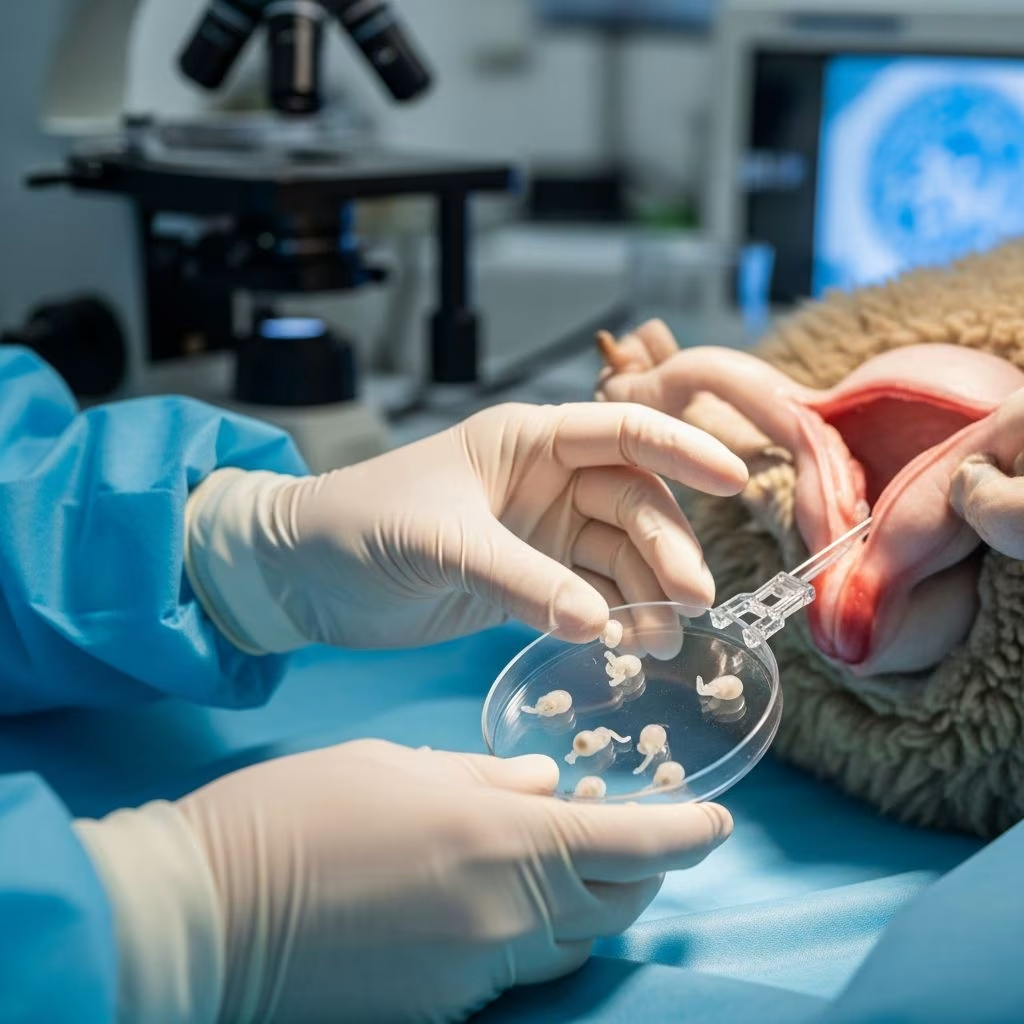
Embryo transfer (ET) represents a cornerstone of modern reproductive biotechnology in small ruminants, allowing breeders to multiply elite genetics rapidly while minimizing disease transmission risks. This technique involves collecting embryos from genetically superior donors and implanting them into synchronized recipient females, dramatically accelerating herd improvement rates compared to natural breeding.
Fundamentals of Reproductive Physiology in Small Ruminants
Understanding the estrous cycle is essential for successful ET programs. Sheep and goats are seasonal breeders, typically entering anestrus during longer daylight periods. The cycle lasts 16-21 days, with estrus (heat) spanning 24-48 hours. Ovulation occurs toward the end of estrus, followed by a 14-16 day luteal phase dominated by progesterone from the corpus luteum.
Hormonal synchronization aligns donors and recipients precisely. Progesterone devices like controlled internal drug release (CIDR) inserts, combined with prostaglandins (PGF2α) and gonadotropins, enable timed breeding events. For instance, a 6-day CIDR protocol followed by PGF injection yields reliable estrus synchronization, supporting fixed-time artificial insemination (FTAI) with pregnancy rates up to 50-70% using frozen semen.
Selecting and Preparing Donor Animals
Donors should exhibit proven fertility, robust health, and elite genetics. Virgin does or ewes can serve via juvenile in vivo embryo transfer (JIVET), slashing generation intervals by years. Superovulation protocols amplify oocyte yield: follicle-stimulating hormone (FSH) administered in declining doses over 3-4 days, paired with progesterone priming and a final PGF shot, induces 5-20 ovulations versus the natural 1-2.
Post-superovulation, donors receive natural mating or transcervical/laparoscopic insemination 24-48 hours after sponge/CIDR removal. Embryo flushing occurs 6-8 days later at the morula-blastocyst stage, yielding 4-10 viable embryos per donor cycle. Skilled technicians achieve this nonsurgically in goats using pediatric catheters, though laparoscopy boosts recovery rates in sheep to over 80%.
Recipient Synchronization and Management
Recipients must match donor embryo age and quality. Synchronization mirrors donor protocols: 12-14 day CIDR insertion, PGF at removal, and eCG (equine chorionic gonadotropin) for ovulation induction. Heat detection confirms cyclicity; only responsive females proceed.
Nutritional priming enhances success: body condition score 3-3.5 (scale 1-5), high-energy diets pre-flush/transfer boost implantation by 20-30%. Recipients receive 1-3 embryos per uterine horn via laparoscopy, with pregnancy rates of 50-70%.
Laparoscopic Techniques for Embryo Collection and Transfer
Laparoscopy, under light sedation, dominates ET in small ruminants due to the tortuous cervix impeding nonsurgical access. For collection, a 1-2 cm flank incision admits a trocar; CO2 insufflation creates visibility. Follicles are visualized, and flushing catheters aspirate embryos from oviducts/uterine horns using saline/dulbecco’s medium.
Transfer mirrors this: embryos loaded into 0.25 mL straws are deposited ipsilateral to the corpus luteum. Procedures last 10-20 minutes per animal, with minimal recovery time. Recent transcervical advances show promise, achieving 40-60% pregnancies nonsurgically in goats.
Comparison of Surgical vs. Nonsurgical Methods
| Method | Pros | Cons | Pregnancy Rate |
|---|---|---|---|
| Laparoscopic | High recovery/transfer efficiency; precise placement | Requires vet expertise; short-term recovery | 60-80% |
| Transcervical | No incision; faster/cheaper | Lower success in sheep; skill-dependent | 40-60% |
| Laparotomy | Direct access | Invasive; longer recovery | 50-70% |
Cryopreservation and Embryo Storage
Vitrification, rapid freezing in cryoprotectants like ethylene glycol, preserves embryo viability post-thaw at 70-90%. Direct in-straw systems (e.g., E.Vit) simplify warming/dilution, enabling field transfers without labs. Frozen-thawed embryos implant comparably to fresh ones when transferred at blastocyst stage.
Storage in liquid nitrogen (-196°C) supports gene banking for rare breeds. Thaw protocols: air-warm straws 10 seconds, dilute stepwise, culture 1-4 hours pre-transfer. IVP embryos tolerate cryopreservation better at expanded blastocyst stage due to cell number thresholds for luteal support.
In Vitro Embryo Production (IVEP) Advances
IVEP circumvents superovulation variability: ovum pick-up (OPU) from live donors yields 10-30 oocytes/session via ultrasound-guided follicular aspiration. In vitro maturation, fertilization (IVF with sexed semen), and culture in semi-defined media produce blastocysts at 30-50% rates.
Co-culture with oviductal cells or temporary ewe oviduct transfer enhances quality. JIVET from 4-8 week lambs accelerates elite sire dissemination. IVEP suits virgin/pregnant females, expanding donor pools.
Optimizing Success Rates and Troubleshooting
- Synchronization Precision: Match donor flush Day 7 to recipient Day 5-7 post-estrus for synchrony.
- Embryo Quality: Grade via microscopy; excellent (symmetric, zona intact) yield 70% pregnancies.
- Health Screening: Quarantine donors/recipients; test for MAEDI-VISA, CAE, Johne’s.
- Post-Transfer Care: Avoid stressors; ultrasound confirm at Day 30.
Common issues: poor superovulation (adjust FSH dose), asynchrony (refine protocols), heat stress (cool environments). Lambing rates average 1.5-2.5 per recipient.
Economic and Genetic Benefits
ET multiplies elite offspring 10-20x annually versus 1-2 naturally. ROI shines in nucleus herds: a top doe yields 50+ progeny/year via repeated flushes. Disease-free genetics export globally, as per international clinics.
Costs: $500-1500/doe cycle (hormones, vet fees); offset by premium sales. IVF/OPU scales for commercial flocks, with 20-40% genetic gain/year.
Future Innovations in Small Ruminant ET
Non-surgical transcervical ET nears routine use, per recent sheep trials. Sexed semen IVF hits 80% female ratios. Gene editing/SCNT, though experimental, produced clones (e.g., Dolly precedents). AI-driven OPU/embryo selection promises 90%+ efficiencies.
Frequently Asked Questions (FAQs)
What is the ideal age for donor goats/ewes?
2-6 years; multiparous preferred for fertility proof.
How many embryos per flush?
4-12 average; top donors 20+.
Can ET work in anestrus?
Yes, via melatonin implants to induce cyclicity.
Fresh vs. frozen embryos?
Fresh: 70% rate; frozen: 60% with vitrification.
Training needed for laparoscopy?
Vet certification essential; 50+ cases for proficiency.
References
- Artificial Insemination and Embryo Transfer in Goats — North Carolina State University Small Ruminant Program. 2015. https://smallruminants.ces.ncsu.edu/wp-content/uploads/2015/06/Artificial-Insemination-and-Embryo-Transfer-in-Goats.pdf
- Embryo biotechnologies in sheep: Achievements and new prospects — PMC/NCBI. 2022-12-01. https://pmc.ncbi.nlm.nih.gov/articles/PMC9790389/
- Intro to Laparoscopic Artificial Insemination & Embryo Transfer — YouTube (Transova Genetics). 2023. https://www.youtube.com/watch?v=Q2tn7SZtogI
- Small Ruminant Embryo Transfer — Creekside Animal Clinic Ltd. 2024. https://www.creeksideanimalclinic.com/small-ruminant-embryo-transfer
- Practical aspects for implementing in vitro embryo production — Animal Reproduction Journal. 2012. https://www.animal-reproduction.org/article/5b5a6056f7783717068b46dc/pdf/animreprod-9-3-188.pdf



