

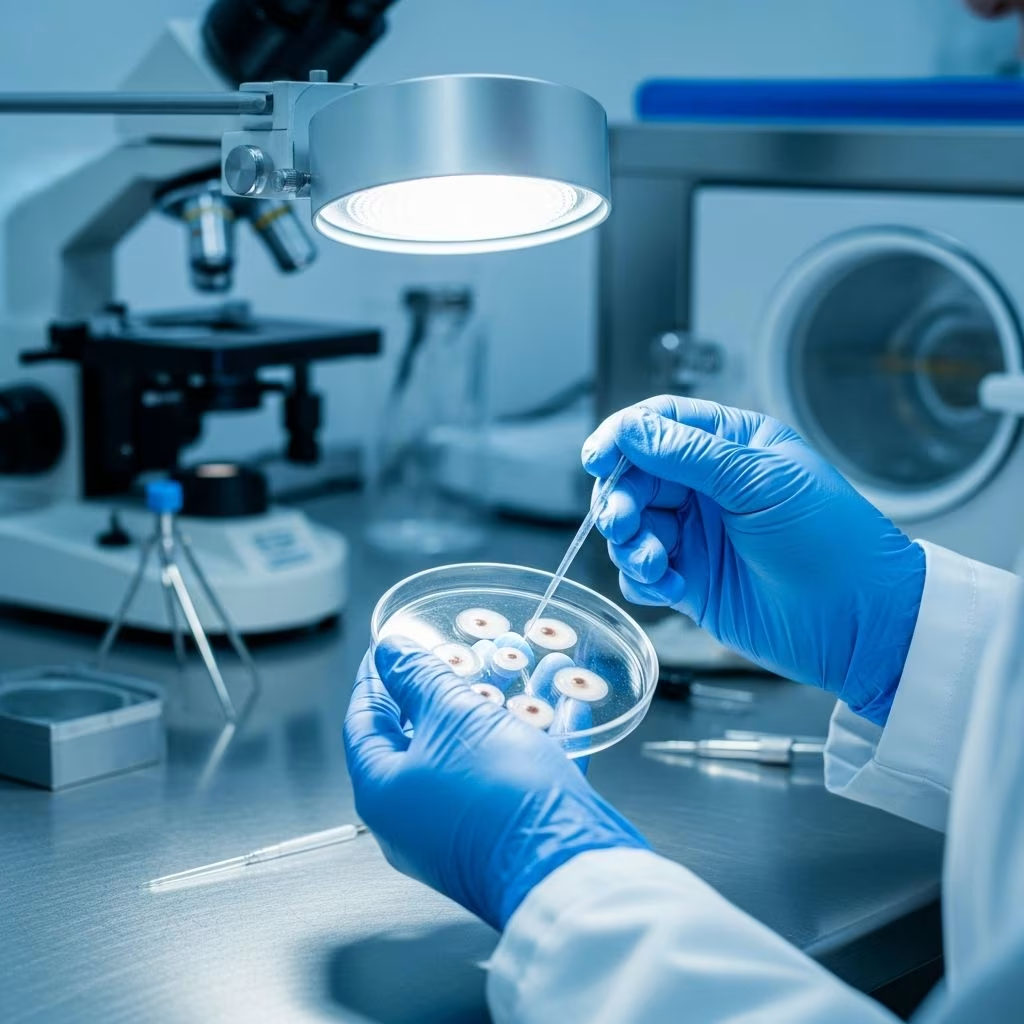
Embryo transfer (ET) stands as a cornerstone of modern livestock breeding, enabling producers to amplify the genetic potential of top-tier females across large populations. This technique extracts embryos from genetically elite donors and places them into healthy recipient animals, dramatically increasing offspring numbers without extended calving intervals.
Why Embryo Transfer Matters in Agriculture
In the quest for enhanced productivity, ET surpasses traditional breeding by allowing one superior cow to contribute dozens or hundreds of progeny annually. Primarily applied in cattle, it extends to sheep, goats, and horses, supporting dairy, beef, and fiber industries. Global data shows over 470,000 transferable in vivo-derived cattle embryos produced yearly, alongside rising in vitro fertilization (IVF) outputs exceeding one million.
Unlike artificial insemination (AI), which targets only paternal genetics, ET captures both maternal and sire traits, offering comprehensive herd upgrades at lower costs than purchasing elite animals.
Core Principles of the Embryo Transfer Process
The ET workflow demands precision in hormonal management, timing, and animal handling to achieve pregnancy rates of 50-70% for fresh embryos.
Selecting Optimal Donors and Recipients
Donors must exhibit proven superiority in traits like milk yield, growth rate, or fertility, typically post-first lactation to preserve health. Recipients require robust reproductive histories, adequate body condition, and cycling status; thin or anestrus cows underperform.
Hormonal Synchronization Essentials
Matching estrus cycles is critical. Protocols use prostaglandins and progestogens for recipients, ensuring uterine readiness. Donors receive follicle-stimulating hormone (FSH) for superovulation, yielding 5-10 viable embryos per flush, far exceeding natural single ovulations.
- FSH injections: Administered over 4 days to spur multiple follicle growth.
- LH surge: Induces ovulation 24-48 hours post-FSH.
- Progesterone support: Stabilizes recipient uteri for implantation.
Superovulation and Embryo Harvesting
Post-insemination (via AI with elite semen), embryos develop for 6-8 days. Nonsurgical flushing via transcervical catheter recovers them in specialized media, with average yields of 6-8 transferable embryos per donor cycle.
Laboratory evaluation grades embryos by morphology: Grade 1 (excellent) to Grade 3 (fair, usable fresh).
Fresh Versus Frozen Embryo Strategies
| Method | Advantages | Challenges | Pregnancy Rate |
|---|---|---|---|
| Fresh | Immediate transfer; higher viability | Tight synchronization needed | 60-70% |
| Frozen (Cryopreserved) | Storage flexibility; export viable | 10-20% rate drop post-thaw | 50-60% |
Fresh transfers suit on-farm operations with synchronized groups, while cryopreservation via ethylene glycol vitrification enables year-round use and international sales.
Advanced Techniques: MOET and IVF Integration
Multiple Ovulation Embryo Transfer (MOET) programs cycle donors every 30-60 days, producing 20-50 embryos yearly per female. In vitro methods complement this: IVF uses oocyte aspiration from live donors—even pregnant or juvenile heifers—fertilized in labs, yielding embryos transferable after 7 days culture.
USDA-supported research advances these, enhancing progeny from superior genetics.
Practical Implementation on Farms
A typical 32-day donor cycle: Days 1-4 FSH shots, AI on Day 10, flush Day 17. Recipients sync similarly, receiving embryos nonsurgically into uterine horns.
Success hinges on skilled labor for injections and monitoring. Post-transfer, ultrasound confirms pregnancies at 28-35 days.
Species-Specific Adaptations
- Cattle: Dominant; nonsurgical standard.
- Sheep/Goats: Laparoscopic recovery; multiple kids viable.
- Horses: No superovulation; natural cycles used.
Economic and Genetic Advantages
ET accelerates progress 2-3 times faster than AI alone, propagating traits like disease resistance or carcass quality. Costs per transferable embryo (~$200-400) yield returns via premium calves, with ROI in 1-2 years for commercial herds.
Elite donors offset expenses by generating 50+ offspring versus 10-15 naturally.
Challenges and Risk Mitigation
Low superovulation response (20% donors), embryo loss, or recipient failures occur. Mitigation: Nutritional optimization, biosecurity, and vet oversight. IVF mitigates donor downtime.
Ethical concerns minimal; welfare protocols ensure humane handling.
Future Directions in Reproductive Tech
Gene editing and cloning expand ET, though commercial uptake lags. IVF surges, with 2017 marking its overtake of in vivo production. AI-driven synchronization promises higher efficiencies.
Frequently Asked Questions (FAQs)
What is the average cost of an embryo transfer program?
Initial flushes cost $500-1,000 per donor, plus hormones ($200) and recipients ($50 each). Scales economically for multiples.
Can embryo transfer work with heifers?
Yes, especially IVF, bypassing calving delays for virgin females.
How soon after transfer can pregnancy be confirmed?
Ultrasound at Day 28 post-estrus; palpation earlier risks.
Is freezing embryos as effective as fresh?
Nearly, with modern protocols; 10-20% lower but flexible.
What breeds benefit most from ET?
Dairy (Holsteins) for milk, beef (Angus) for growth; any elite.
Getting Started with Embryo Transfer
Consult certified embryologists; start small with 10-20 recipients. Track metrics: flush yield, transfer rates, calving success. Partnerships with labs accelerate adoption.
References
- What is Embryo Transfer? A Guide for Livestock Breeders — EmbryoPlus. 2024-11-26. https://www.embryoplus.com/2024/11/26/what-is-embryo-transfer-a-guide-for-livestock-breeders/
- Considering Embryo Transfer – Beef and Dairy Cows — 4 Star Vets. Accessed 2026. https://4starvets.com/considering-switching-to-embryo-transfer-for-your-beef-and-dairy-cows/
- Overview of Embryo Transfer in Farm Animals — Merck Veterinary Manual. Accessed 2026. https://www.merckvetmanual.com/management-and-nutrition/embryo-transfer-in-farm-animals/overview-of-embryo-transfer-in-farm-animals
- Embryo Transfer in Cattle — University of Arkansas Extension (FSA-3119). Accessed 2026. https://www.uaex.uada.edu/publications/PDF/FSA-3119.pdf
- In Vitro Fertilization and Embryo Transfer: A Comparison — Transova Genetics. 2020-05. https://transova.com/wp-content/uploads/2020/05/EtvsIVF-3.pdf
- Research in Assisted Reproductive Technologies — USDA NIFA. Accessed 2026. https://www.nifa.usda.gov/grants/programs/animal-programs/research-assisted-reproductive-technologies
- Embryo Transfer 101 with a Technical Slant — Kansas State University Veterinary. Accessed 2026. https://www.vet.k-state.edu/academics/student-faculty-handbook/studentorgs/aadpDocs/ChrisFriedel.pdf



