

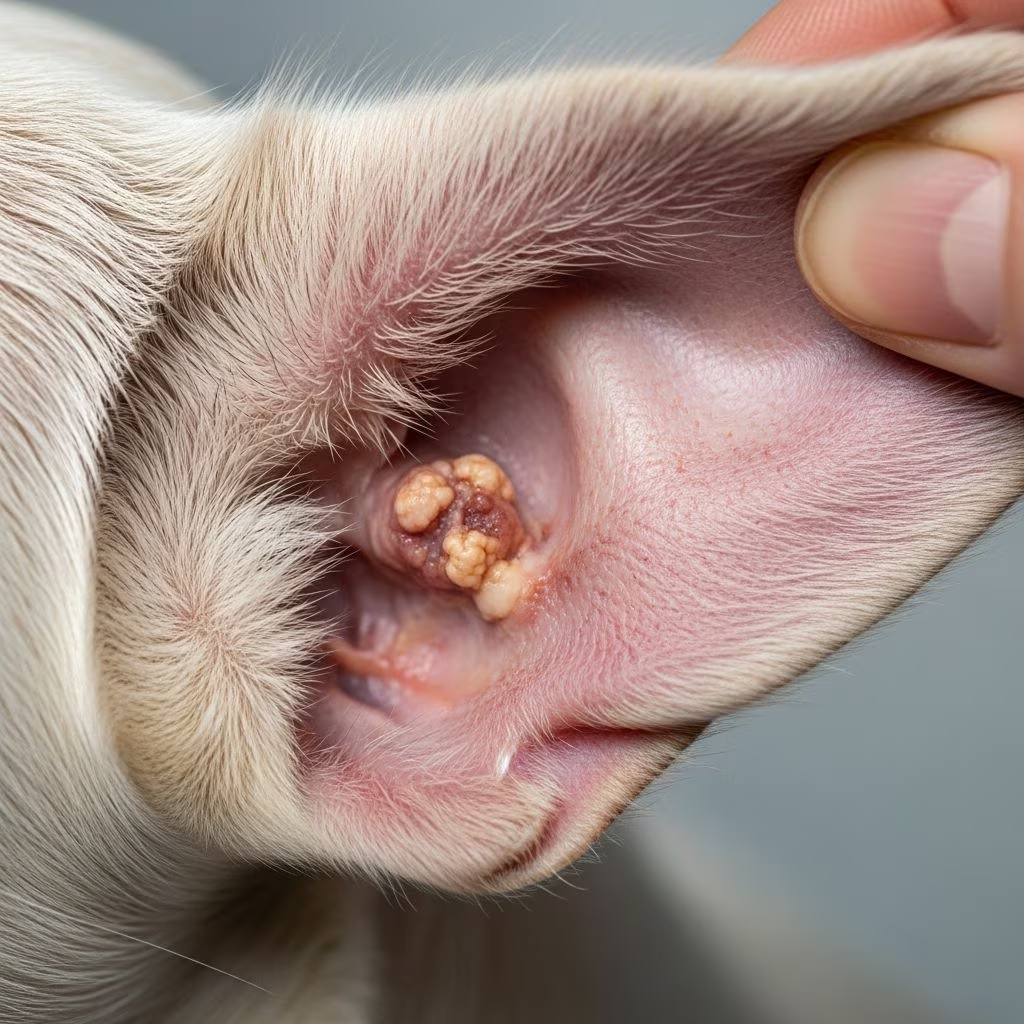
Ear canal tumors represent a significant health concern for dogs, often mimicking chronic infections but requiring distinct diagnostic and therapeutic approaches. These growths, which can be benign or malignant, primarily affect the ceruminous glands lining the ear canal and may lead to discomfort, infection, and neurological complications if untreated. Understanding their development, identification, and management is crucial for pet owners seeking to improve their dog’s quality of life.
Understanding the Anatomy of a Dog’s Ear
The canine ear consists of three main parts: the outer ear (pinna and vertical canal), the horizontal ear canal, and the middle and inner ear structures including the tympanic bulla. Tumors most commonly arise in the apocrine ceruminous glands of the external ear canal, where they can obstruct drainage and promote secondary bacterial or yeast infections. Breeds with pendulous ears, such as Cocker Spaniels and Labrador Retrievers, appear predisposed due to poor ventilation and moisture retention.
Benign tumors tend to grow slowly and remain confined, while malignant ones, like ceruminous gland adenocarcinomas, invade surrounding tissues, including the temporal bone or brain, leading to more severe outcomes. Approximately 10% of malignant cases show neurological involvement early on.
Recognizing Early Warning Signs
Dogs with ear canal tumors often exhibit unilateral symptoms, distinguishing them from bilateral infections. Key indicators include:
- Persistent odorous discharge, which may be waxy, purulent, or bloody.
- Frequent head shaking or tilting to one side.
- Intense scratching or rubbing of the affected ear.
- Visible swelling, ulceration, or a mass protruding from the canal.
- Pain upon touch, leading to yelping or avoidance behavior.
Advanced cases involving the middle ear may present with vestibular signs such as ataxia, nystagmus (rapid eye movements), Horner’s syndrome (drooping eyelid, constricted pupil), or deafness. These neurological deficits occur in about 10% of malignant tumors. Owners frequently mistake initial signs for recurrent otitis, delaying diagnosis until the tumor ulcerates or causes a draining abscess.
Risk Factors and Predispositions
Chronic ear inflammation from untreated infections is a primary risk factor, fostering hyperplastic changes that may progress to neoplasia. Older dogs over 10 years are most affected, with no strong breed bias beyond those prone to otitis externa. Malignant tumors outnumber benign ones at a ratio of 6-10:1 in the ear canal, unlike the pinna where benign lesions predominate.
Environmental factors like UV exposure play minimal role in canal tumors compared to pinnal squamous cell carcinomas. Genetic predispositions remain understudied, but vigilant ear care in at-risk breeds can mitigate risks.
Diagnostic Approaches for Accurate Identification
Veterinarians begin with a thorough otoscopic examination under sedation if needed, revealing narrowed canals, proliferative tissue, or friable masses. Cytology of discharge identifies inflammatory cells, bacteria, or atypical epithelial cells suggestive of neoplasia.
Imaging is pivotal: CT scans delineate tumor extent, bulla involvement (seen in 25% of malignant cases), and skull base invasion, far superior to radiographs. Biopsy via fine-needle aspiration or incisional sampling confirms histopathology—ceruminous adenocarcinoma features glandular structures with atypia, while benign adenomas show organized ceruminous elements.
| Diagnostic Tool | Purpose | Advantages |
|---|---|---|
| Otoscopy | Visualize mass | Non-invasive initial step |
| Cytology/Biopsy | Cell typing | Confirms malignancy |
| CT Scan | Tumor mapping | Assesses invasion depth |
| Radiographs | Bulla check | Quick but less detailed |
Secondary infections demand culture-guided antibiotics pre-diagnostics to avoid misleading inflammation.
Benign vs. Malignant: Key Differences
Benign tumors, such as ceruminous gland adenomas or papillomas, present as smooth, pedunculated growths rarely causing ulceration. They respond well to excision, often curative if margins are clean.
Malignant counterparts—adenocarcinomas (90% of gland tumors), squamous cell carcinomas—exhibit irregular, ulcerated surfaces with hemorrhage. They aggressively infiltrate, with 25% involving the bulla and potential for distant metastasis (lymph nodes, lungs). Prognosis diverges sharply: benign cases boast excellent outcomes, while malignant survival hinges on stage.
Surgical Interventions: The Cornerstone of Treatment
Surgery remains the gold standard. For benign or superficial malignant tumors, lateral or vertical ear canal resection suffices, preserving audition if unilateral.
Total Ear Canal Ablation with Lateral Bulla Osteotomy (TECA-LBO) addresses advanced disease: the vertical and horizontal canals are excised, bulla wall opened to curette neoplasia, and pinna retained for cosmetics. This yields median survival times (MST) of 36 months vs. 9 months for lesser resections, with 0% local recurrence vs. 75%. Post-op, dogs adapt remarkably, maintaining directional hearing.
Pinnal tumors may require partial/total pinnectomy. Laser ablation offers precision for select cases, minimizing bleeding. Complications include facial nerve paralysis (temporary), infection, or dehiscence, managed with meticulous care.
Radiation and Chemotherapy Options
When surgery is infeasible—due to skull invasion or owner declination—radiation therapy shines. Curative intent protocols (48 Gy fractionated) achieve disease-free intervals of 40 months and 56% one-year survival. Palliative radiation relieves pain effectively, as in one case providing 70 days relief.
Radiation excels post-incomplete resection or for middle ear extension. Chemotherapy (e.g., carboplatin, mitoxantrone) targets metastases, though response rates vary (20-50%). Multimodal approaches combining TECA-LBO with adjunct radiation/chemotherapy optimize MST beyond 5 years in some reports.
Post-Treatment Care and Recovery
Recovery spans weeks to months. Pain control (opioids, NSAIDs), antibiotics for infections, and e-collars prevent self-trauma. Monitor for seroma, dehiscence, or Horner-like signs resolving in days. Owners note improved demeanor post-resolution of chronic pain.
Follow-up includes imaging at 3-6 months, then biannually, watching for recurrence (local >80% if margins positive) or mets.
Prognosis: What to Expect
Benign tumors: Excellent, near 100% cure with excision. Malignant: Guarded to fair; TECA-LBO cohorts show MST 36 months, radiation 12-40 months DFI. Extensive disease (brain involvement) portends poorer outlook, averaging under a year. Early intervention dramatically sways survival.
Prevention Strategies for Ear Health
Proactive otitis management—regular cleaning, prompt treatment—curbs chronicity. Routine vet checks for at-risk breeds aid early detection. Tumors prove non-contagious, reassuring multi-pet homes.
Frequently Asked Questions (FAQs)
Are ear canal tumors common in dogs?
No, they are uncommon, though chronic ear disease elevates risk.
Can my dog hear after TECA-LBO surgery?
Yes, dogs retain hearing via inner ear conduction, adapting fully.
Is radiation painful for dogs?
Treatments occur under anesthesia; side effects are mild, like temporary alopecia.
What breeds are most affected?
Any, but floppy-eared breeds like Spaniels face higher otitis-related risks.
How quickly do symptoms progress?
Benign slowly over months; malignant accelerate with ulceration in weeks.
References
- A dog with squamous cell carcinoma in the middle ear — PMC – NIH. 2008. https://pmc.ncbi.nlm.nih.gov/articles/PMC2519907/
- Ear Cancer in Dogs — PetCure Oncology. 2023. https://petcureoncology.com/ear-cancer-in-dogs/
- Ear Canal Tumors in Dogs — Vetster. 2024. https://vetster.com/en/conditions/dog/ear-canal-tumors
- End-Stage Ear Disease in Dogs — BluePearl Pet Hospital. 2022. https://bluepearlvet.com/medical-articles-for-pet-owners/end-stage-ear-disease-ear-canal-ablation/
- Ear Tumors – Canine — VSSO. 2023. https://vsso.org/ear-tumors-canine
- Tumors of the Ear Canal in Dogs — Merck Veterinary Manual. 2024. https://www.merckvetmanual.com/dog-owners/ear-disorders-of-dogs/tumors-of-the-ear-canal-in-dogs



