
Drug Journey in Animals: Absorption to Elimination
Explore how veterinary drugs move through animal bodies, from entry to exit, shaping dosing and safety in practice.
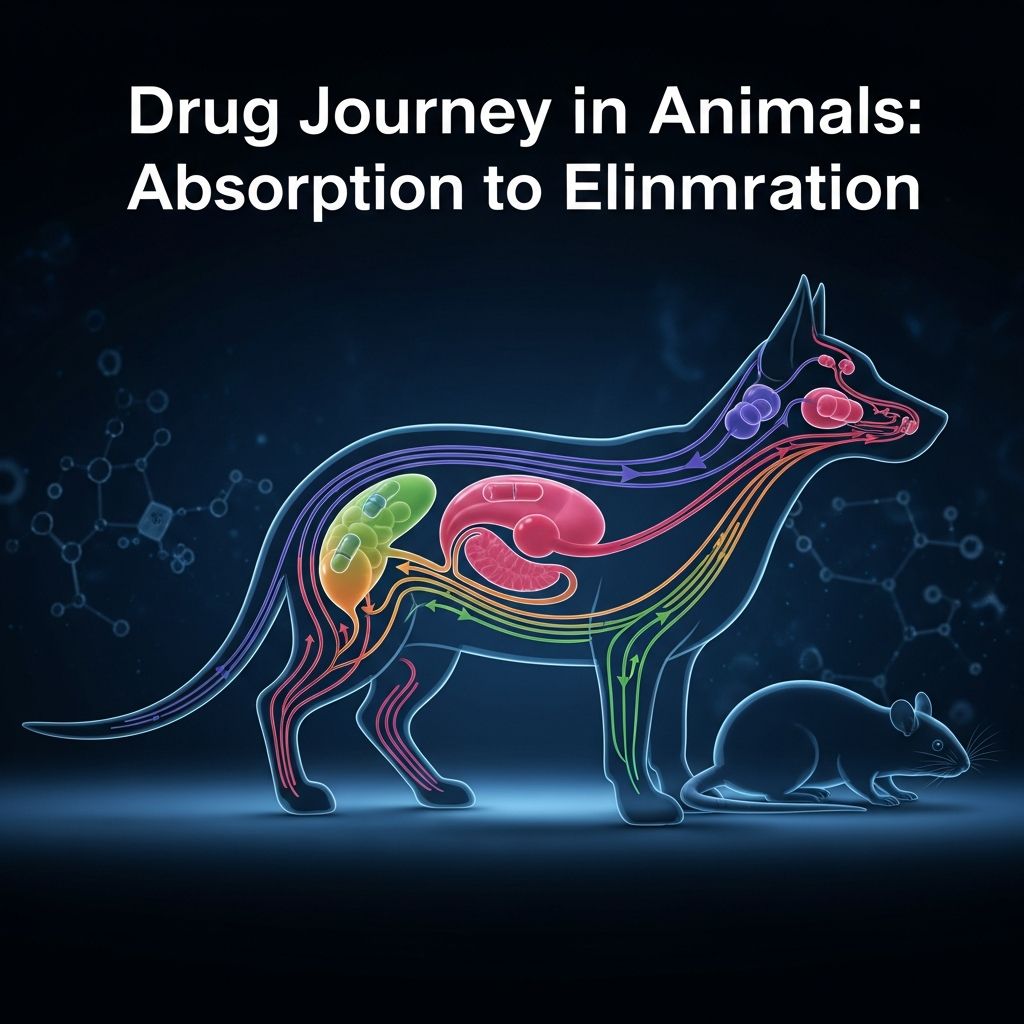
Veterinary drugs follow a predictable yet complex path through an animal’s body, influencing their effectiveness and safety. This journey, known as pharmacokinetics, encompasses absorption, distribution, metabolism, and excretion (ADME), guiding veterinarians in selecting routes, doses, and intervals tailored to species variations.
Foundations of Pharmacokinetics in Veterinary Practice
Pharmacokinetics examines what the body does to a drug, distinct from pharmacodynamics, which studies the drug’s effects on the body. In animals, these processes determine administration routes, dosing schedules, and potential toxicities. Key parameters like volume of distribution (Vd), clearance (Cl), and half-life (t½) are derived from plasma concentration data post-administration, enabling predictions for optimal regimens.
Studies typically occur in healthy animals, but real-world applications adjust for age, breed, sex, pathology, and drug interactions. Therapeutic drug monitoring validates models, crucial for narrow therapeutic index drugs like gentamicin.
Step 1: Drug Entry via Absorption
Absorption marks the drug’s transition from administration site to bloodstream. For oral drugs, disintegration and dissolution precede uptake, often rate-limited by dissolution in the gastrointestinal (GI) tract. Factors like pH, motility, and formulations (extended or delayed release) affect this, complicating cross-species dosing.
Intravenous (IV) administration bypasses absorption for 100% bioavailability, ideal for rapid action. Other routes—subcutaneous, intramuscular, transdermal—vary by lipid solubility and vascularity. Lipophilic drugs cross membranes easily via passive diffusion, while hydrophilic ones rely on transporters.
- Oral absorption: Influenced by GI pH; weak bases absorb better in intestines.
- IV bolus: Immediate plasma peak, followed by distribution.
- Species note: Ruminants alter oral kinetics due to forestomach fermentation.
Step 2: Spreading Through Distribution
Once absorbed, drugs distribute from plasma to tissues. Initial rapid phase targets highly perfused organs (brain, liver, kidneys), then slower to muscle and fat. Volume of distribution (Vd) quantifies this: Vd = dose / plasma concentration, indicating extent (low Vd: vascular confinement; high Vd: tissue affinity).
For phenobarbital in dogs, Vdss of 0.6 L/kg allows dose calculation: for 10 mg/L target, dose = 6 mg/kg IV. Protein binding affects free drug availability; hypoalbuminemia increases it, risking toxicity.
| Drug | Species | Vd (L/kg) | Notes |
|---|---|---|---|
| Phenobarbital | Dog | 0.6 | Steady-state for epilepsy dosing |
| Thiopental | Dog | High | Redistribution ends anesthesia |
| Propofol | Goat/Dog | High | Breed affects recovery (e.g., Greyhounds slower) |
Step 3: Transformation Through Metabolism
Metabolism, or biotransformation, primarily in liver via cytochrome P450 (CYP) enzymes, converts drugs to inactive, water-soluble metabolites for excretion. Phase I (oxidation, reduction) prepares substrates; Phase II (conjugation) enhances polarity.
Species differences are stark: cats poorly glucuronidate acetaminophen or carprofen, prolonging half-lives (carprofen t½ 50% longer than dogs/humans). Dogs metabolize propofol via CYP2B11 oxidation, unlike human glucuronidation. In sheep/goats, rapid liver metabolism trumps redistribution for thiopental duration.
Inducers (e.g., phenobarbital) accelerate metabolism; inhibitors prolong effects. Pathology like liver disease slows this, necessitating dose adjustments.
Step 4: Removal by Excretion
Excretion eliminates drugs/metabolites, mainly renal (glomerular filtration, tubular secretion/reabsorption) and biliary/fecal. Clearance (Cl) measures removal rate: Cl = elimination rate constant (kel) × Vd. Half-life t½ = 0.693 / kel predicts duration.
Short t½ drugs (e.g., propofol) require frequent dosing or infusions; long t½ allow wider intervals but risk accumulation. In food animals, t½ dictates withdrawal times for residues.
Reaching Steady State and Dosing Strategies
Repeated dosing builds to steady state in 3–5 half-lives: 50% after 1, 75% after 2, etc. Efficacy/toxicity assesses post-steady state. Loading doses accelerate: Dose = Vd × target Cp (adjust for oral bioavailability F).
Constant-rate infusions suit short t½ drugs: Infusion rate = Cl × target Cp. Fluctuation depends on t½/dosing interval ratio; long intervals cause peaks/troughs.
- Accumulation: Occurs if dosing interval < t½.
- Withdrawal: Based on 5–7 t½ for near-complete elimination.
- Monitoring: Plasma levels guide adjustments in disease.
Species and Breed Variations: Critical Considerations
Veterinary pharmacokinetics demands species awareness. Cats’ deficient glucuronidation heightens risks (e.g., aspirin, propofol). Greyhounds’ leanness prolongs lipophilic anesthetic recovery. Ruminants’ ruminal microbes alter oral drugs; foals mature liver enzymes slowly.
Table showcases interspecies clearance differences:
| Drug | Cat Cl (mL/min/kg) | Dog Cl | Human Cl | Implication |
|---|---|---|---|---|
| Carprofen | 0.22 | 0.6–1 | 1.06 | Lower cat dose/frequency |
| Piroxicam | 0.044 | 0.3 | 0.5 | Slower feline clearance |
Practical Applications in Clinical Scenarios
In anesthesia, thiopental’s brain redistribution enables quick recovery in dogs, but goats rely on metabolism. Chronic therapies like phenobarbital for seizures use Vd for loading, t½ for maintenance. Critical care infusions maintain levels for unstable patients.
Toxicity arises from ignored kinetics: prolonged cat NSAIDs cause GI ulcers; overdosing renally impaired animals risks accumulation.
Challenges and Advances in Veterinary Pharmacokinetics
Modeling assumes health; comorbidities alter parameters. Population pharmacokinetics analyze diverse data for better predictions. Therapeutic monitoring, though invasive, ensures safety for high-risk drugs.
Future: breed genomics for CYP variations; nanoparticle formulations for targeted delivery. Always extrapolate cautiously across species.
Frequently Asked Questions (FAQs)
What is the main difference between pharmacokinetics and pharmacodynamics?
Pharmacokinetics tracks body handling of drugs (ADME); pharmacodynamics examines drug effects on tissues/receptors.
How does half-life affect dosing in animals?
Short t½ needs frequent/short intervals; long t½ risks buildup, suits once-daily.
Why are cats prone to drug toxicities?
Deficient Phase II enzymes slow metabolism of many drugs.
When is a loading dose used?
To rapidly achieve steady state in urgent cases or long t½ drugs.
Can dog pharmacokinetics apply to cats?
Rarely directly; cats often have slower clearance, requiring adjustments.
References
- Principles of Drug Absorption, Drug Disposition, and Drug Action — Veterian Key. 2023. https://veteriankey.com/principles-of-drug-absorption-drug-disposition-and-drug-action/
- Pharmacokinetics – Pharmacology – MSD Veterinary Manual — MSD Veterinary Manual. 2023-10-15. https://www.msdvetmanual.com/pharmacology/pharmacology-introduction/pharmacokinetics
- Feline drug metabolism and disposition: pharmacokinetic evidence… — PMC (NCBI). 2013-09-30. https://pmc.ncbi.nlm.nih.gov/articles/PMC3811070/
- Disposition and Fate of Drugs – Pharmacology — Merck Veterinary Manual. 2023. https://www.merckvetmanual.com/pharmacology/pharmacology-introduction/disposition-and-fate-of-drugs
- Drug Metabolism and Pharmacokinetics in Veterinary Sciences — Wiley Online Library. 2022. https://onlinelibrary.wiley.com/doi/10.1002/9781119589181.ch9
Similar Articles








Read full bio of Sneha Tete


