

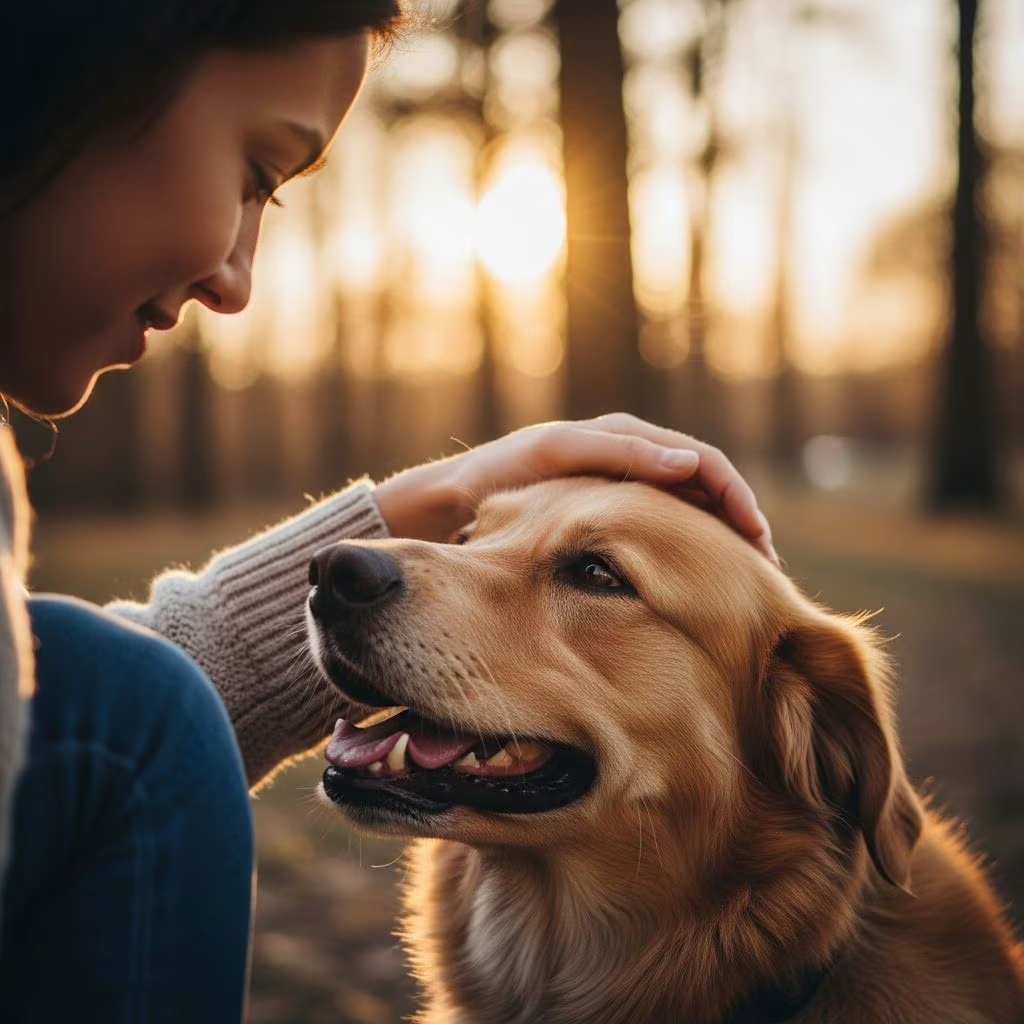
The question of how dogs perceive their human companions has fascinated pet owners and researchers alike for generations. Rather than viewing humans simply as fellow canines, evidence suggests that dogs recognize humans as distinct beings worthy of special social bonds and communication strategies unique to interspecies relationships.
Understanding Canine Social Cognition
Dogs possess remarkable abilities to interpret human behavior, emotions, and intentions in ways that go far beyond basic animal instinct. Through thousands of years of domestication, dogs have developed specialized cognitive capacities that allow them to understand the nuances of human communication in a manner fundamentally different from how they relate to other dogs.
Research has demonstrated that dogs can recognize individual humans, remember them over time, and distinguish between different people based on their interactions and emotional expressions. This capability suggests that dogs have created a mental category specifically for humans—one that is separate from their understanding of other canines. Dogs integrate multiple forms of human communication simultaneously, including facial expressions, vocal tones, and body language, to form comprehensive representations of their human companions.
The Evolution of Dog-Human Cooperation
The domestication process fundamentally shaped how dogs interact with humans. During domestication, dogs underwent selection for reduced fear and heightened tolerance, traits that enabled closer cooperation with humans compared to their wolf ancestors. This evolutionary pressure wasn’t random; it specifically enhanced dogs’ ability to work alongside humans in ways that required understanding and responding to uniquely human cues.
The Canine Cooperation Hypothesis explains that dog-human cooperation likely evolved from wolf-wolf cooperative behaviors, with domestication reducing dogs’ fear of humans rather than creating entirely new social skills. This means that dogs may interpret humans through a lens of interspecies cooperation rather than viewing them as fellow pack members or alternative canines.
Reading and Responding to Human Cues
One of the most compelling pieces of evidence that dogs do not categorize humans as dogs comes from their sophisticated ability to follow human-specific gestures and commands. Dogs reliably respond to distal pointing, head turns, eye glances, and other human communication methods that have no equivalent in canine-to-canine interaction. Additionally, dogs demonstrate flexibility in generalizing these behaviors to novel human movements, suggesting they have learned to decode specifically human forms of communication.
This specialized skill set exists because humans communicate differently than dogs do. Humans rely heavily on pointing, facial expressions, and verbal instruction—communication methods that evolved specifically within human societies. Dogs’ ability to master these uniquely human forms of expression indicates they have learned to treat humans as a distinct social category requiring specialized interpretive skills.
Emotional Recognition and Attachment Styles
Dogs demonstrate the capacity to assess and respond to human emotional states, but their responses often differ markedly from how they would react to emotional expressions from other dogs. When dogs encounter human emotional displays, they engage in behaviors—such as seeking proximity to their caretaker during stress or exploring confidently when their human is present—that mirror caregiver-infant attachment patterns rather than pack hierarchies observed in canine groups.
The biochemistry of this bond further distinguishes the human-dog relationship from dog-dog relationships. When dogs and humans interact positively, both species release oxytocin, a neurochemical associated with social bonding and attachment. This mutual hormone release creates a feedback loop that strengthens the emotional connection between species, something that would operate differently if dogs viewed humans as simply unusual pack members.
Learning Individual Human Characteristics
Beyond instinctive responses, dogs actively learn about their human companions throughout their lives. Living in human households provides extensive opportunities for dogs to understand the specific behaviors, preferences, and emotional patterns of individual humans. Dogs develop memory for specific human faces, voices, and behavioral patterns, suggesting they maintain detailed mental models of their humans as unique individuals rather than interchangeable members of a human “pack.”
This learning process is individual and ongoing. A dog may recognize certain humans as less trustworthy based on past experiences, while forming strong attachments to others. Such discrimination indicates that dogs evaluate humans as complex social agents whose individual characteristics matter, rather than responding to them as generic members of a single category called “human.”
The Question of Species Recognition
| Aspect of Perception | Dog-to-Dog Interaction | Dog-to-Human Interaction |
|---|---|---|
| Primary Communication Method | Body language, scent marking, vocalizations | Responding to human gestures, facial expressions, verbal commands |
| Hierarchical Understanding | Pack dynamics with territorial and dominance signals | Cooperative framework with special attentiveness to human needs |
| Emotional Expression Recognition | Interpretation of canine-specific emotional displays | Comprehension of uniquely human emotional cues and vocal tone variations |
| Attachment Behavior | Socialization within litter and wider pack groups | Caregiver-seeking behavior resembling parent-infant bonds |
While dogs may occasionally display behaviors toward humans that superficially resemble pack-related activities, the structure and content of these interactions reveal fundamental differences in how dogs categorize humans. Dogs do not appear to incorporate humans into canine social hierarchies or evaluate them through the same behavioral frameworks they use for other dogs.
Special Adaptations for Human Partnership
Through domestication, dogs developed what some researchers term “hypersociability”—an enhanced capacity for forming bonds across species boundaries. This trait distinguishes dogs from many other animals and even from their closest wild relatives. The ease with which dogs form attachments to humans, and occasionally to entirely different species, suggests that dogs have evolved a flexible social cognition system capable of recognizing and bonding with beings fundamentally different from themselves.
This flexibility indicates that dogs have developed mental categories beyond “canine” and “non-canine.” Instead, they appear to recognize specific meaningful categories: primary caretaker, familiar human, unfamiliar human, and so forth. Such cognitive sophistication suggests dogs process humans through a specialized social framework rather than forcing them into pre-existing canine categories.
The Neuroscience of Cross-Species Bonding
Brain imaging and behavioral studies reveal that the human-dog relationship engages attachment systems in dogs’ brains that may operate somewhat differently from canine-to-canine social bonds. When dogs interact with their human companions, particularly during eye contact, both parties experience significant neurochemical changes associated with caregiving and affiliation rather than dominance establishment or territorial negotiation.
The bidirectional nature of this bonding—where both dog and human mutually reinforce attachment through biochemical pathways—suggests a relationship that transcends typical pack dynamics. Dogs recognize humans as beings capable of providing care, attention, and emotional regulation, roles that exist somewhat differently in canine social structures.
Implications for Pet Care and Training
Understanding that dogs do not categorize humans as canine companions has practical implications for how we approach dog training, behavior modification, and welfare. When training dogs, handlers leverage the dog’s recognition that humans operate under different rules and communication systems than other dogs. Dogs respond to human training methods precisely because they have learned to treat humans as a distinct social category requiring specialized interpretive skills.
Recognizing this distinction helps explain why dominance-based training approaches that mimic canine pack structures often prove less effective than methods that acknowledge dogs’ capacity for interspecies cooperation. Dogs appear to have evolved not to follow humans as pack leaders in the traditional sense, but to cooperate with them as partners in uniquely human social frameworks.
Cultural and Contextual Variations
Research examining human-dog relationships across diverse cultures reveals that the fundamental perception dogs hold of humans remains consistent, even as the specific quality of relationships varies. Whether dogs function as herding companions, hunting partners, or household pets, they appear to maintain recognition of humans as a distinct category worthy of specialized social engagement.
The intensity and character of individual human-dog bonds may differ based on cultural practices, the dog’s role, and owner characteristics, but the underlying perception that humans represent a special category appears universal across domesticated dog populations.
Frequently Asked Questions
- Do dogs think they are human?
- No. Dogs recognize humans as distinctly different from themselves while simultaneously understanding that humans warrant special communication strategies and emotional engagement. Dogs have likely developed a specific cognitive category for humans rather than believing themselves to be human.
- Can dogs tell the difference between individual humans?
- Yes, extensively. Dogs can recognize, remember, and differentiate individual humans based on facial features, scent, voice, and behavior patterns. They assess familiarity levels and respond differently to strangers versus familiar people.
- Why do dogs obey human commands if they don’t see us as pack leaders?
- Dogs have evolved cooperative instincts and the capacity to recognize humans as social agents worthy of attentiveness and collaboration. Obedience stems from this interspecies cooperation rather than from pack hierarchy dynamics.
- Do dogs feel love for humans?
- Research strongly suggests that dogs experience genuine attachment and emotional bonding with humans. The mutual release of oxytocin during positive interactions and dogs’ distress at separation both indicate emotional bonds rather than mere behavioral conditioning.
- Is the dog-human bond unique?
- The intensity and specific character of dog-human bonding may be unique among human-animal relationships, though dogs demonstrate capacity for cross-species attachment with other animals as well. What is distinctive is the degree to which dogs have been selected for human-directed sociability.
Conclusion: Recognition Across Species
Dogs do not perceive humans as fellow canines but rather as members of a distinct species with whom they have developed sophisticated means of communication and cooperation. Through domestication and individual learning, dogs have created specialized cognitive frameworks for understanding, predicting, and bonding with humans.
This recognition of fundamental difference does not diminish the bond between dogs and humans; rather, it enriches it. Dogs’ capacity to form deep emotional connections with beings as fundamentally different from themselves represents a remarkable achievement of animal cognition. The human-dog relationship succeeds precisely because dogs have learned to treat humans as worthy partners in a form of social cooperation that exists outside traditional canine hierarchies.
References
- How Dogs Perceive Humans and How Humans Should Treat Their Dogs — Frontiers in Psychology. 2020. https://www.frontiersin.org/journals/psychology/articles/10.3389/fpsyg.2020.584037/full
- Human–canine bond — Wikipedia. Accessed 2026. https://en.wikipedia.org/wiki/Human%E2%80%93canine_bond
- The Welfare of Dogs as an Aspect of the Human–Dog Bond — National Center for Biotechnology Information (NCBI). 2024. https://pmc.ncbi.nlm.nih.gov/articles/PMC11240373/
- Is the Human-Canine Bond Unique? — American Kennel Club. https://www.akc.org/expert-advice/training/is-the-dog-human-bond-unique/
- Inside the Human-Dog Love Affair — Psychology Today. October 2023. https://www.psychologytoday.com/us/blog/the-baby-scientist/202310/for-the-love-of-a-dog



