

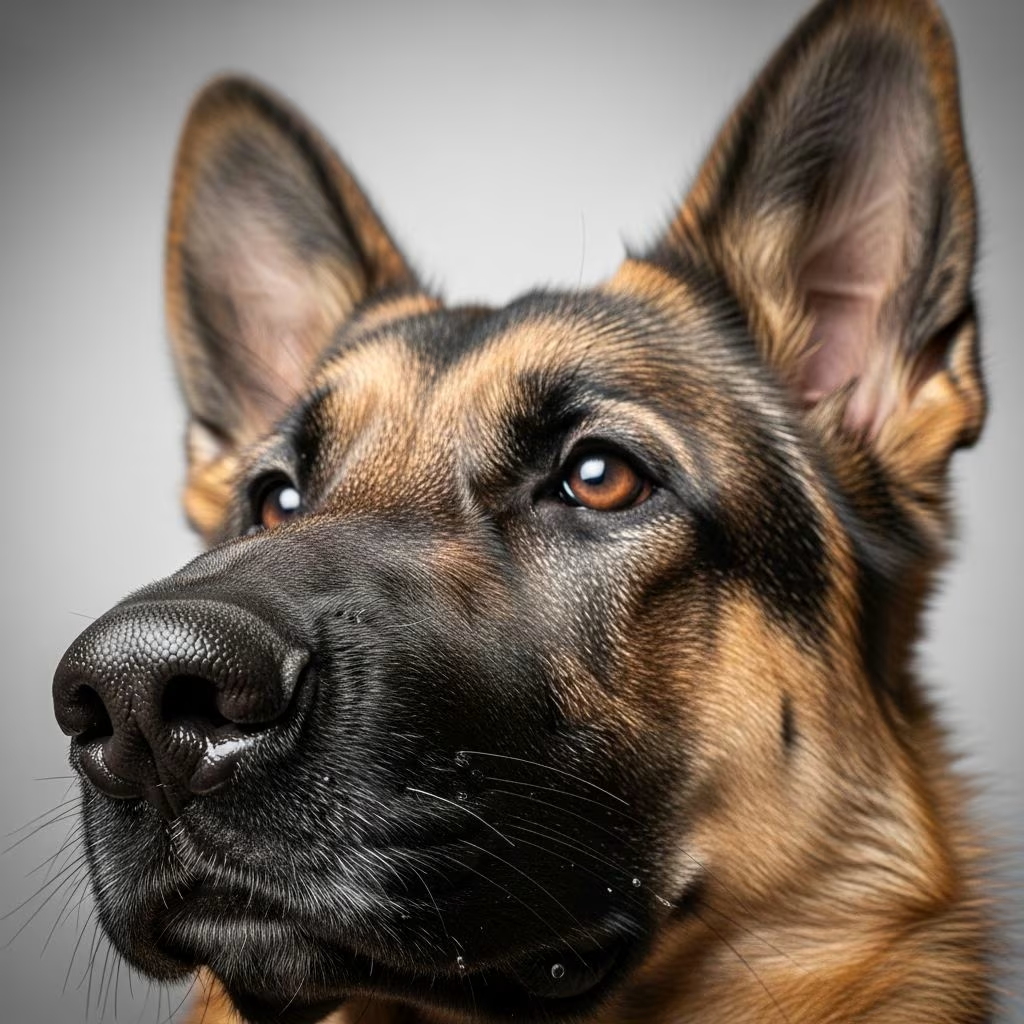
Dogs’ Strongest Senses: How Your Pup Experiences the World
Dogs share the same five primary senses as humans—smell, hearing, sight, taste, and touch—but they do not all operate at the same level. While people are highly visual, dogs are scent and sound specialists. Their brains and bodies are built to detect, interpret, and react to information in ways we can’t always see, but that deeply influence their behavior every day.
This guide breaks down each of your dog’s senses, explores which ones are strongest, and explains how they use them to navigate their world—and their relationship with you.
Which Sense Is a Dog’s Strongest?
Among all five senses, a dog’s sense of smell is widely considered their strongest and most specialized sense. Their sense of hearing is a close second, giving them a powerful one-two combination that far surpasses human abilities in many ways.
Dogs have an incredibly advanced scent detection system in both their nose and brain. Veterinary and animal behavior research suggests that dogs have more than 100 million scent receptors in their nasal cavity, compared with around 6 million in humans, and the part of their brain devoted to analyzing odors is about 40 times larger (relative to total brain size) than in people. This makes smell their primary way of gathering information about their surroundings, other animals, and even human emotions.
Their hearing is also exceptionally acute. Dogs can detect high-frequency sounds far beyond human capacity—up to 35,000 vibrations per second compared with about 20,000 for humans—allowing them to hear noises we never notice and from greater distances.
| Sense | Relative Strength in Dogs | Compared With Humans | Primary Uses |
|---|---|---|---|
| Smell | Strongest | Estimated thousands of times more sensitive | Tracking, communication, emotional cues, navigation |
| Hearing | Very strong | Wider frequency range and longer distance | Alerting to danger, communication, locating sounds |
| Sight | Moderate | Better motion and low-light detection, less color range | Detecting movement, body language, orientation |
| Taste | Weaker | Fewer taste buds than humans | Food selection, safety, preference (guided by smell) |
| Touch | Important but variable | Different sensitivity areas than humans | Social bonding, comfort, environmental feedback |
Sense of Smell: A Dog’s Superpower
Your dog’s nose is their main tool for understanding the world. When a dog sniffs the ground, the air, or even you, they are gathering layers of information that go far beyond what humans can detect.
How Dogs’ Smell Outperforms Ours
Research from veterinary and animal science sources shows that dogs have a dramatically more powerful sense of smell than humans:
- Dogs possess tens to hundreds of millions of scent receptors in their nasal cavity, compared with about 6 million in humans.
- The area of the brain dedicated to processing scents is about 40 times larger (relative to brain size) than in people.
- Estimates suggest dogs can detect some odors at concentrations 1,000 to 10,000 times lower than humans can.
This sensory advantage allows dogs to follow faint trails, identify individuals by scent alone, and pick up chemical changes in sweat and breath associated with stress, illness, or emotional shifts.
Jacobson’s Organ: The Hidden Scent System
Dogs also have a specialized structure called the vomeronasal organ, often referred to as Jacobson’s organ. It sits inside the nasal cavity and opens into the roof of the mouth, behind the upper front teeth.
This organ acts as a secondary smell system designed specifically for detecting certain chemical signals, including pheromones. These are chemical messages that can carry information about:
- Reproductive status (for example, whether another dog is ready to mate)
- Social relationships and individual identity
- Mother–pup recognition and nursing cues
The signals from Jacobson’s organ are wired directly to parts of the brain involved in reproduction and social behavior, bypassing the usual pathways for ordinary odors. This helps explain why your dog may show intense interest in other dogs’ urine, genital area, or specific spots on the ground—they are effectively reading detailed social and biological information.
What Dogs Use Smell For
Because smell is their strongest sense, dogs rely on it for a wide range of tasks and behaviors:
- Navigation and orientation: Dogs can use scent trails and environmental odors to find their way home or track a specific route.
- Social communication: Urine marking, sniffing other dogs, and even sniffing humans help dogs learn who is around and what state they are in.
- Work and assistance: Trained dogs support humans by detecting missing people, explosives, drugs, wildlife, and even medical conditions such as low blood sugar or seizures.
- Emotional information: Dogs can detect subtle changes in human body odor associated with stress, fear, or excitement, which can influence their responses.
Sense of Hearing: Always on Alert
If your dog barks at the door long before anyone knocks, or turns toward sounds you cannot hear, that is their powerful hearing at work. Dogs evolved to detect faint noises over distance and to localize sounds quickly, which helped their ancestors find prey and avoid danger.
How Dog Hearing Compares to Human Hearing
- Dogs can detect sounds up to around 35,000 vibrations (hertz) per second, compared with roughly 20,000 in humans.
- They are especially sensitive to higher frequencies, which is why high-pitched toys, whistles, and certain electronic noises get their attention.
- Dogs can also hear softer sounds at greater distances and are skilled at distinguishing between similar noises.
Many dogs can also adjust their outer ear position to better capture sound. This helps them quickly determine where a sound is coming from, even in noisy environments, and focus on what matters.
Everyday Ways Dogs Use Hearing
Hearing plays a key role in how dogs interact with their environment and with humans:
- Alerting to changes: Dogs often hear approaching people, vehicles, or animals before humans do, leading to barking or attentive behavior.
- Communication: Dogs respond not just to words, but to tone, pitch, and rhythm in human voices, as well as to other dogs’ barks, whines, and growls.
- Work and safety: Hearing is essential for guard dogs, herding dogs, and many service dogs who must react quickly to sounds or verbal cues.
As dogs age, their hearing can decline. A dog with hearing loss may startle more easily when touched, sleep through sounds that once woke them, or respond less reliably to voice commands. Adjusting communication—such as using more visual signals—can help support them.
Sense of Sight: Built for Motion and Low Light
Compared with humans, dogs are less dependent on sight, but their vision is still well adapted to their needs. Rather than seeing the world in full detail and color like humans, dogs excel at detecting movement and seeing in low light.
How Dogs See the World
Scientific research suggests that dogs are not completely colorblind. Instead, they have a more limited color range, likely seeing mainly blues and yellows with less distinction between reds and greens. Their eyes are structured differently from human eyes, with adaptations that support their lifestyle as dawn-and-dusk active animals:
- A reflective layer behind the retina (the tapetum lucidum) enhances low-light vision, which is why dogs’ eyes may appear to glow in the dark.
- They are particularly good at noticing moving objects, even at a distance, which would have been useful for spotting prey or potential threats.
- Some breeds, especially those developed for sight-based work (like herding or hunting), may have a wider field of vision to monitor their surroundings.
What Sight Means for Daily Life
In everyday situations, your dog’s vision helps them:
- Recognize familiar shapes and body postures from people and other dogs.
- Follow gestures and visual cues, such as pointing or hand signals.
- Navigate obstacles, judge distances when running or jumping, and interact with toys and other animals.
Because sight is not their strongest sense, dogs often rely on smell or sound when visual information is unclear. A dog may appear to recognize someone from far away, but often it is scent, sound, or movement—not detailed facial features—that tells them who it is.
Sense of Taste: Guided by the Nose
Compared with humans, dogs generally have a less refined sense of taste. Where humans have around 9,000 taste buds, dogs have been estimated to have only a fraction of that number, which means they rely more heavily on their sense of smell to decide what is appealing or safe to eat.
How Dogs Experience Flavor
Dogs do have taste receptors for basic flavor categories such as sweet, sour, salty, and bitter, and some evidence suggests that they also have taste sensitivity for specific nutrients, like certain amino acids or fats. However, smell does most of the work:
- If something smells interesting or strong, a dog is more likely to want to eat it.
- If it smells unfamiliar or unpleasant, they may refuse it, even if the actual taste is mild.
- Dogs may show preferences for certain textures or temperatures, but smell remains the primary driver.
This helps explain why many dogs will try to eat objects that smell rich or novel, even if they are not traditionally considered food, and why strong-smelling treats work so well in training.
Sense of Touch: Connection and Comfort
The sense of touch in dogs is often overlooked, but it is essential for both physical awareness and emotional connection. Dogs have touch receptors throughout their skin, and certain areas—such as the face, ears, and paws—may be especially sensitive.
Touch in Social Bonding
Gentle touch plays an important role in human–dog relationships:
- Petting and grooming can reduce stress in both dogs and people, supporting bonding and trust.
- Playful contact, such as wrestling or gentle tug-of-war, allows dogs to interact physically with their human family and other dogs.
- Comforting touch may help some dogs cope with anxiety, although others might prefer space—individual preference matters.
Touch as Feedback
Touch also gives dogs important feedback about their environment:
- Whiskers and facial hairs help them detect objects and changes in air movement, especially in low light.
- Paws sense temperature and texture, helping dogs assess whether surfaces are safe or comfortable.
- Pressure or discomfort alerts them to injuries, parasites, or irritants.
Because touch can be both pleasant and overwhelming, it is important to observe each dog’s individual responses. Some enjoy full-body hugs, while others may only tolerate light petting in certain areas.
How Dogs’ Senses Work Together
In real life, dogs rarely use just one sense at a time. Their strongest senses—smell and hearing—work together with sight, taste, and touch to form a complete picture of their surroundings.
- A dog may smell another dog before seeing or hearing them, using scent to determine sex, mood, and familiarity.
- They may hear a car in the driveway before smelling who is inside, then use smell and sight to confirm it is you.
- During play, they use sight for movement, hearing for cues, touch for feedback, and smell to recognize toys and people.
Understanding this multi-sensory world can help you better interpret your dog’s behavior and provide experiences that match how they naturally explore—more sniffing opportunities, sound-aware environments, and thoughtful touch.
Frequently Asked Questions (FAQs)
Q: What is a dog’s strongest sense?
A dog’s strongest sense is smell, supported by a large number of scent receptors and a brain region devoted to odor analysis that is many times larger (proportionally) than in humans.
Q: Can dogs really smell things we cannot?
Yes. Research indicates dogs can detect some odors at concentrations far below human detection levels, often estimated to be thousands of times more sensitive, which is why they can track faint trails, locate substances, and even assist in medical detection work.
Q: Do dogs see in color or only in black and white?
Current evidence suggests dogs see a limited range of colors—primarily blues and yellows—rather than only black and white, but their color range is smaller than that of humans.
Q: Why does my dog react to sounds I can’t hear?
Dogs can hear higher-frequency sounds and often detect quieter noises at greater distances than humans. This allows them to notice approaching people, animals, or devices long before we do.
Q: How can I enrich my dog’s strongest senses at home?
You can enrich your dog’s life by offering sniff-based activities (like scent games, sniff walks, or puzzle feeders), using clear voice and sound cues for training, providing safe tactile experiences (gentle grooming, varied surfaces to walk on), and allowing them time to explore with their nose and ears instead of rushing them.
References
- How Dogs Use Smell to Perceive the World — VCA Animal Hospitals. 2021-05-01. https://vcahospitals.com/know-your-pet/how-dogs-use-smell-to-perceive-the-world
- Dog – Senses — Encyclopaedia Britannica. 2023-08-01. https://www.britannica.com/animal/dog/Senses
- Your Dogs Senses Are More Powerful Than You Know — Doindogs / Discount Pet Mall. 2010-01-01. http://www.doindogs.com/senses.shtml
- A Dog’s Strongest Sense — Barks n Purrs. 2018-06-01. https://barksnpurrs.com/a-dogs-strongest-sense/



