

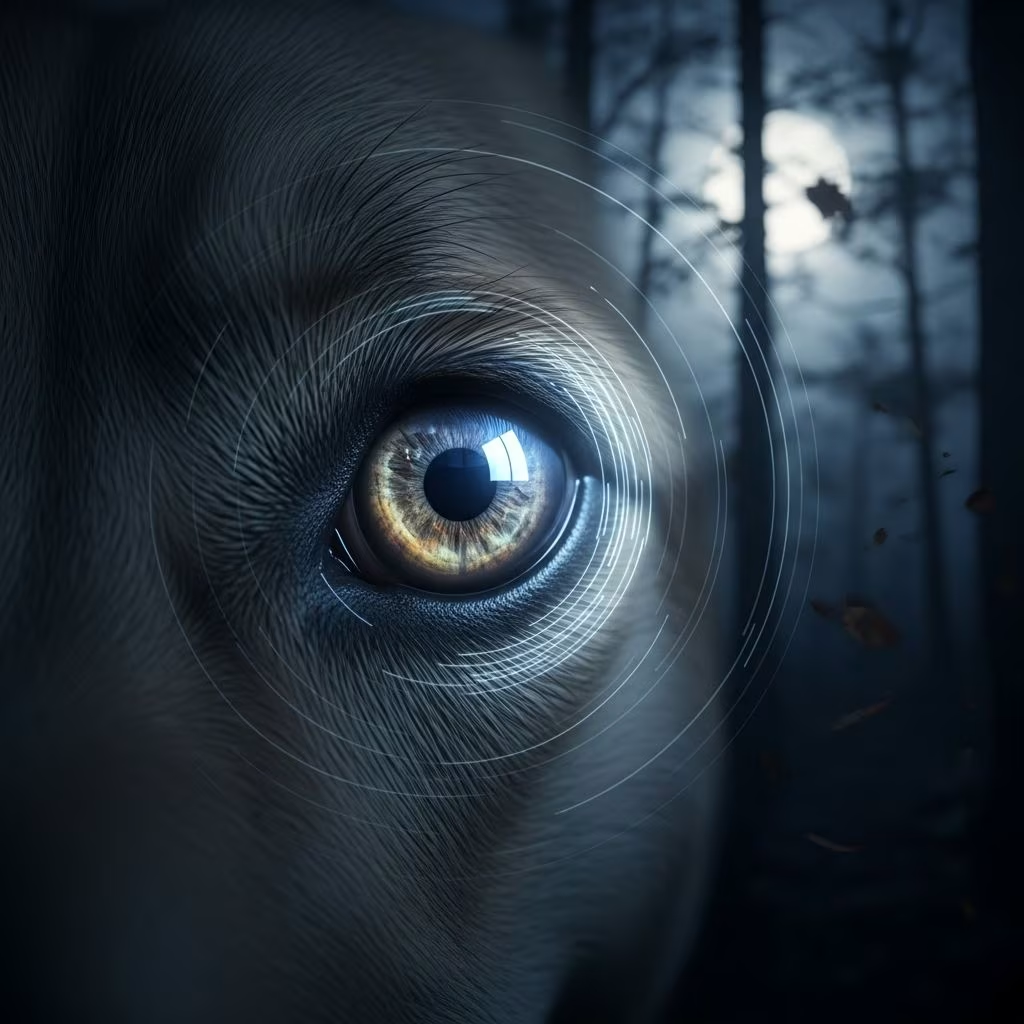
Dogs possess remarkable abilities to navigate and detect objects in low-light environments, far surpassing human capabilities in dim conditions. This adaptation stems from evolutionary needs for hunting and survival during twilight hours.
The Building Blocks of Canine Vision
At the heart of a dog’s visual system lie specialized cells in the retina known as photoreceptors: rods and cones. Rods excel in low-light detection, providing sensitivity to faint light sources, while cones handle color perception and detail in brighter settings.
- Rods: Dominate the dog’s retina, enabling vision in light levels as low as one-fifth to one-sixth of what humans require.
- Cones: Fewer in number and types, limiting color range but prioritizing motion and shape recognition in dusk.
This rod-heavy composition equips dogs for crepuscular activities, when prey is most active at dawn and dusk.
Key Anatomical Advantages
Several structural features amplify dogs’ low-light prowess beyond mere rod count.
Larger Pupils for Maximum Light Intake
Dogs’ pupils dilate significantly wider than human ones, allowing more light to flood the retina. This rapid adjustment enhances visibility during sudden transitions from light to dark.
The Tapetum Lucidum: Nature’s Mirror
Behind the retina lies the tapetum lucidum, a reflective layer unique to many nocturnal animals. It bounces light back through the photoreceptors, effectively doubling light exposure and causing the characteristic eye glow in headlights or flashes.
While boosting sensitivity, the tapetum scatters light, reducing acuity to roughly 20/50 to 20/80 compared to human 20/20 vision.
Enhanced Motion Detection
Dogs boast a higher flicker fusion frequency, perceiving rapid changes in light that humans miss. This sharpens their ability to track fast-moving objects in shadows.
Comparing Dog and Human Night Vision
| Feature | Dogs | Humans |
|---|---|---|
| Rod Density | High (better low light) | Low (cone-dominant) |
| Pupil Size | Larger dilation | Smaller max opening |
| Tapetum Lucidum | Present (reflective) | Absent |
| Visual Acuity | 20/50-20/80 | 20/20 in light |
| Light Threshold | 5x dimmer tolerance | Requires more light |
Humans rely on cones for daylight detail, faltering in dimness without aids. Dogs, conversely, thrive where we struggle.
Evolutionary Roots of Superior Sight
Wolves, dogs’ ancestors, hunted in low light, selecting for these traits. Domestic breeds retain them, aiding vigilance and play after sunset. Side-positioned eyes widen their field of view, scanning peripherally for threats.
Limitations in Total Darkness
Despite advantages, dogs cannot see in pitch black. They depend on minimal ambient light, like moonlight or streetlamps, relying on smell and hearing otherwise.
Health Issues Impacting Night Vision
Certain conditions impair this gift. Congenital stationary night blindness (CSNB) disrupts rod signaling in ON bipolar cells, treatable via gene therapy in trials. Progressive retinal atrophy also erodes photoreceptors over time.
- Monitor for bumping into furniture or hesitation at night.
- Consult vets for sudden changes; early intervention preserves quality of life.
Practical Tips for Dog Owners
Harness their strengths safely:
- Use dim night lights for navigation without overwhelming eyes.
- Avoid sudden flashes; they disrupt adaptation.
- Leash walks in unlit areas, as smell guides but sight has limits.
- Breeds like hounds excel here; smaller ones may vary slightly.
Myths vs. Facts on Canine Eyesight
| Myth | Fact |
|---|---|
| Dogs see in complete dark | Need some light; better than us but not absolute |
| Dog vision equals night-vision tech | Natural, biological enhancement only |
| All dogs see colors | Limited to blues/yellows; grayscale dominant in dark |
Scientific Insights and Research
Studies confirm dogs detect motion in 1/6th human-needed light. University research on CSNB gene therapy restores function, targeting bipolar cells for dim-light response. Ophthalmologists note tapetum’s dual role: aid and blur.
FAQs
Can all dogs see equally well at night?
Most share core traits, but breed variations exist; wolves surpass domestic dogs slightly.
Why do dog eyes glow green at night?
Tapetum lucidum reflects light; color varies by individual pigments.
Do puppies have full night vision at birth?
Vision develops over weeks; rods mature later for low-light capability.
How does age affect dog night vision?
Cataracts and atrophy degrade it; annual eye checks recommended.
Can training improve night vision?
No, it’s anatomical; training enhances use of smell/hearing complements.
Enhancing Your Dog’s Evening Experiences
Provide toys with scents for dark play. Secure yards prevent mishaps. Recognize their world: blurrier, motion-focused, scent-layered. This fosters bond through their sensory reality.
In summary, dogs’ night vision blends rod abundance, reflective tapetum, expansive pupils, and motion acuity into a toolkit for twilight mastery. Owners benefit by adapting environments accordingly.
References
- Correcting night blindness in dogs — National Eye Institute (NIH). 2023-10-10. https://www.nei.nih.gov/research-and-training/research-news/correcting-night-blindness-dogs
- Success treating night blindness in dogs could lead to human gene therapy — University of California. 2022-03-30. https://www.universityofcalifornia.edu/news/success-treating-night-blindness-dogs-could-lead-human-gene-therapy
- Can Dogs See in the Dark? — Zoetis Petcare. 2024-01-15. https://www.zoetispetcare.com/blog/article/can-dogs-see-dark
- Can Dogs See in the Dark? — PetMD. 2023-11-20. https://www.petmd.com/dog/general-health/can-dogs-see-dark
- Do Dogs Have Night Vision? Exploring Canine Visual Abilities — Brown Vet Hospital. 2024-02-05. https://brownvethospital.com/blog/do-dogs-have-night-vision/
- Curiosities: How well do dogs see at night? — University of Wisconsin–Madison News. 2007-07-18. https://news.wisc.edu/curiosities-how-well-do-dogs-see-at-night/



