

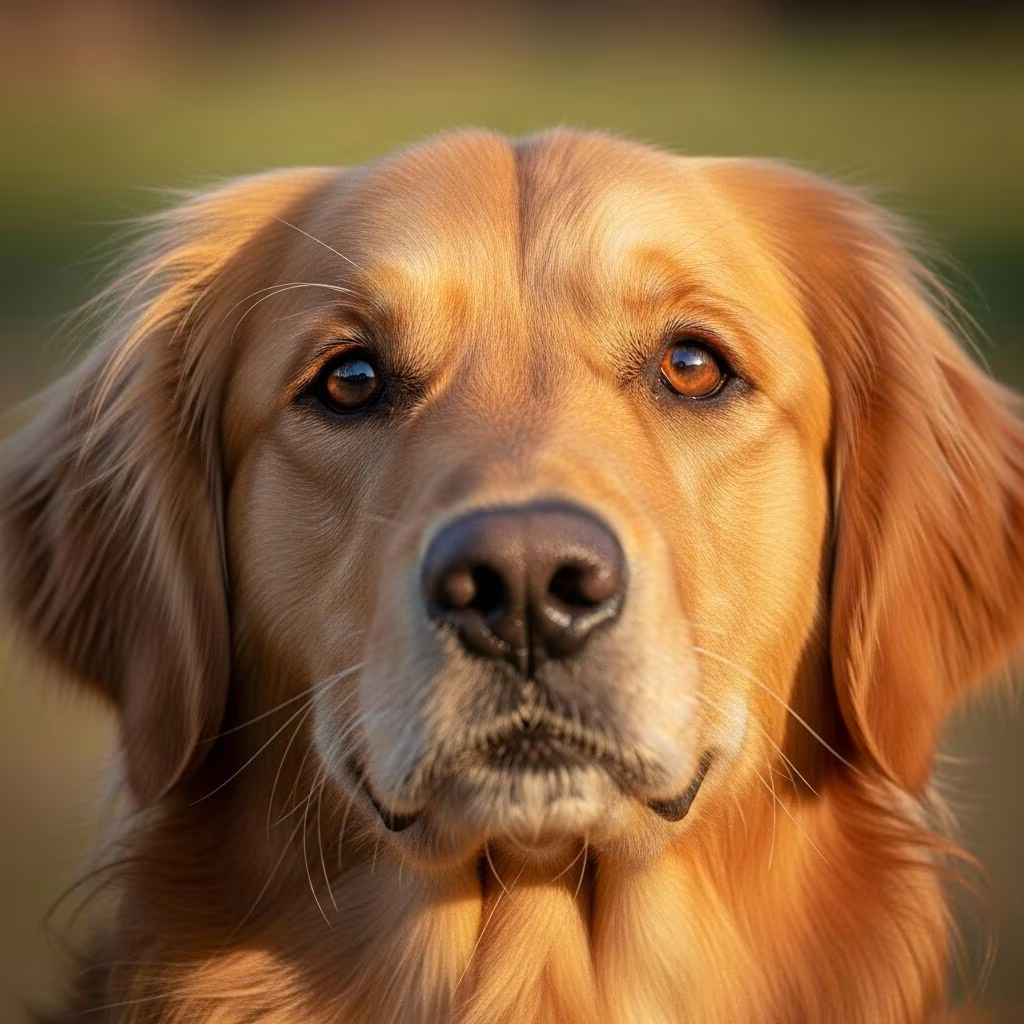
Dogs have evolved a remarkable ability to use facial expressions not just to convey their own emotions, but to actively engage humans and foster stronger relationships. Research shows that these expressions, such as raised eyebrows creating ‘puppy dog eyes,’ are produced more frequently when people are paying attention, indicating intentional communication rather than mere reflex.
The Science of Canine Facial Communication
Canine facial expressions serve as a bridge in interspecies interaction. Studies using advanced imaging and behavioral analysis reveal that dogs activate specific brain regions, like the amygdala and insula, when processing positive social cues from humans, linking neural responses to visible facial changes. This suggests dogs are wired to express emotions in ways that resonate with us.
Unlike wild counterparts, domestic dogs exhibit heightened expressiveness. Functional MRI scans demonstrate limbic system activation during rewarding human interactions, correlating with outward gestures like widened eyes and perked ears. These findings challenge the notion that animal faces merely reflect internal states involuntarily.
Key Facial Expressions and Their Meanings
Dogs employ a repertoire of facial signals tailored to contexts. Here’s a breakdown of common expressions:
- Puppy Dog Eyes (Raised Brows): Brows lifted to enlarge the eye appearance, mimicking infant-like features that trigger human empathy. This is the most frequent expression when humans watch.
- Ear Positions: Erect ears signal alertness or positive anticipation; flattened ears indicate fear or submission.
- Eye Exposure: Whites of the eyes shown (sclera flash) during stress warns of threats.
- Mouth and Lip Cues: Lip licking often denotes stress or appeasement; bared teeth with forward stare convey aggression.
- Head Tilt with Furrowed Brows: Appears during surprise or focused interest, enhancing cuteness.
Humans frequently misread these: positive anticipation mistaken for frustration, or fear for happiness, highlighting the need for better education.
How Dogs Respond to Human Attention
Dogs calibrate expressions based on whether we’re looking. In experiments with 24 family pets, expressions surged when humans faced them but not when distracted or food was visible, proving audience-directed communication. Brow raises dominated, amplifying perceived vulnerability to elicit care.
This sensitivity likely stems from domestication. Dogs avoid similar expressiveness toward food, underscoring social intent over excitement. Dr. Juliane Kaminski notes: “Dogs produce facial expressions dependent on the attention state of their audience.”
Brain Lateralization in Expression
Facial movements show hemispheric bias. Positive social stimuli provoke left-side eyebrow and ear activity, tied to right-brain emotional processing; neutral objects elicit right-side responses. Gaze lateralization aids emotion recognition, with contralateral visual pathways enhancing sensitivity.
Dogs Reading Human Faces
Dogs don’t just express; they interpret our faces too. They distinguish happy from angry human expressions, fixating more on positives, especially under oxytocin influence, which enlarges pupils and boosts attention to joyful cues.
Studies confirm dogs avert gaze from sad faces while engaging happy ones, using posture, tone, and expressions holistically. This cross-species empathy supports their role as companions, predicting our moods to offer comfort like licks or sad faces.
| Dog Response | To Happy Human Face | To Angry/Sad Face |
|---|---|---|
| Gaze | Prolonged fixation | Aversion or shift |
| Pupil Size | Dilated (oxytocin effect) | Normal or constricted |
| Expression | Relaxed, playful | Appeasement (lip lick) |
This table summarizes key reactions, drawn from neuroimaging and behavioral data.
Evolutionary Roots of Expressive Dogs
Domestication selected for traits favoring human bonding. Over millennia, dogs developed facial muscles akin to ours, enabling nuanced signals absent in wolves. The ‘puppy dog eyes’ muscle (AU101) hypertrophied in domesticated breeds, directly appealing to our nurturing instincts.
Positive reinforcement loops strengthened this: expressive dogs gained more attention, food, and safety, perpetuating the trait. Today, it manifests in varied breeds, from tiny Chihuahuas to massive Great Danes.
Practical Tips for Interpreting Dog Faces
Owners can deepen bonds by learning these signals:
- Observe Context: Pair face with body—tail wag amplifies joy; tucked tail signals fear.
- Avoid Misreads: Lip licking isn’t always hunger; it’s often stress.
- Respond Appropriately: Mirror positive expressions to encourage reciprocity.
- Use Training: Reward calm faces to reduce aggression cues.
- Seek Pro Help: Persistent distress signals warrant vet or behaviorist checks.
Accurate reading prevents mishaps, like mistaking fear for defiance.
Applications in Training and Welfare
Understanding expressions aids welfare. Shelters use them to match dogs with owners; trainers leverage positives for compliance. Oxytocin studies suggest nasal sprays could enhance emotional syncing, though more research is needed.
In therapy, dogs’ empathetic faces comfort patients, reading subtle cues. Veterinary assessments incorporate faces for pain detection, improving care.
Common Myths Debunked
- Myth: All Tail Wags Mean Happiness. Reality: Direction and speed matter; left-side wags indicate positives.
- Myth: Dogs Can’t Feel Complex Emotions. Evidence shows nuanced responses rival primates.
- Myth: Expressions Are Purely Instinctual. They’re audience-aware, communicative tools.
FAQs
Why do dogs make ‘puppy dog eyes’?
This expression enlarges eyes, tapping human baby-schema response for care and attention.
Can all dogs read human emotions equally?
Breeds vary, but domestication enables most; training enhances skill.
What if my dog shows stress faces often?
Check environment; consult pros for anxiety management.
Do wolves make similar expressions?
Less frequently; domestication amplified canine expressivity.
How accurate are humans at reading dog faces?
Moderate; anger is easiest, but positives often misread as negatives.
References
- Current Advances in Assessment of Dog’s Emotions, Facial Expressions, and Dogodog Challenging Relationships — PMC/NCBI. 2021-11-10. https://pmc.ncbi.nlm.nih.gov/articles/PMC8614696/
- Dogs are more expressive when someone is looking — University of Portsmouth. 2017-12-13. https://www.port.ac.uk/news-events-and-blogs/news/dogs-are-more-expressive-when-someone-is-looking
- Yes, dogs really can read facial expressions — Loyal. 2023-05-15. https://loyal.com/posts/yes-dogs-really-can-read-facial-expressions
- What Do My Dog’s Facial Expressions Mean? — American Kennel Club. 2024-01-22. https://www.akc.org/expert-advice/training/dog-facial-expressions/
- Dogs Watch Us Carefully and Read Our Faces Very Well — Psychology Today. 2019-04-12. https://www.psychologytoday.com/us/blog/animal-emotions/201904/dogs-watch-us-carefully-and-read-our-faces-very-well



